It all started so great: a bracing and surprisingly energetic three days in Delhi without significant jet lag; a quick overnight trip to Agra to see the incredible Taj Mahal; and then, perhaps best of all, our arrival at the Ravla Khempur (now dubbed the “Best Exotic Marigold Hotel”) outside Udaipur, which I was expecting to be kitschy but was in reality one of the more unique places I’ve stayed, with its stunning architecture, rambling spaces (which we had the run of as the only guests at the very tail end of the tourist season), horse stables, and adjacent village where we were welcomed into homes, a school, and even a wedding.
Then the Indian tourism gods smote me down and I spent the night throwing up every 45 minutes from dusk until dawn. Since then, I’ve seen two doctors and been on two different kinds of antibiotics. Yesterday, four days after it all started, here’s a pictoral sum of my total food intake:


But I’ve still loved it. I’ve loved moving back and forth between the chaos of the streets and the quiet hyper-elegance of the places we’ve been privileged enough to stay at. I’ve loved the food — at least the parts of it I’ve managed to eat. I’ve loved a surprising fact that Nora astutely pointed out: Unlike other places we’ve traveled, India has never, not once, not down the darkest Old Delhi alley, felt menacing. Most of all I’ve loved the many exchanges we’ve had: with Stanford alum Sumeet Nair and his lovely wife Gitanjali, who hosted us at their home and shared several hours of conversation about Indian food, culture, and family life; a chance poolside conversation with NYTimes writer John Burns at our Delhi hotel; and then day-long interactions with a spectacular series of guides.
There was Poonam, who told us about the challenges of entering into an unusual interfaith marriage (she’s Hindu; her husband is Sikh) marriage 30 years ago as she walked us around the beautiful Friday Mosque in Old Delhi…
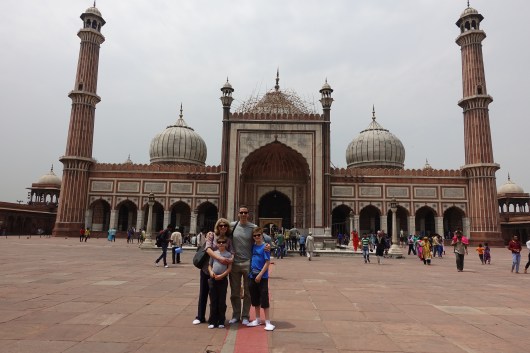
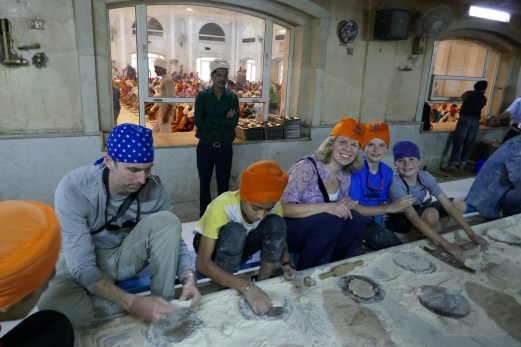
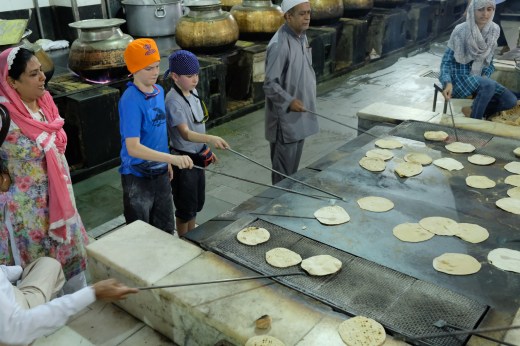
…and then took us to a Sikh temple and put us to work in the soup kitchen that feeds thousands every day. Connor, Elliot, and I chatted with the boy to my left about sports (we like hoops and baseball; he prefers cricket and kabaddi).
There was Anu, who was lousy as a tour guide. (At the stunning Qutub Minar in South Delhi, which in his defense we asked to see on our way home from Sumeet’s house on the spur of the moment, he could only muster that it was 73 meters tall and kept denying that the monument included a mosque, even though all signs and tour books noted it has one of the oldest mosques in India.) But he turned into a blur of a quick-moving, fast-talking, bribe-giving, Michael-Clayton-level corporate fixer at the Delhi airport to get us past one of the craziest check-in and security scenes I’ve ever seen in five minutes flat — and thereby provided an important lesson about the workings of Indian society.
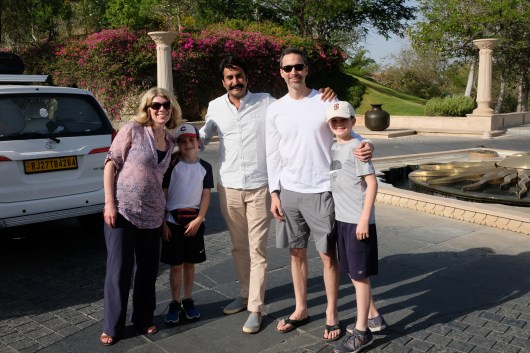
And then there was Mann, the educated, urbane, handlebar-mustachioed former polo player from Udaipur who spoke in paragraphs and gave us the most incredible lectures on Indian politics, the caste system, Hindu-ism, and ancient irrigation systems. (He was also a true gentleman while overseeing three different roadside vomiting episodes.)
It’s been sensational to have such smart and talented company as we try to piece together a composite sense of the politics, economics, and culture of the place. My favorite economic factoid: In a country of 1.3 billion people, only 35 million Indians work in what is called the “organized sector” (that is, work for a single, regular, non-seasonal employer), and 21 million of these are government employees. Then there’s the complicated political interplay of Gandhi-ists, Hindu nationalists, and lower-caste groups vying for control of state power and, with it, the fruits of the world’s largest system of formal political patronage and informal corruption. And everywhere you look, you see a society with a steadily growing but grossly unequal economy and a recent history of extreme ethnic and religious violence (see today’s NYTimes piece by Jeffrey Gettleman), and yet also just might be a pluralistic beacon of hope in an increasingly divided world.
Moving past all that seriousness, here are a few miscellaneous moments of zen:
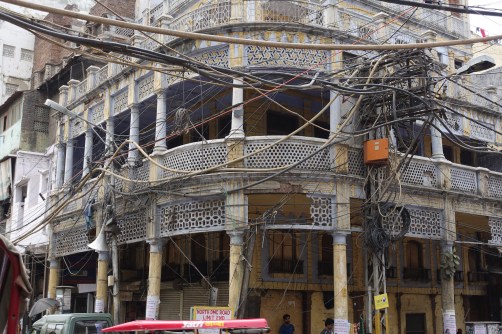
Best Old Delhi jerry-rig:
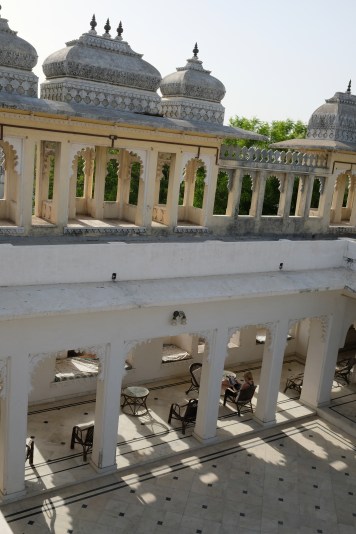
Best afternoon reading spot (at “Marigold”):
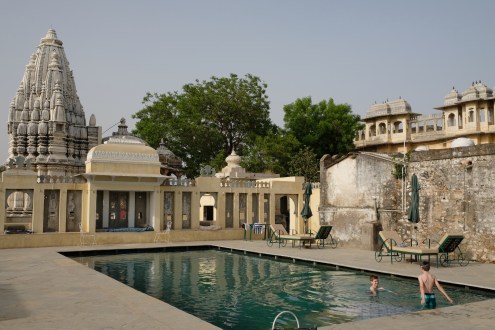
Best swim spot (also “Marigold”):
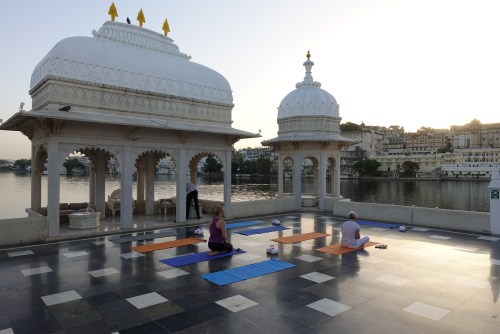
Best yoga spot for undeserving, inflexible, non-yoga people (at Lake Taj):
Most romantic dinner spot ruined by presence of 9 and 11 year old (also Lake Taj, which was sucking up to us because they canceled part of our reservation when someone bought out the entire hotel for a wedding):


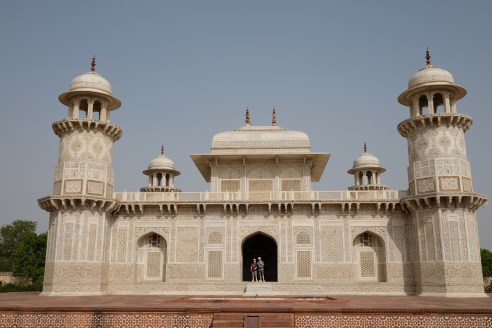
Best it’s-so-hot-no-one-else-is-here spot (at “Baby Taj” in Agra):
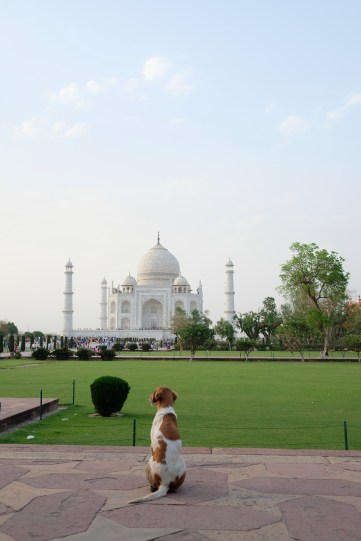
Best bow-wowed by Taj Mahal spot:
Today we head to Nepal!
 Fanatical Sabbatical
Love reading about your adventures.
LikeLike