The Minoan Civilization on Crete and Santorini
We are having a good time on Crete, and had a good time in Athens, Naxos, and Santorini, but we leave early in the morning tomorrow for Rome, Italy
Why this post is about the Minoans is because we have gone to an ancient Minoan city, which is on the island of Santorini, and an ancient Minoan palace on the island of Crete.
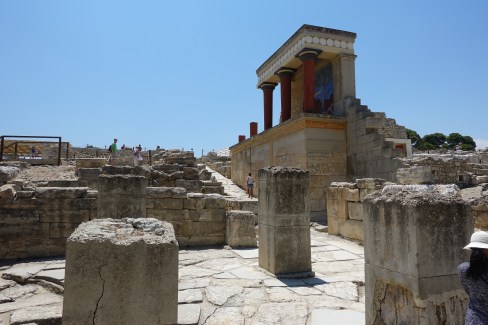
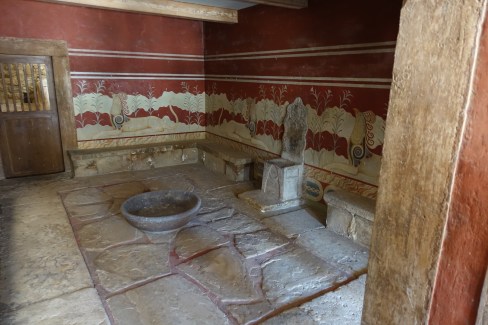
The palace on Crete, called Knossos, dates back to 1900 BC, so it is nearly 4000 years old. Knossos was most likely home to King Minos, which you probably know about because of his labyrinth and Minotaur. In and around the palace, there were a lot of “firsts.” For example, the oldest road in Europe leads to the palace, and the first throne of Europe is in the palace, made of alabaster. They also had the first flushing toilet ever; it was even linked to a water system. Outside, the palace had 3 big holes, called kouloures, that may have been storage holes, or houses. The evidence of each hypothesis maybe being true is because there are the remains of steps in the holes, which may have been leading into a storage room, or a house. Each one was about 9 by 9 feet across, and 15 or so feet down. Some people think that the palace was the labyrinth, because it kind of looks a lot like one because there are lots of hallways, and the courtyard may have been where the Minotaur was but that wouldn’t make sense because it could run away. Also, no one has discovered any labyrinth on Crete, because that’s where it would have been.
Here is a picture of the Palace Knossos site:
Here is Europe’s first throne:
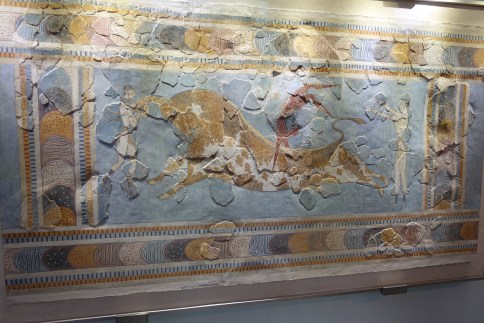
Here is a picture of a mural, depicting bull acrobats, from the Palace Knossos at the museum in nearby Heraklion. The 3-D bits are the real pieces, and the non 3-D was the archeologists’ best guess on how it would have looked:
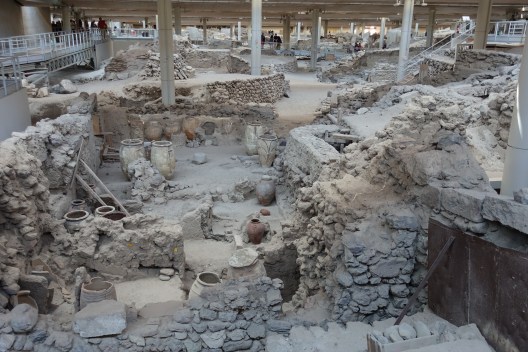
The Bronze Age city on Santorini, known as Akrotiri, is 90 miles north of Crete. There were baths, storage rooms, pots, houses, roads, squares, places where murals would have been, bathrooms, pretty much everything! Recently, archeologists have constructed a roof over the ancient city that keeps things at a pretty cold temperature at night, yet shields it from the sun. Archeologists have also constructed walkways on top of the buildings and around the town, as well as stairs leading down into the city that led you through the streets of the city, which was really cool. At one point, the path let you go through one of the houses! There was this really cool house that would have been a three-storied building, but the top floors fell off, and most of the bottom floor was not there because a mudslide had destroyed most of it. It was called the lady house, because there were signs that women had lived in it. It had had 2 big paintings, which were taken off and now are in the Athens archeological museum, so more people can see them. (My Dad and I went to the Athens museum and saw the paintings before we visited Akrotiri.)
Here is a picture of the Akrotiri dig:
Here are the Akrotiri murals we saw in Athens. This one is called the spring fresco:
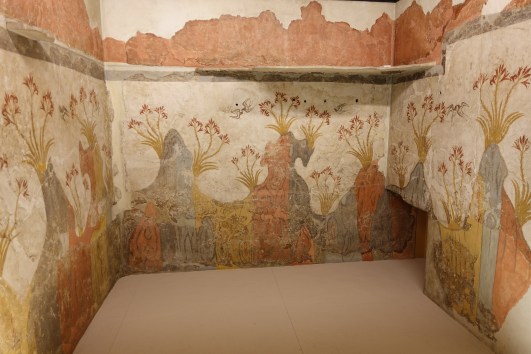
The ancient city of Akrotiri was destroyed when one of the largest volcanic eruptions in the history all of the world happened and blew up the island. Santorini used to be a circular island, but now, it is only a thin crescent. When the volcano erupted, ash covered the city of Akrotiri, destroying it, yet also preserving it. The two floors that got smashed on the lady house got smashed because rocks got lifted into the sky by air currents from the ground caused by the eruption, and fell down on the houses and destroyed a lot of them. The date that the eruption happened is 1627 BC. The explosion was so huge, layers of ash got as far as China!
 Fanatical Sabbatical