We limped out of the Asian sub-continent and quickly fell in love with Greece. Was it just Western familiarity? Rediscovering tap water and fresh fruit and vegetables? Cheap and delicious Greek salads and gyros at every turn? Freedom from the draining crush of hyper-obsequious service providers? (Let slip that you’re not feeling well at the hotel restaurant, and you return to your room with “Get well soon” spelled out in rose petals on your bed, then receive manager visits to your room and breakfast table the next morning.) Surely these were all part of the story, but Greece stood on its own.
We started with two days in Athens, which delivered in every possible way. Antiquity Athens is surprisingly compact: Virtually everything of interest is right around the Acropolis, and its constant presence, lurking around every corner of every winding street, both inspires and makes it easy to navigate. On Day One, Elliot and I woke up early (more on this later – my pleasure, my pain) and had breakfast at the rooftop restaurant of our hotel below the Acropolis.
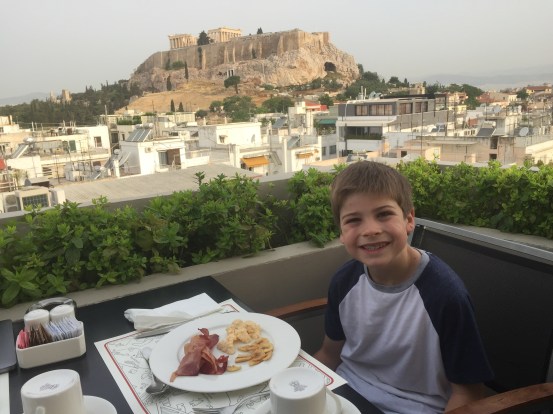
Then we went on a “lost walk,” in which we alternate making decisions at each possible turn or other decision point we come to. We ended up working our way around the base of the Acropolis, with a stop to climb the Areopagus, the hill next door to the Acropolis where Athenians held trials for severe crimes, and where St. Paul once preached to the Greeks (and occupying Romans) in what was likely a combination of a sermon and a trial.
In the afternoon, Elliot and I continued our quality time together with a “2 and 2,” in which Nora and I each go off with a kid in search of adventure. Elliot and I had a spectacular lunch in Anofiotika (a quiet neighborhood off the right shoulder of the Acropolis) at a little taverna next to a Byzantine church along a picturesque winding and cobbled street – and at a table next to a Greek Orthodox priest, so plenty authentic and far from the tourist hordes. Then we jumped back into tourism with both feet with a full circuit on a surprisingly good “Big Bus” tour – one of those “hop on, hop off” deals –which gave us a solid overview of the city and filled us with facts and useful perspective on Greece as the birthplace of democracy and theater. (This was great because it helped to convey to Elliot, I think, that lots of things just spring from people’s minds; it’s turtles all the way down!) We got off the bus long enough to visit the National Archaeological Museum, where we gazed at many a kouri, statue of mythological figures, and frescoes from ruins we would soon visit on Santorini and Crete. More on this in a moment.
Day Two was even better. We were Connor-less (stomach ache, but maybe just needing some alone time), but Nora, Elliot, and I crawled all over the Acropolis with a terrific guide who had plenty to say about the Parthenon itself, which delivers.
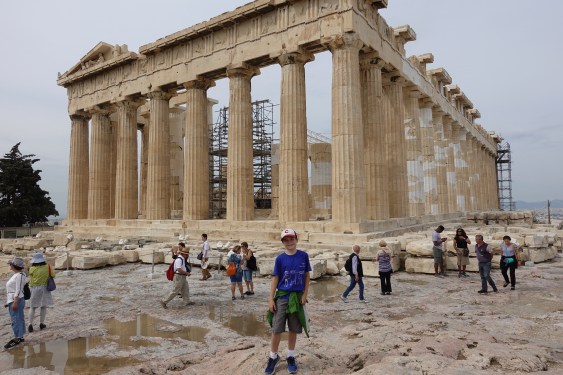
But she also directed our attention away from it, to the equally spectacular and in some ways neater Erechtheion, with its split-level design and columns carved into figures of maidens.

The showstopper, I’m a little embarrassed to say, was not the Acropolis itself, but the breathtaking Acropolis Museum that sits below it. Four things that wowed me:
- The museum’s floors are glass so you can see all the way down to the archaeological dig going on beneath it, first unearthed during the building process (as apparently consistently happens during construction of any significance in Athens).
- The museum’s first floor is dotted with statuary that shows that the Acropolis was actually full of smaller-scale ornamentation, contributed by leading (status-conscious?) community members.
- The second floor is the precise size of the Parthenon and lays out the sculpture and relief carvings of its frieze, metopes, and pediments, at least the parts that have survived the ages and the plundering of the Brits. White new plaster fills out broken pieces of sculpture and reliefs based on historical photos. Snarky outlines mark where original marbles plundered by the Brits will sit once (if?) ever returned. And as you walk around this perimeter and enjoy the up-close view of the ornamentation that would otherwise be fifty feet above you, you can look up and out the vast windows and see the actual Parthenon sitting atop the Acropolis.
- An ingenious movie shows the Parthenon thru the ages, including animations detailing the various transformations of its interior and exterior over time as Christians and Muslims took control of Athens.
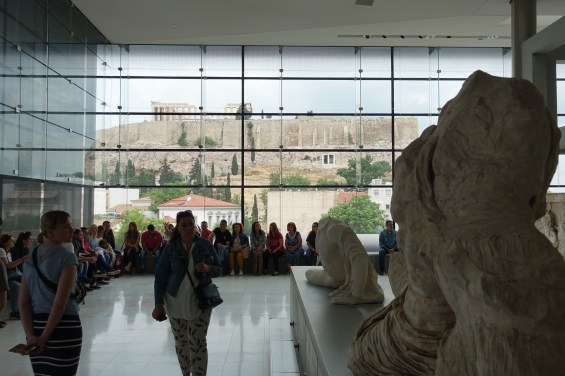
The quality of the museum rankles because the Brits apparently have said they will return the marbles once there’s a suitable museum to house them. It seems like one of my very favorite museums in the world should qualify, no?
After Athens came two or three days on each of three Greek Islands – Naxos, Santorini, and Crete. Naxos was laid back – which is saying something in a part of the world that specializes in laid back. Tourist season hadn’t begun yet, and most shopkeepers and taverna owners were sweetly painting and prepping their spaces. With few other tourists, we had the run of the island in our little light-blue convertible Fiat – an awesome feeling of independence after being so thoroughly handled in India and Nepal. The highlight was a terrific cooking class at a taverna in a tiny town in the island’s interior, presided over by the matronly, joyous, hugging-and-kissing, non-English-speaking owner.
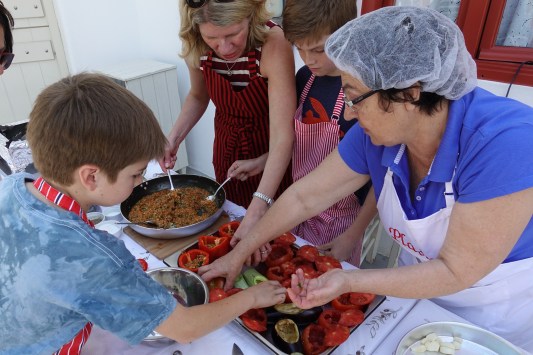
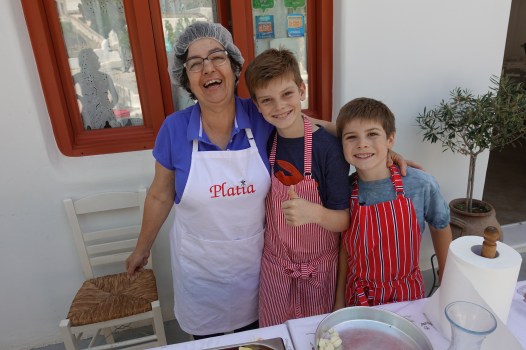
She quickly sold the kids on the enterprise, and everyone was soon prepping and constructing a vegetarian moussaka and making fresh tzatziki, among other delights. Then we sat and ate the meal after a quick tour of the gardens in the back of the house that had produced all the ingredients, including the staggering amount of olive oil used.
After Naxos, Santorini was a let-down at first: filled with tourists of the worst Chinese (can I say that?) and cruise-ship variety, the constant buzz of Euro-trash (can I say that?) house cover music in virtually every establishment. (On the latter, no musical sacrilege is too great. The nadir for me was a house remix of Bruce Springsteen’s “I’m Goin’ Down.”) But Santorini really grew on me. There’s the sheer implausibility of multiple beautiful whitewashed towns hugging the cliffs overlooking the volcano-made caldera, and the gorgeous sailing trip we took along the entire caldera in one of those fancy catamaran sailboats.


There was the hike we took from Thera, the main town at the middle of the island where our hotel was located, to Oia, the picturesque town at its northern tip.
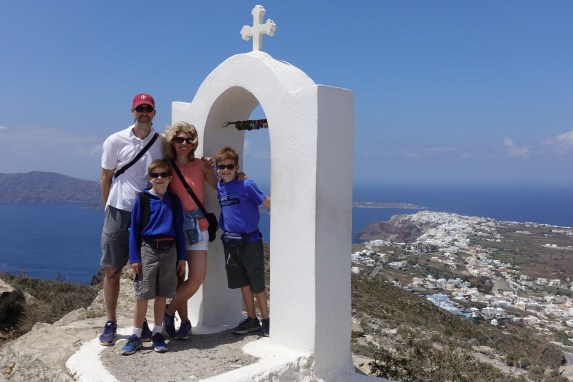
The hike was terrific, but it was made even better by yet another great guide — an expat American who, in addition to being the most perfectly realized hipster in hipster history (really? a porkpie hat, pointy beard, little red new balance shoes, *and* opening a vinyl record store next week?), was engaging and, given his expat status, spoke perfect English and so we could effortlessly take on-board all the interesting things he had to say. (One of my favorites was his lecture on Santorini agriculture. With no water on the island, crops are irrigated entirely by morning fog as the humidity that has seeped the night before into the pumice stone that makes up the island emerges.) There was the pure fun of renting an open-top jeep to get mom over to a Mother’s Day massage at a spa run out of cliffside caves. . .
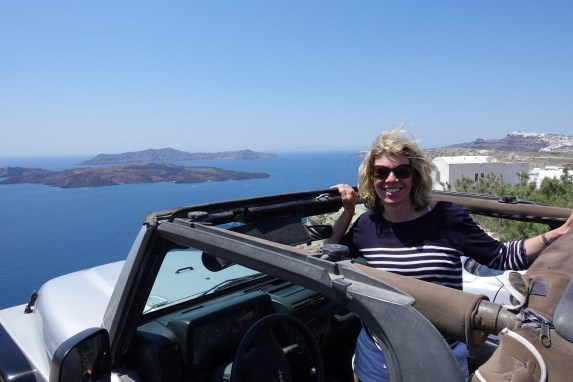
. . . and then taking a boys-only drive down to the Minoan ruin of Akrotiri at the southern tip of the island before picking up mom and stumbling upon a Mexican restaurant, of all things, with the most stunning view.
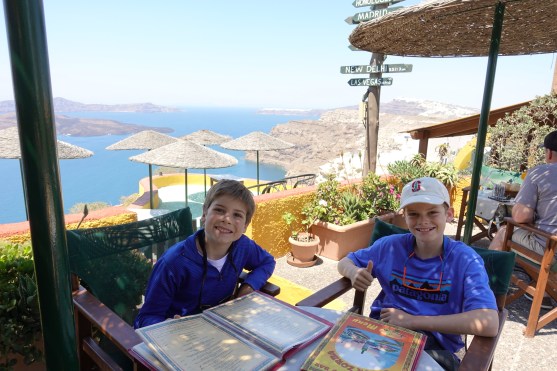
But most important of all, we hit our stride as a traveling family and simply rolled with it – witness, for instance, the fish spa experience Nora and I did, on a dare from our children. . .
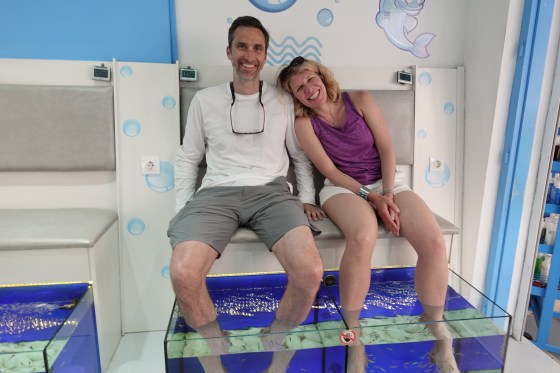
. . . or the gyros and brown-bag-wine dinners we learned to enjoy in the park near our hotel gazing at the sunset over the caldera rather than dropping another $150 on dinner.


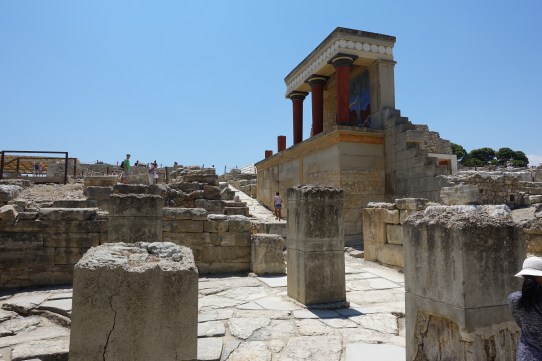
Crete? The Palace of Knossus and the accompanying museum downtown in Heraklion – explored with another great guide – were awesome and filled out our understanding of the Minoans. It also, I think, set the hook of an interest in ancient history that has been a central and inevitable theme of our trip.
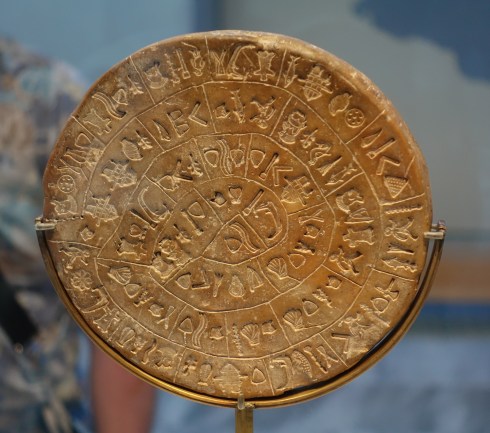
The highlight of the museum was the Phaistos Disk, found at another Cretan palace and one of the world’s great archaeological mysteries. It sports 241 hieroglyphic symbols arranged in a spiral pattern. And yet, because we lack a Rosetta Stone equivalent for the Minoans, no one has been able to crack the code.
Perhaps best of all, I read a terrific book as part of my effort to engage in at least some in situ reading during each leg of our trip. In Greece, the book was Eurydice Street, by Sofia Zinovieff, which is an account of the first couple of years of a British anthropologist’s relocation to Greece after marrying a Greek guy. Its chapters are loosely organized around a particular topic (family culture, politics, religion, ancient and then more recent Greek history, the Greek economy, etc.) and is beautifully done. Highlights are an exquisite account of the place of the Acropolis in the cultural imagination likening it to a female body as:
violated, venerated, and exploited. It is picked over by scholars, trampled over by tourists, and reproduced as gaudy plaster mementoes and as tacky ouzo bottles. As a symbol, this hill can be a saint and a goddess, a virgin and a whore, a mother and a daughter. It is used as a backdrop by romantics and cynics, by revolutionaries and dictators, and by men of the Church and visiting film stars.
There are many other gems, including her explanations of: the linguistic politics of demotic versus classical Greek, which I had never fully understood; Greece’s class and ethnic politics, with rural Greeks, Albanians, and a Filipino servant class at the bottom, and an intelligentsia, a class of Northern European royalty (left over from the short-lived installation by the Western powers of a Bavarian monarch in 1832), and the great shipping magnates at the top; Athens’s post-war growth and architectural transformation as the result of a policy encouraging developers to buy up large residential properties from cash-poor owners, who would then build apartment buildings with one of the units reserved in perpetuity for the owners; and the roots of the hyper-masculine, devil-may-care Greek personality, born of Spartan feats of derring-do in battle followed by several centuries of occupation and economic woes. The book was more insightful, and had more of a personal story and heart, than a conceptually similar book I read in India, Edward Luce’s In Spite of the Gods, with its mostly geopolitical focus. Eurydice was also frankly less weird than my Nepal read, the cult classic The Snow Leopard by Peter Mathiessen, which is unique and memorable but, as a travelogue of a Nepal expedition by a hippy scientist Buddhist mourning the recent loss of his wife, was also less accessible to a spiritual simpleton like me.
Here’s the other thing that happened in Greece: I fell in love with traveling with Elliot. Nora and I have long referred to him as our “pleasure and pain,” a reference to the climactic deathbed scene in The Descendants in which George Clooney says goodbye to his estranged, philandering wife. But many of Elliot’s personality traits, which are so exhausting in Palo Alto, turn out to be virtues on an around-the-world trip. First off, Elliot’s a morning person – a nightmare on a California weekend, but on an around-the-world trip means there’s no crowbarring him out of bed, like a certain pre-teen of ours. In addition, he’s got superhuman physical stamina, proven during four days of watching him bound up Nepal mountain trails as the porters hustled to keep up. He’s got his usual and goofy sense of humor, which keeps things light when we’re hungry or tired or homesick. He loves to tell jokes (his current favorite, courtesy of his cousin Mary: “Two muffins are in an oven. One says, “It’s hot in here.” The other says, “AHHHHHH, TALKING MUFFIN!”), and he loves more general goofing, including many a bedtime turn as Captain Underpants, lots of time spent perfecting his coy sunglasses look, and sometimes doing both at the same time.


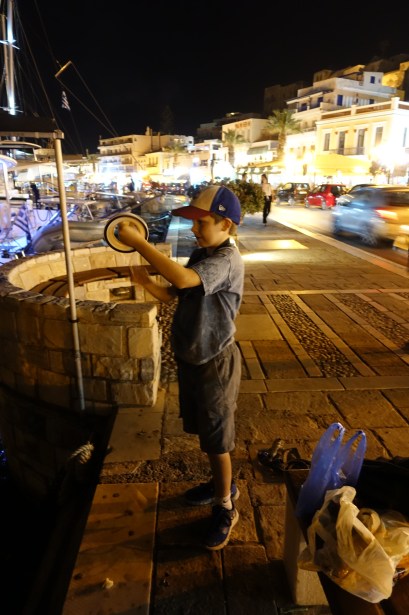
His pliable young brain comes up with the most evocative descriptions and connections. A recent favorite is “That bathroom smelled like a seal enclosure” — a reference, when we asked him, to a visit to the Seattle Aquarium a couple of years ago. Best of all is his boundless curiosity – as evidenced by his devouring of dozens of books since we left in mid-April, and his persistent and sometimes sweetly challenging questions to guides (“You said X. But how can that be given that you also said Y?”) – combined with his raw, irrepressible enthusiasm. The combination came through most strongly for me at the National Archeological Museum in Athens where, to the consternation of the guards charged with protecting the exhibits, he ran from sculpture to sculpture in search of new mythological figures that he could then lecture me on. The combination also takes you places you’d never expect, such as night-fishing (at 11:00 p.m.!) in the Naxos harbor without a prayer of actually catching a fish — and yet one of my favorite experiences of the trip thus far.
The most perfect crystallization, though, captured in a video (which hopefully works), is Elliot eagerly peering over the counter as they cook him a “fish cone” – a mix of fried calamari, shrimp, and fish in a newspaper cone that he loved eating on Santorini – and mindlessly doing a dance that reminds me of the old Steve Martin “happy feet” routine.
 Fanatical Sabbatical