There’s a temple in Nagano with what they call the “dark walk.” To do it, you walk to the back of the Zenkoji temple and then descend some stairs off to the side of Japan’s oldest Buddha statue. From there, you enter a tunnel, where you immediately find yourself plunged into total, encompassing darkness. Stripped of sight, you must travel from one end of the corridor to the other, while groping along for the Key to Paradise. If you’ve located and laid your hands upon this Key, it is said, you obtain enlightenment and salvation.
We tried it. We took a train to Nagano, found the temple, and disoriented and uncomfortable (particularly for David, who had to crouch), we stumbled through the long tunnel in a single-file line. Midway through we found what we think was the Key (it was metallic and cool), though we can’t be sure because of course we couldn’t see, and what was the Key supposed to feel like?
That — that feeling of complete disorientation and discomfort mixed with a little bit of magic — sums up Japan for me.
As I’ve said, I’m reading a lot these days. One book I’ve read is “Rice, Noodle, Fish: Deep Travels Through Japan’s Food Culture” which starts with a soulful prolog written by the gone-too-soon Anthony Bordain. In it, Bordain writes:
“In Japan you are confronted constantly, almost violently, with how much you don’t know. I liked that feeling. I liked that steep, virtually impossible learning curve. I liked, it turned out, that feeling of being a stranger in a strange yet wonderful land, not understanding the language, lost. Every little thing was a discovery.”
We leave tomorrow morning for Indonesia, and I’m currently sitting in a room in the Tokyo Park Hyatt where, fittingly enough, Sofia Coppola’s “Lost in Translation” was filmed. (The view from our room, snapped through the window with my iPhone, is pretty nice.)
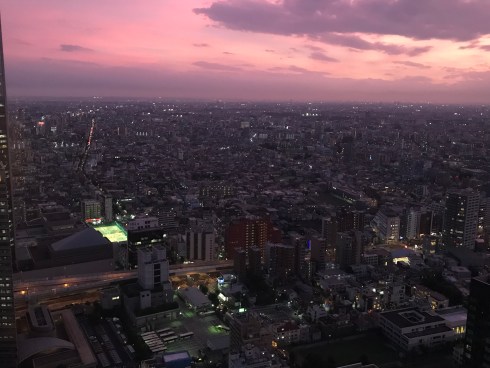
As I sit here and reflect upon the past month of travel in Japan, Bordain’s words ring true. Over the past month I’ve felt discombobulated and at sea. For better and worse, every little thing has felt new.
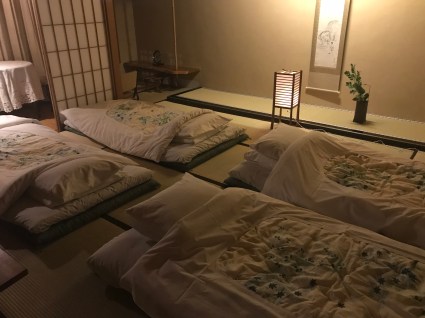
Of these myriad discoveries, many have been simply delightful. For example, it turns out that it’s really fun to wear what feel like pajamas to dinner — and, particularly when trekking, we donned these night after night. Further, there’s a word in Japanese (Zakone) for sleeping all together in a huddle, like fish. I discovered, I love that too. It reminded me of being a kid when the electricity went out, and we had to sleep all together by the fire. Nothing could be cozier.
What else?
I hadn’t heard of onsens until this trip, and I’m now officially a big onsen fan, particularly after a long day hiking.

The fact that many of Japan’s most historic sites are positively teeming with tame deer = so strange and otherworldly and very, very cool.


The safety = so unusual, even for someone who lives in the bubble of the Stanford Campus, which is extraordinarily safe by American standards. I can’t get over the fact that, even in the largest cities, there’s no need even to lock your bike.

Next up, the insistent juxtaposition of old and new = extraordinary. Of course, lots of places intersperse historic sites and high-rises. But in Japan, the mash up is more pronounced — and both sides of the coin more exaggerated — than any place I’ve ever been. Witness below the women in traditional garb, in Starbucks, Facetiming. Need I say more?

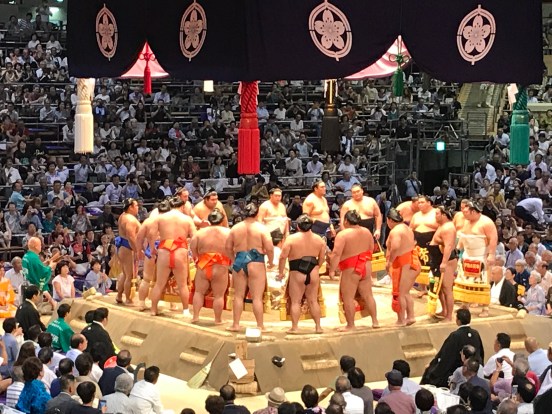
Finally, sumo! What on earth could be stranger than sumo?? I have to say, when David told me back in March that he had dropped big bucks to get us box seats at one of the year’s biggest sumo tournaments, I thought he had gone mad. But, guess what? Worth every penny. Sumo = super fun.
But, unlike the others in the family who loved Japan passionately and unreservedly (Connor and David rank Japan as the #1 spot thus far, and for Elliot, Japan comes in at a more-than-respectable #2), I have to confess, I found Japan — and the constant feeling of being such a stranger in a strange land — EXHAUSTING.
For one, THE RULES. Japan is positively studded with rules of etiquette, some of which are obvious (“don’t touch other people”), and others of which you might find written down (“don’t eat or drink in public”). But many of these rules (“shoes here not there, though those shoes in there” or “shower like this, not that”) you just learn through trial and error.

Particularly during our two homestays, I had a hard time knowing what was required in any given situation, and I had a very hard time trying to ensure that we conformed to expectations (especially when trying not only to comply for myself but to ensure that two shall we say “spirited” boys also didn’t overtly offend). It all made me feel distinctly off balance.
Indeed, in the same prolog, Bordain writes:
“It’s a minefield of potential offense. I’m quite certain that at all times every single thing about me is somehow ‘wrong,’ from my posture, the way I hold my chopsticks, bow, pour my drink, sit, cross my legs–and so on.”
He goes on say: “But I don’t care. Japan is just too awesome to not just forge on.” Fair enough. But as for me, I do care. And I found it all vexing.
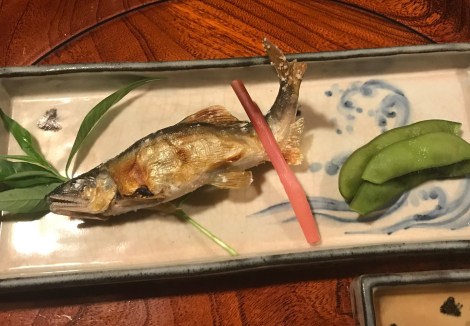
Second, the food. Now, this is going to make me sound like a philistine. But, unlike the rest of the family (who ate even the most unfamiliar items with gusto) and, apparently, the rest of the world (Japanese cuisine, with its pronounced umami flavor, is roundly seen as the finest there is), I had a really hard time with the unfamiliar textures and flavors — and of course the reality that I couldn’t ever be sure what I was getting, in any particular bite.
Finally, as you may have heard, we traveled (hiked, mostly) in the midst of record rainfall, as two or three times more rain fell in a few days than typically falls in the entire month of July (generally, Japan’s rainy season). Though we weathered the storm well, save for some travel complications (see below), this too, created a sense of uncertainty. (I don’t have great pics of the rainiest times, as we were hiking without umbrellas, and I couldn’t pull out my phone as it would have been instantly ruined by the deluge.)


Alas. Over the past month, I’ve learned a lot — about history, about religion, about my family, and about myself. I’ve been delighted and challenged, in a place that’s foreign but that also, like a bowling lane with the bumpers up, offers protection from dark alleys and wrong turns. (What I mean is: Unlike in most places you travel, even the dumbest decision won’t carry dire consequences. Japan is too safe, and the Japanese people too kind, for that.)
So, in this strange new land, I’ve gotten my feet wet (literally and figuratively). I’ve seen and eaten and felt entirely new things. I’ve been made to feel uncomfortable, ungainly, clueless, and unsure — and I’ve also had numerous transcendent moments and seen other-worldly beauty.

I may not have grasped the Key to enlightenment. But I feel extraordinarily lucky all the same.

 Fanatical Sabbatical
I have loved reading yours and the boys’ blogs. You may not have found the “key to enlightenment” but boy have you each been enlightened by these fabulous experiences– you truly are one very lucky family.
Safe travels for the last month of your trip.
Love,
Wannelle
LikeLike