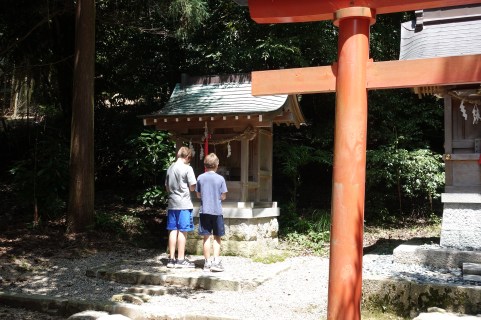
One of the things that I have most enjoyed about Japan is the country’s culture. I think that Shintoism is especially interesting. Adherents of Shintoism believe that divine spirit resides in everything. If somebody has an especially powerful divine influence in them, they could be worshipped, whether animal, plant, or thing. Fun fact. There is actually a rock being worshipped because people claim that if they get near it, they can feel power radiating from it. Shintoism is (like Hinduism) polytheistic, which means there are many, many gods, each of which represents a different pursuit. For instance, when we took a bike trip outside Kyoto at lake Biwa, we visited a shrine that had a smaller shrine behind it that was dedicated to the god of learning. I stopped and said a prayer at the shrine to help me with middle school.
Now, you might be wondering: How does sumo wrestling fit in to all of this? Well, sumo actually started when grown men in a village lined up to wrestle one of those divine spirits around 300 A.D. Some 50 years later, people from other villages heard about what was going on and decided that the men should not only wrestle divine spirits but wrestle each other. Another 50 years and the concept of pushing was invented. After another century, sumo wrestling, or sumo, became widespread.
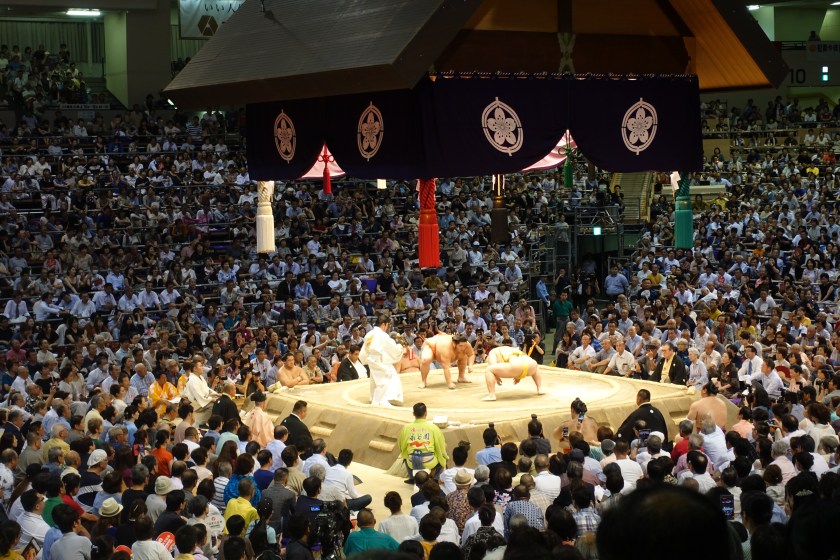
Believe it or not, sumo wrestling is actually more ritual than it is sport! A sumo match’s average time is about five seconds, while the preparation and the Shinto purification leading up to it take more than two minutes! You are probably wondering what exactly those rituals are. Well, here you go.

First, both of the sumo wrestlers climb onto a raised platform, stare into each other’s eyes, walk to a corner of the platform, and perform what is called a shaki. To do it correctly, they have to raise one leg as high as they can, and then stomp it down. Repeat with the other leg.
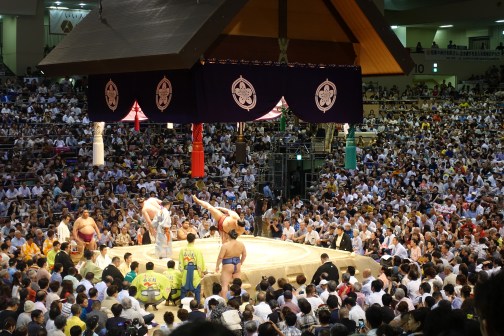
To be honest with you, I’m less flexible than some of the sumo wrestlers. Once they have finished, they drink strength water from a traditional Shinto cup, and are given a piece of paper to dry their mouth. Then, they do another shaki in the middle of the platform. After that, they and their opponent get in position to wrestle. But then they opt out and hold their hand in the air showing that they have no weapons and that they wish their opponent a fair fight. (Every single ritual is overseen by a referee dressed in silk robes.) Then, they go back to their corners and receive a towel to dry their body from the sweat. Once they have done that, they go back to the middle, perform shaki one more time, get in starting position and fight. After each action in the corner, the wrestlers take a handful of salt and throw it in the circle to purify the place of the wrestle.
For all of the complications of ritual, sumo wrestling rules are actually quite simple. There are four ways sumo wrestlers can win a match: They can push their opponent out of the circle of ropes that is on the raised platform, they can actually wrestle their opponent until he touches the ground with any part of his body except for his feet, they can accidentally win when their opponent uses an illegal technique, or finally, they can do one of the things that will give their opponent the win, but their opponent may be found to be in such a helpless position that the referee gives them the win anyway. (Girls do not sumo wrestle, so it is always “he”.) Keep in mind, sumo is a full contact sport, so it is pretty violent, as you can see in the slo-mo video my mom took below.
As for our experience at the tournament, it was everything you could ask for. We sat cross-legged in a little box about 15 rows back from the action, so we were able to see pretty well.
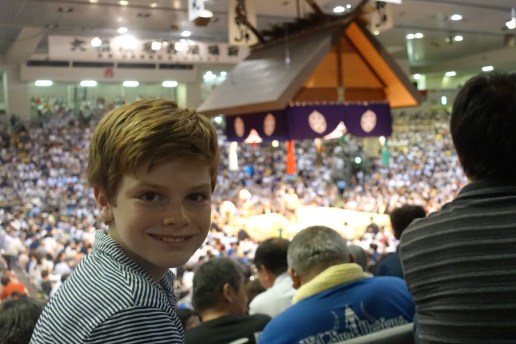
There were a lot of really hard-fought matches, and I had a great time overall. One day in the tournament (what we went to) starts around 10:00 and ends at 6:00. We got there at around 3:00, so we were able to see a good bit of the action without staying too long and getting bored. Another advantage of arriving at that time was we got to see some of the big dogs arrive at the arena. (The better sumo wrestlers arrive and wrestle later, so we got there just as the top-rated wrestlers were gearing up.) As the pictures below show, some of those guys are nearly seven feet tall and 450 pounds. Pretty scary if I knew I had to fight them.


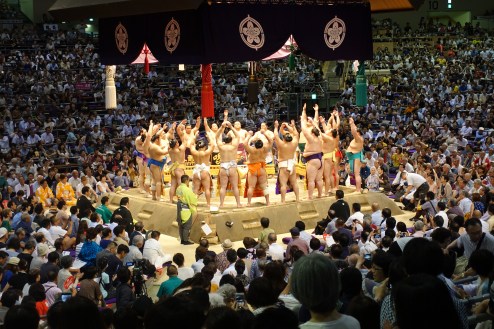
We also got to see the top division come out to do a starting ritual. Remember how I told you how one sumo wrestler stands on the southwest corner, and one on the southeast? These are the sumo wrestlers who are going to be on the southeast corner. They perform the ritual with their fellow southeasters, rather than doing it all together.
An extra little bonus to our stay was, even though we didn’t do it, after the final match, everybody threw their cushions down towards the ring. It was really cool seeing all of those purple squares fly.
So, there you go! That is pretty much sumo for you! The ritual, the rules, and the history. Sumo really is a wonderful tradition, and I hope that you get to experience it someday. There is still a lot I don’t know about sumo, so don’t look to me for more advanced stuff. This is all I know. Essentially, the basics. So, perform your last shaki, get in your stance, and start sumo wrestling.
 Fanatical Sabbatical