I shouldn’t have been surprised that, on a four-month trip that was exquisitely mapped out by travel planner Sam McClure, our time in Indonesia would be perfectly choreographed from start to finish. But it was, and that’s no mean feat. I made it through several books during our month in Indonesia, including the mostly forgettable A Brief History of Indonesia by Tim Hannigan and In the Time of Madness by Richard Perry, but also the brilliant Elizabeth Pisani’s Indonesia Etc. The title of the latter is taken from the full text of the document in which Indonesia declared independence from the uniquely brutal Dutch in 1945: “We, the people of Indonesia, hereby declare the independence of Indonesia. Matters relating to the transfer of power etc. will be executed carefully and as soon as possible.” Starting from there, Pisani, who had spent substantial time in Indonesia as a journalist, travels far and wide for a year in search of the “etc.” in the declaration – and, in particular, insight into the still-evolving, near-impossible task of carving out and maintaining a nation from an archipelago of 15,000 or so islands, each with its own culture and tribal past, united at its birth by not much more than anti-colonial sentiment. So our challenge was how to gain at least some kind of a sense of the country in only a month of travel. And the answer is: Let Sam identify four discrete and radically different experiences and then lean in and enjoy.
Bali was the perfect entry point: plenty exotic, but also touristy and trading in a kind of Westernized mysticism built around meditation, yoga, “traditional” dance and music, and some of the more earnestly spiritual artwork I’ve seen. (Think 10-by-10-foot sentimental landscapes full of doves, trees of life, and the like.) We did our best, staying in a schmancy place in Ubud in the center of the island, but getting out as much as we could, first on a trek through terraced rice paddies. . .
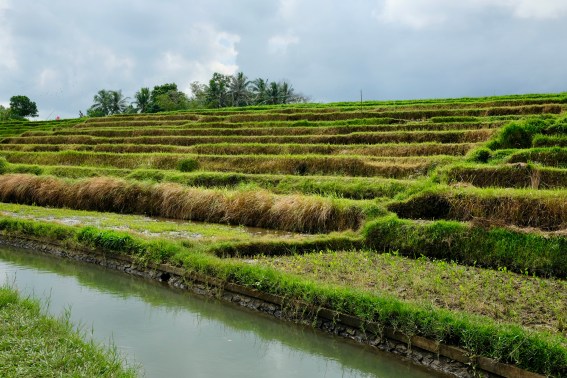
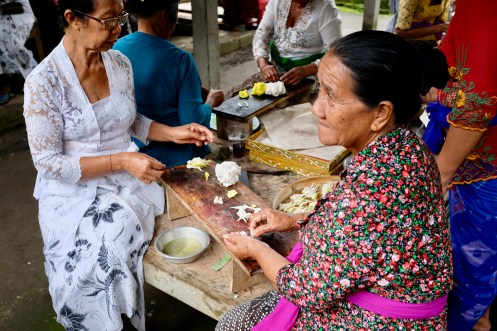
. . . then a visit to a nifty temple complex (said, according to our guide, to be the first example of a gate-guardian Dwarapala in Indonesia) where we did our own little purification ceremony in a fountain and then watched women preparing for a once-every-35-years religious festival. . .


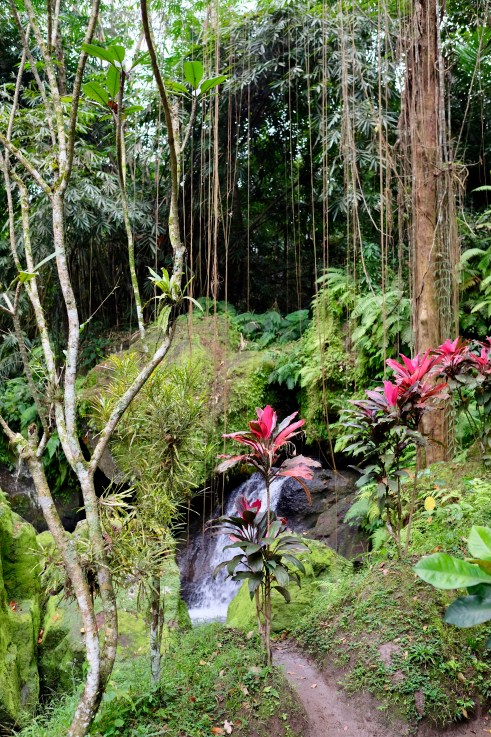
. . . and finally a walk around a sacred monkey forest full of banyan trees, waterfalls, and little critters.

We also, consistent with our entire trip, tried low- and highbrow food, which started with some roadside bakso (Obama’s favorite childhood food):


It continued later that same day with dinner at Michelin-starred Mozaic, where we had one of my favorite meals of the trip – and perhaps ever – because it managed to strike a perfect balance by being unique and refined but not too fussy.


From Bali, we took a much deeper plunge into Indonesia by taking several increasingly hair-raising flights to tiny Pankalan Bun, in Central Kalimantan, Borneo, where we boarded a klotok houseboat at the end of knackered, garbage-strewn dock and then sat for roughly 30 minutes as our crew loaded final supplies next to a work crew building another klotok using a deafening combination of chainsaws and nailguns and wondered what the hell we had done. Here’s the dock at launch and our “super deluxe” klotok, which means weak but much-appreciated air conditioners to cut some of the heat in our cabins at night when the boat is docked jungle-side and the generator is on:


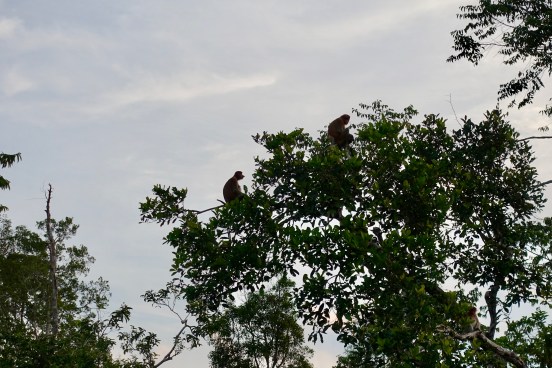
But it was tremendous. Life quickly boils down to a seductive simplicity — which we first experienced and loved during our Botswana safari last summer. You wake up, eat whatever the crew puts in front of you, watch as they untie the boat from the riverside jungle, and then set off in search of monkeys. You see plenty along the banks, including lots of fairly generic macaques but also the only-in-Borneo probiscus monkeys, with long schnozes that create a striking resemblance, in profile at least, to Gerard Depardieu.
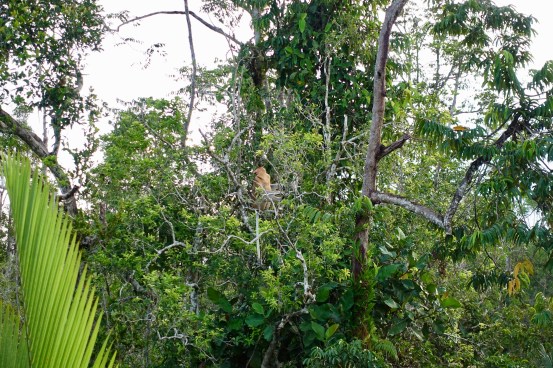
But the showstoppers are the orangutans, some of them wild, others having been raised as orphans (after their mothers were killed, usually by angry palm-oil farmers) in a research camp founded by Birute Galdikas. (Galdikas was part of the trio of famous female primatologists mentored by pioneer Louis Leakey that also includes Diane Fossy and Jane Goodall.) These “semi-wild” orangutans live on their own in the jungle but can, when fruit trees are less productive, be lured back to camp for twice-daily feedings.
Tourists can only get to the feedings by klotok, so there are never more than 30 or so others there, seated on makeshift benches in front of a feeding platform laden with bananas and a few other fruits. Here’s the general scene, including a wild boar family who showed up hoping for scraps:
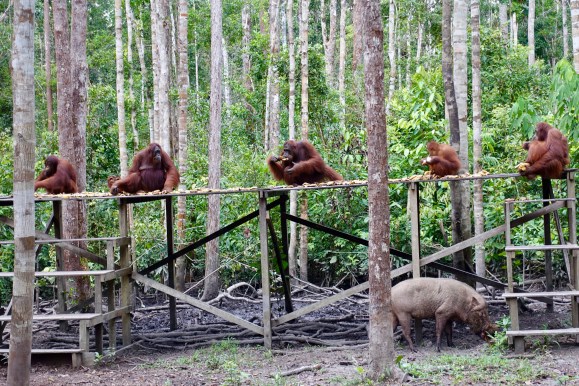
My favorite memories are from the very first feeding we attended. Walking the mile or so into the jungle, we suddenly came face-to-face with an orangutan who, according to our guide, was not planning to attend the feeding but was waiting by the trail and banking that one of the banana-hauling park rangers would throw him a little snack on the way past.

A minute later, another orangutan came ambling past Connor on the trail.
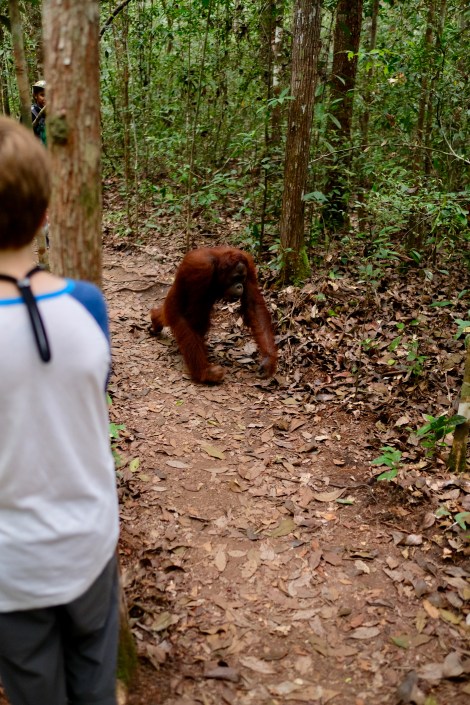
It was then we realized this would be an up-close experience with these massive creatures.
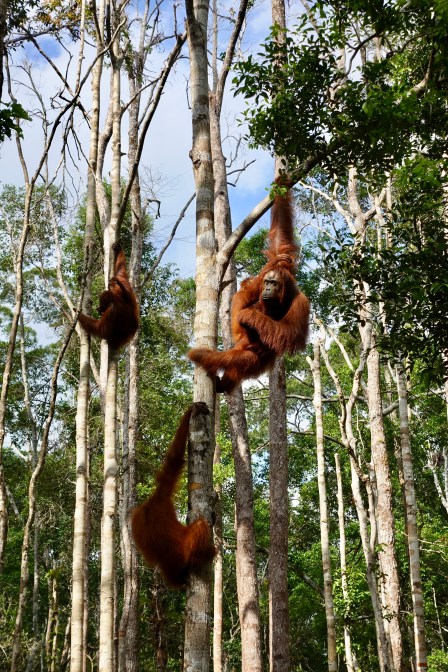
Even neater moments came once we got to the feeding area. The first: As feeding time neared, orangutans converged on the feeding platform from all directions. As they did, they used a highly intuitive but mesmerizingly beautiful movement that I came to call canopy-surfing. They skimmed across the very tops of the trees by using them as flexible rods and moving their bodies to generate just enough momentum, and enough lean, to grasp the next tree. Here’s an attempt at capturing the overall effect, though you’ll need good eyes to spot the the three or four that are highest in the trees behind the more visible ones:

The arrival of the bananas brought the second moment, when the orangutans descended toward the platform. Many grabbed a quick “take-out” bundle of bananas and clambered back up a tree, especially if a male was present. Others stuck around. The mom and baby interactions were precious. What I loved about all of these comings and goings, however, was that it filled in, as a kind of prequel, our trip’s march through the history of human civilization. The intellectual glue of our trip, the book A Little History of the World, started with the agricultural revolution but barely gestured, in a paragraph, toward prehistoric times as primates evolved into neanderthals and homo sapiens. As I sat and watched apes literally coming down from the trees, Strauss’s “Also sprach Zarathustra” (better known as the opening song from 2001: A Space Odyssey) rang in my ears. Here are a few more pics that attempt to capture the overall effect:

The third (okay, two separate moments) came when a pair of moms, unhip to the rope meant to separate tourists from apes, strolled with babies hanging on into the viewing area and plunked down next to us for photo sessions.

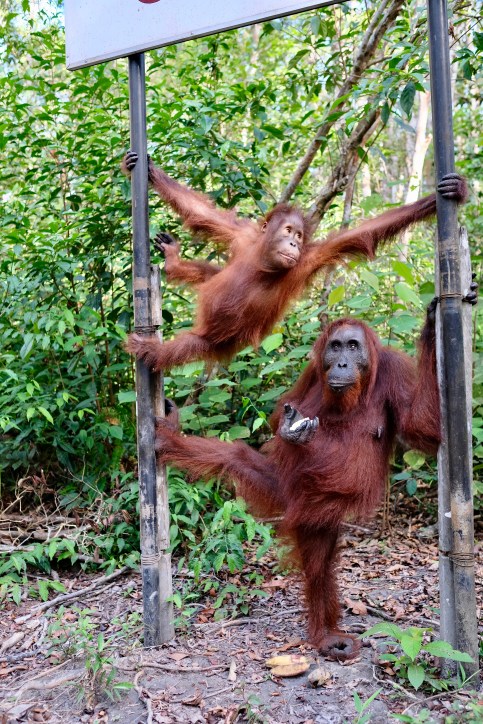
Other parts of the boat trip were great, too. As Nora already noted, we planted trees as part of a conservation project. And the crew of our ship was top-notch, especially its leader Jefri, who followed his mother into a job at the Leakey camp and then, more recently, moved into the tour business. He showed us amazing pictures of his time at the Leakey camp, including a sweet but heart-wrenching (once you think about it) shot of him pushing a wheelbarrow full of cute babies. Jefri was the undeniable king of klotok guides. He held court in any guide gathering. His jungle calls alerting less-tuned-in orangutans that a feeding was nigh were loudest and most confident. And he was the one who leapt up to scare off a big male who was fast approaching the platform where an alpha male was already tucking in. (Had that male reached the platform, his arrival would have triggered nasty hand-to-hand-to-hand-to-hand combat between alpha and alpha-wanna-be that could, he said, have injured apes and tourists alike.) Here’s the alpha-wanna-be just before he came down from a tree and headed towards the alpha on the platform — plainly much bigger, you can see, than the females in the photos to this point:

And here’s a photo featuring an ecstatic Jefri (in red Facebook t-shirt and Facebook hat) at the end of our trip, when we tipped the crew but, perhaps even better in a country that reportedly has one of the highest per-capita rates of Facebook usage in the world, passed along a bunch of swag that our nephew John had brought to us for precisely these moments.

Here are a few more pictures from our time in Borneo, with brief annotations.
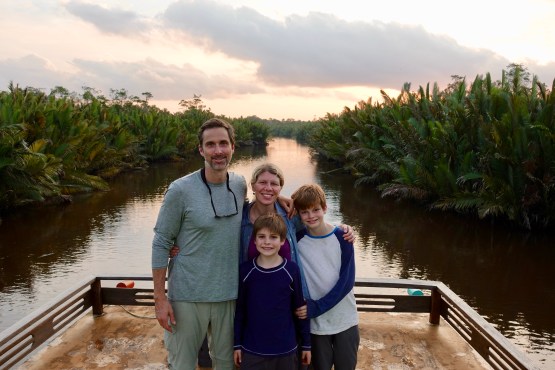
Family shot on klotok roof cruising upriver at sunset:
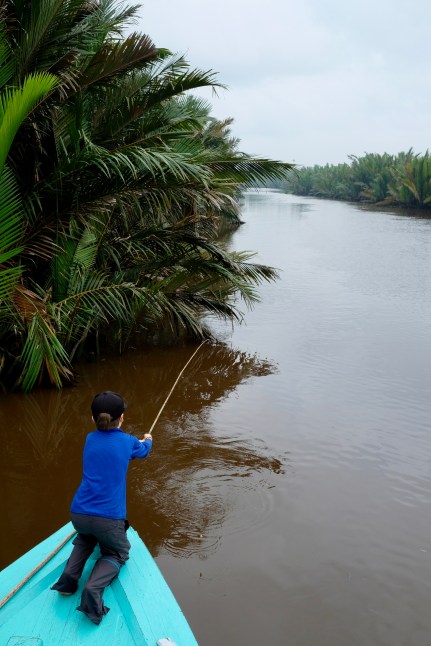
Elliot doing some morning fishing off the front of our klotok:
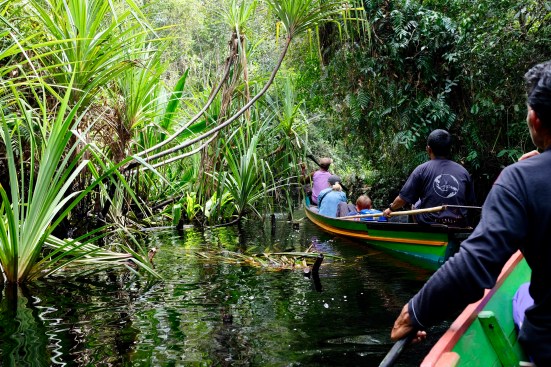
Deeply unpleasant but also kind-of-awesome canoe ride through stiflingly hot, humid, mosquito-infested jungle after a two-hour hike through same:
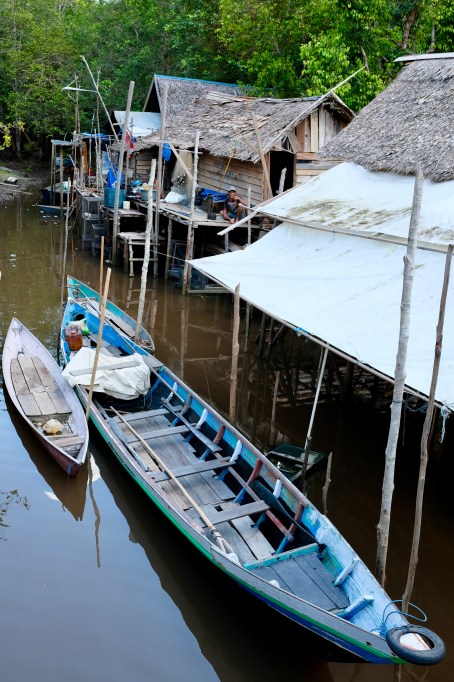
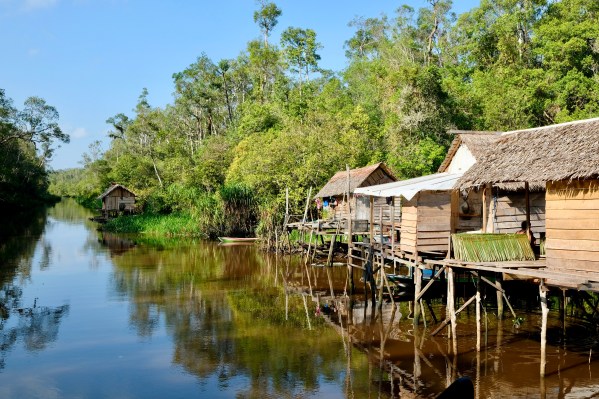
Riverside village shots. As Nora and I said at moments like these, “We are in IN-DO-NES-IA!”:
Next up Java and Lombok. . .
 Fanatical Sabbatical