Our time in Java got off to a rocky start. Wulan, our guide, met us outside baggage claim at the Semarang airport, but it was clear from the beginning that she was both under-fluent in English and, perhaps more importantly, over-matched in the role. Simple questions – whether the shop labeled “café” over there in the corner served coffee; whether we should eat inside the airport or launch and eat somewhere along the three-hour drive to Magelang; whether the outside-the-airport restaurant she was recommending was on the way or would extend our driving time – didn’t seem to land right. Things got worse when our driver and transport pulled up: a bucket-of-bolts, bright-green-and-purple party bus that we soon realized also featured weak AC, very little suspension, and no seatbelts. Fortunately for us, the restaurant we headed toward was decidedly *not* on the way to Magelang, to the north of Semarang, but rather due west, near the city’s colonial old town. This gave Nora and me time to huddle and conclude that all of this was unacceptable. The Freeman Engstrom clan from the India phase of the trip might have knuckled under and just gutted out the hot, bone-rattling drive. But by now we were seasoned and weary travelers and so made clear our refusal to do such a long drive under such conditions, then camped out in a café for three hours while the tour company, on a Sunday afternoon, scrambled to cover. I’ll spare you some of the details lest this post begin to sound (more) horrible and entitled. Suffice it to say, we got new wheels, a new guide, and treated to dinner later in our trip, though not before Connor, sitting in the front seat to minimize car sickness on chaotic roads, spent the final half-hour of the trip holding an iPhone for our fill-in, non-English-speaking driver and trying to direct him as he blundered through the last few turns on dark roads to our hotel — and then fell to pieces as we walked into the lobby.
All’s well that ends well, I suppose, because we were on fumes and due anyway for one of those down days that long-term travel requires. We canceled all tour plans for the next day and barely left the room, darting out just long enough to grab some meals and hand off virtually everything in our duffles – which were also on fumes, or at least emitting them – to the hotel’s laundry service. Much “Friday Night Lights” was watched, some video games played, a blog post drafted (Nora’s), a pesky health insurance issue resolved. It ended up being the perfect re-charge for the final three weeks of our trip.
The next day we started up again with relish – initially me, then the whole crew. First on our line-up was the stunning Borobudur, the largest and one of the most beautiful Buddhist temples in the world. It was likely built sometime in the 8th or 9th century, around the time that Charlemagne was ruling much of Europe. Early riser that I am, I asked our driver and guide to pick me up and take me over, alone, at 6:00 a.m. Sunrise comes an hour earlier than that, and the more hardcore – younger? – travel set climbs the temple’s eastern side and watches it. My plan meant I could at least see it in the warm morning light, and it delivered.
The temple is more than 100 yards square at the base and tapers as you go up, with several sets of tiered walkways ringing the complex. Each tier features elaborate carved reliefs – together adding up to several miles’ worth – that I’ll come back to shortly. Here’s the walk up to the temple, with the giant stupa at the temple’s summit just visible in the distance. . .
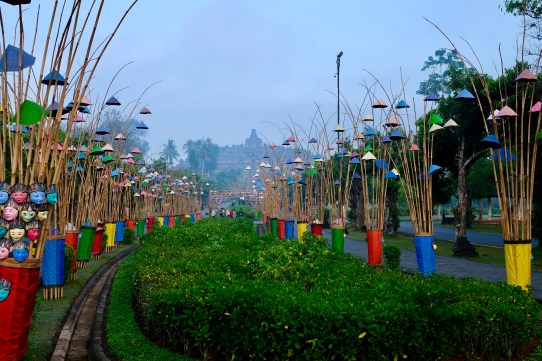
. . . and then a pic showing you the temple’s basic structure from ground-level.

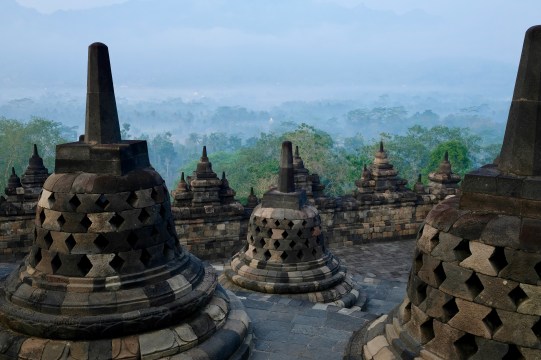
For my morning visit, I climbed straight up to the temple’s stupa-studded top and took photos. Our new (read: replacement) guide Narwan was pitch-perfect, showing me angles I might have otherwise missed, but realizing that this was not the time for active tourguiding. Here are some of the results, as the light gradually came up over the hazy jungle:


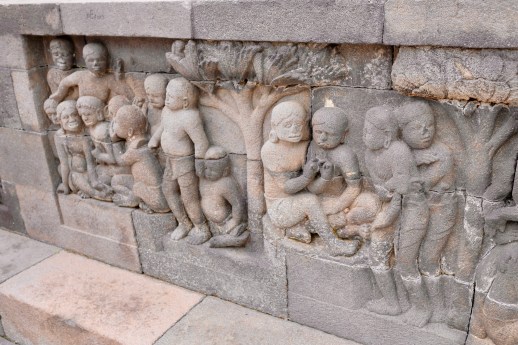
At 8:00, we returned to the hotel, grabbed Nora and the kids, and headed over again. This time Narwan took more of a teaching role and brilliantly walked us through the entire complex and the miles of reliefs it contains. The temple, we learned, is a monument to enlightenment that starts, at the bottom, with reliefs devoted to worldly and terrestrial concerns via morality tales that were apparently covered up even in ancient times to shield young eyes. An entirely PG set, however, is exposed and warns of the dangers of gossip via a depiction of a centuries-past version of telephone, as a message passes from one person to another and becomes increasingly garbled and injurious.
The next tier up recounts the life of Buddha – and, indeed, is apparently the most complete set of reliefs doing so in the Buddhist world – and Narwan walked us through many of the highlights. Among them are a panel in which Buddha’s mother dreams of a white elephant, which in western culture, of course, means something you can’t get rid of, but in Buddhist myth is something unique and a symbol of fertility, knowledge, and royal majesty.
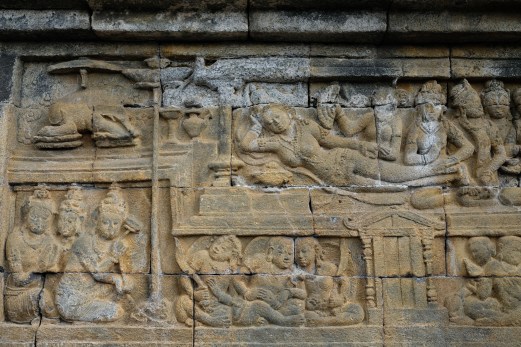
There are also plenty of panels of various of the young Siddhartha’s feats of derring-do, at least some of them to win the hand of his wife (though he will leave her when he begs off all worldly comforts and starts down the road to enlightenment). But the panels get good when he emerges from his cloistered palace life and sees a sick person, an old person, and then a dead person and begins to ruminate about suffering.


Narwan explained all of this in a kid-accessible fashion, then adopted a Buddha pose to explain to us the various hand positions in the representations of Buddha.
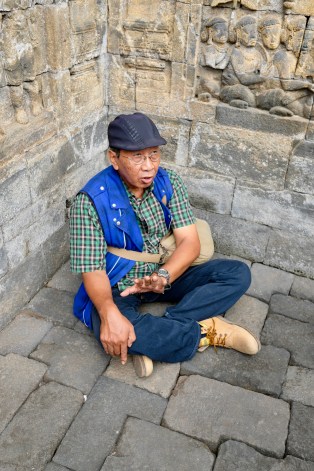
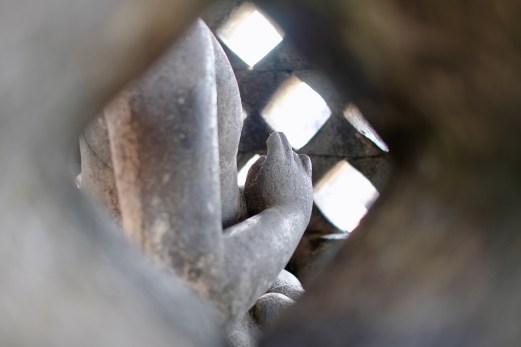
None of the reliefs down in the temple’s lowlands, however, depict the Buddha with the hand positions representing the state of nirvana. That is reserved for the temple’s summit, studded with one very large stupa and 72 smaller, perforated ones. And inside each of the mini-stupas, which Narwan had brilliantly set up with the kids, is a mini-Buddha statue with hands adopting the enlightenment pose.
Here are a few more pics as the heat of the day approached:


Borobudur was the whole show in Magelang, and we left soon afterward for Yogyakarta – AKA “Jogja.” We started there with a mostly forgettable tour of the sultan’s palace, who kept his role as head of the prefecture following independence from the Japanese and Dutch in 1945 and remains, to this day, the only unelected governor in Indonesia. But the federal government has apparently steadily reduced his subsidy, and so his palace and grounds have slipped well below shabby chic. Even more run-down was the Taman Sari water castle, which an earlier sultan used as a place of recreation, apparently mostly of the sexual sort. (The short version is that maidens bathed in the pools below the sultan’s study high up in the tower and could be summoned inside, typically by dropping a flower down into one of the pools to mark the one he wanted.)


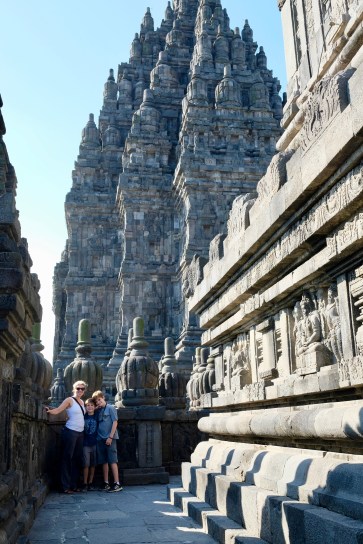
Things picked up when we headed to one of Indonesia’s other architectural and archaeological gems, the lovely Prambanan. The heart of this Hindu complex is three enormous peaked temples, honoring Brahma, Shiva, and Vishnu, respectively, with smaller temples in front of each for their transport (a goose, a buffalo, an eagle). The complex also once featured hundreds of smaller temples outside its main walls, since reduced to rubble. Compared to Borobudur, Prambanan is less substantive because it lacks the highly accessible reliefs recounting the life of Buddha. But there’s also more to climb and more nooks and crannies to explore. We spent a happy couple of hours taking it all in.


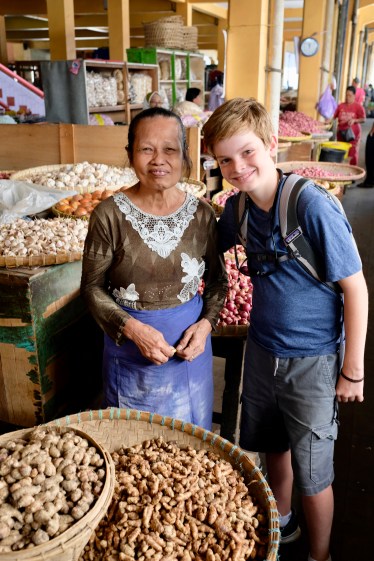
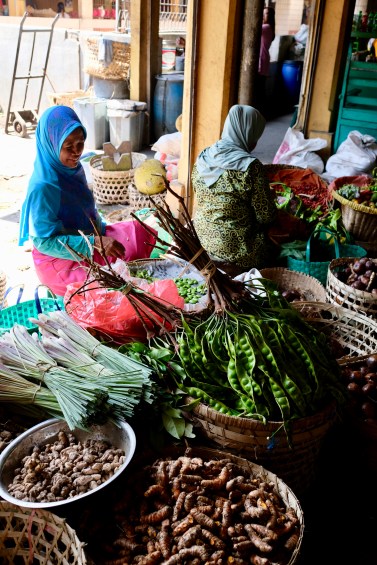
But what made Jogja great was that it’s something we hadn’t yet experienced, not counting the view from the car on the way out of Semareng: a vibrant, busy, Indonesian city. During a free morning, we walked much of the city’s main drag, including the parts where no tourists were in evidence, then made our way into the town market. Taking a tip from our guidebook, we moved as quickly as we could through the first several hundred yards of tiny, stall-lined corridors to the back of the market, where food and spices are sold. There our boys were the stars of the show. The spice ladies asked to take pictures with Connor and Elliot, during which, Connor reported, they seemed to enjoy smelling him in much the same way one smells a baby to drink in that newborn baby smell. Here are some pics:

Then we took becaks – Indonesia’s front-loading version of a tuk-tuk or moto-rickshaw – to lunch. (I love the guy who takes our picture from his truck at the end of the video.)


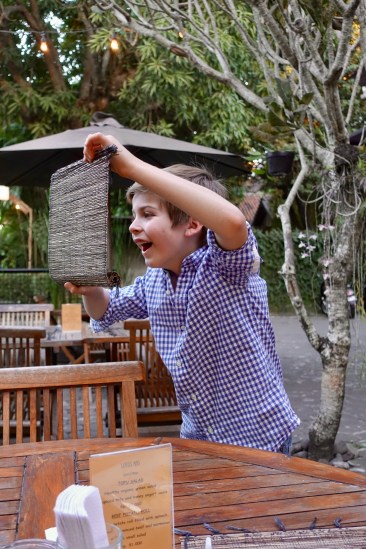
That night was guys night, as Nora wasn’t feeling well, and the Freeman Engstrom boys hit the town in style. We started with drinks and garlic bread at a Western café – always a smart move when you’re not sure what dinner will look like – and laughed until we cried at Elliot’s placemat-aided rendition of “Christopher Columbus reading a map.”
Sure enough, we then suffered our way through a dinner that was undoubtedly delicious traditional Indonesian food but didn’t quite do it for us.

Then came the best part of the night. On Narwan’s recommendation, we headed to the Southern City Square in the heart of Jogja, which comes alive in the evenings with Indonesian youth and families. We donned blindfolds and tried walking between two banyan trees from roughly 50 yards out, which local custom says will bring you good luck. (It took me several tries, but I persevered, ultimately winning a thumbs up from the local ladies serving as unofficial judges.)


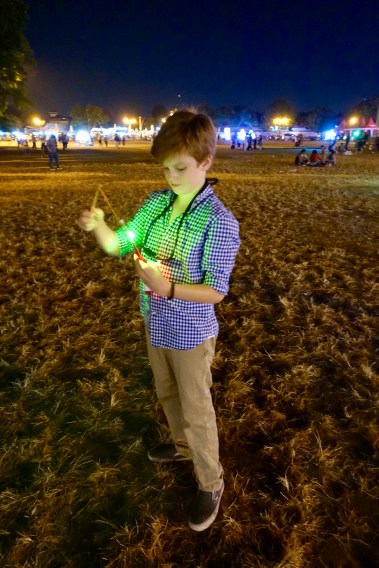
The kids had been badgering Nora and me throughout the trip to get them glow-in-the-dark slingshot/parachute/helicopter contraptions that might just be the one great universal across the many countries and cultures we experienced. I finally relented, and Connor and Elliot fired them off for a good 45 minutes.
But mostly we strolled around, admiring the many food carts (bakso!). . .


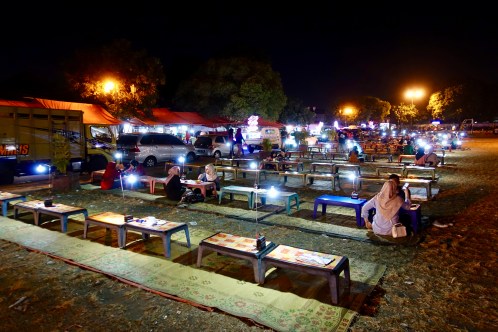
and also the pop-up cafes made up of rows of carpets and low tables set on the grass starting at dusk.
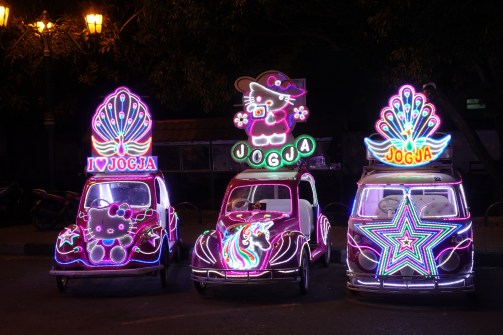
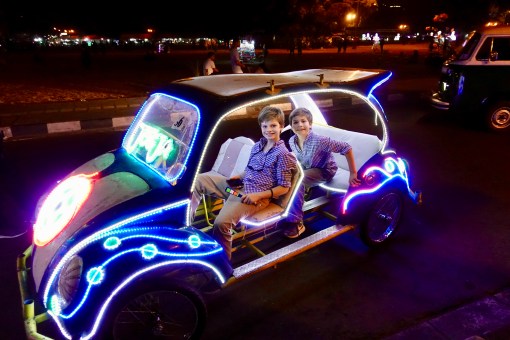
We crowned the night with a lap around the square in one of the dozens of VWs that have been hollowed-out and then outfitted with bike pedals, neon lights, and stereo systems.
Here’s a video of us rocking it to Havana by Camila Cabello, to the extent a middle-aged dad and his two young boys can, with lots of Indonesian friends and a guy in the world’s saddest Winnie the Pooh suit cheering us on.
It was one of those glorious travel nights – utterly random, devoid of other tourists, and endlessly fun.
 Fanatical Sabbatical