A Farmhouse Homestay (Connor and Elliot)

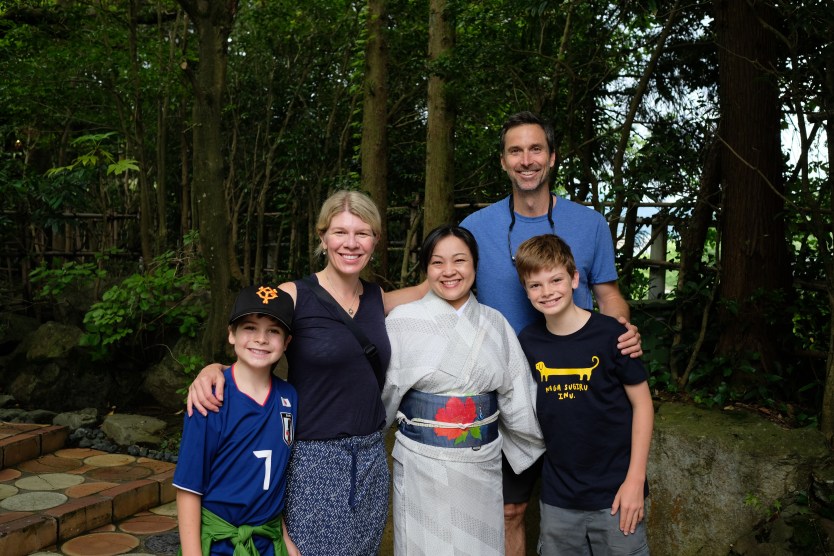
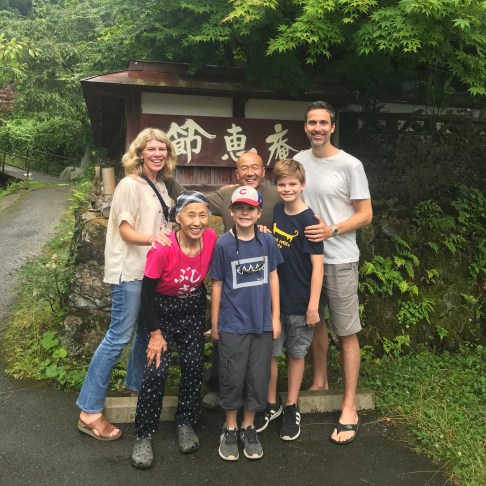
After the ryokan, we hopped in a car and drove three and a half hours, all the way to a little rice farm even more in the middle of nowhere than the earlier ryokan. We really enjoyed our stay. Some activities that we enjoyed included hiking, fishing, and impromptu cooking classes, where we learned how to make mochi, tempura, and pizza. It’s a little weird to make pizza in Japan, especially knowing that the Naples style pizza here in Japan is better that the actual pizza in Naples. Kind of funny.

One of the first activities that we did was making a Japanese rice cake called mochi. How to make it is pretty simple. You hit warm, cooked rice with a sledgehammer-sized mallet for a little while. Pretty simple, right? After you have taken your anger out on the rice, and once the rice is a doughy consistency, you take it off of the pounding block, rip a small piece off of the big hunk, and dip it in some sweet red beans, the most common mochi topping. Other toppings include sesame, seaweed, and soybean powder.

DSC04286

DSC04289

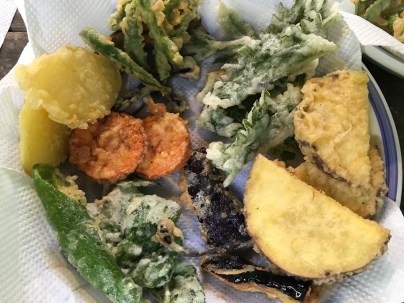
Another cooking “class” that only mom and Connor took was to make tempura. If you don’t know already, tempura is pretty much vegetables or shrimp dipped in a batter and fried in oil to make a crispy treat. One of the cool parts about the tempura experience was that, before mom and Connor started frying, they went into Kai-San’s and Setsu-San’s garden and picked the vegetables that we would use for the tempura. Now that is fresh food.
IMG_1941

Here’s a picture of the cooking process, with Connor cooking with our other host, Setsu-San.

Since we have been away from home for nearly three months, the pizza making gave us a little taste of home. I know we had just gotten back from Italy, where the pizza there is a lot better than anything else, but our pizza still had that incredible, unmatchable taste of home cooking because our hosts had a wood-fired oven they constructed themselves.

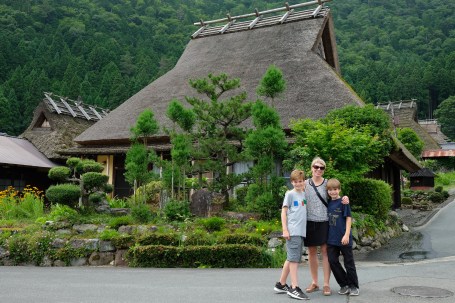
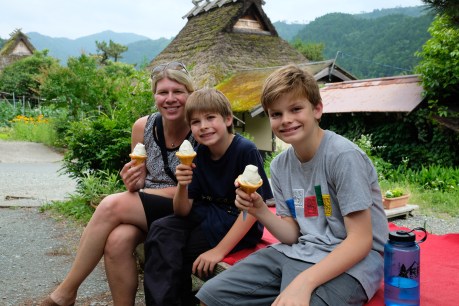
The farm, even though we were only staying there for two nights, gave us a launching-off point to the nearby tourist attraction and village of Miyama, a charming town of beautiful thatched roof houses, amazing temples scattered here and there, and the best softserve in Japan.
DSCF3688

DSCF3702

Not bad for a little town with a population of only a few hundred people!

IMG_1923

But, the farm experience might have been even better. After dinner that night, we played two traditional Japanese new years games with Kai-San. One of them was kind of a pin- the-tail-on-the-donkey game, where the object was to make someone’s face using about ten pieces while blindfolded.

The other game was simple but fun. What you do is you try to get from one side of the board (Tokyo), spiral inward, and make it to the center (Kyoto) by rolling the die and moving the number of spaces shown. The one complication was that if you landed on a spot with a red mark, it meant that you were so tired, that you have to spend another day at that inn. (Our equivalent of lose-a-turn.) The first one to make it to Kyoto wins. Elliot won once, but then I won the next game. Mom and dad were both somewhere in between. We really enjoyed the games that we played, and I hope that we will get them on Amazon once we get home.

Another highlight of our stay was getting to explore the attic of Kei-San and Sei-San’s home, which is over 150 years old and made entirely of straw.

IMG_1947

We loved the time we spent on the farm with Kai-San and Setsu-San and would recommend the experience to anyone. If we had the choice, we would probably go back there. But we are looking forward to adventures to come, such as Kyoto, Nagoya, Hiroshima, and the Kumano Kodo trek that we are doing with our cousin, John. We can’t wait for more Japan.
img_1961.jpg

Living in Japan (Connor and Elliot)

Ten days into the Japan leg of the trip we have already experienced different ways of life in this magnificent country. So far, we have stayed in everything from luxury hotels, to little farmhouses that were choked with bugs, spiders, and frogs.

Now, we are going to talk about an experience we had that fell somewhere in between:  The ryokan (pronounced “yokan”) that we stayed at in the middle of nowhere, in the Yamanaka valley. If you didn’t know already, a ryokan is a traditional Japanese inn, and if you like public baths, extraordinary Japanese cuisine, and (in our case) the nicest room attendant that you ever laid eyes on, then this is the place to be.

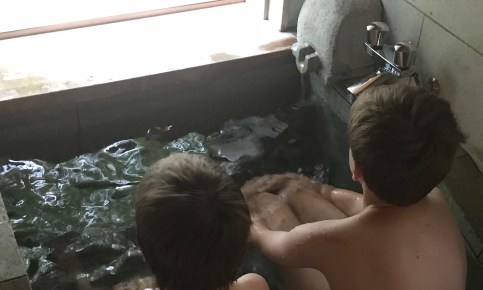
The public bath is called an “onsen” and is very comfortable. It is warm, about 113 degrees, maybe more, and feels really nice, as it is pure mineral water from a hot spring.

IMG_5566

One of the many things that we like about it is that you have to take a shower beforehand, so you are clean before you enter, and you are assured that others are as well. The Japanese take this very seriously.

IMG_5567

When the mineral water is in the bath, it has gone through no heaters, just a pipe, directly from the hot springs, which are nearby. We also had a private mini onsen (kazoku buro) in our room, but it was much smaller than the public bath.

IMG_1807

Onsens are actually really important culturally in Japan. A lot of Japanese people take three fifteen-minute onsens a day! Some people think that the minerals in the water have healing properties. Therefore, onsens and people in them are really interested in keeping the onsen clean and in great condition, as well as just having a good time.

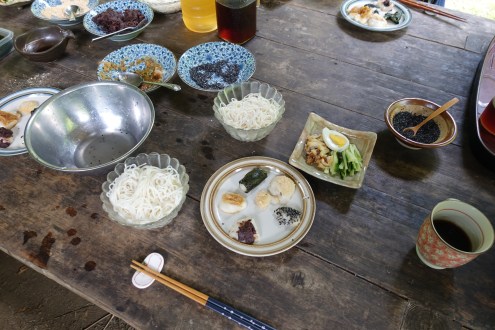
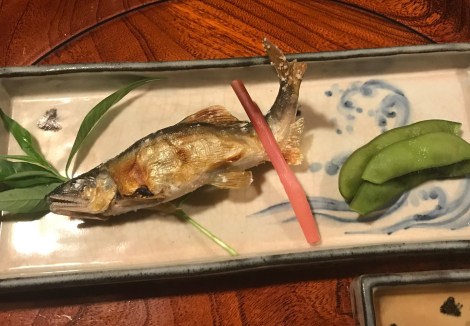
We know that one of us (Connor) has already written a blog post focused on food, but the meal that we had at the ryokan really stands out. We had so many really interesting dishes. The menu was pretty much this: Vegetable surprise, exotic fish sashimi, miso soup, and a whole fish. No butchering needed. You just rip the head off of the body with your teeth and eat it, eyeballs and all. So, yeah. Japanese cuisine can be really weird sometimes. But the craziest thing about that meal was the fact that we both liked it! Really and truly. Of course we kind of had to favor a parent with that decision, because dad was all for it, but mom thought it was a bit icky.

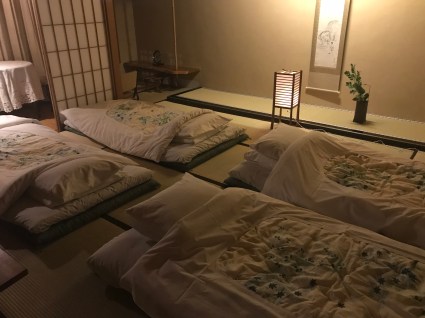
Another thing we liked about the ryokan was the sleeping situation. While we were at dinner, our room attendant came and made four beds, called futons, each about half of a foot above the ground, and really comfy. We slept for about twelve hours when we were in those beds. The comforter was warm and fluffy, the mattress was the prefect mix of soft but firm, and the pillows were large and inviting. It was an awesome bedroom to be able to sleep in.

DSCF3502

The one thing that really rounded out the experience for us was our amazing room attendant, Aki. She is probably the nicest person we have seen on this trip. She taught us how to wear our kimonos, gave us tops to spin so we could pass the time when we were bored, and just showed amazing overall kindness toward us and the rest of the family.

DSCF3521.JPG

Another enjoyable part about the ryokan was the beautiful hiking trail that was only 200 yards away. The path winds through the Japanese countryside along a river, which was beautiful.

DSCF3337

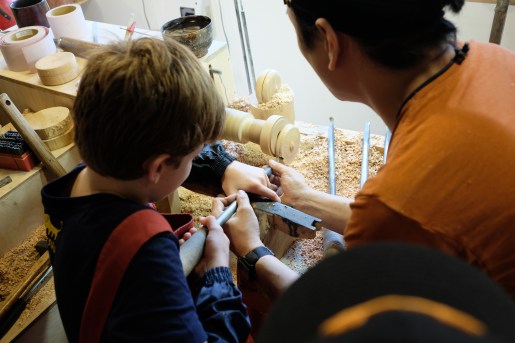
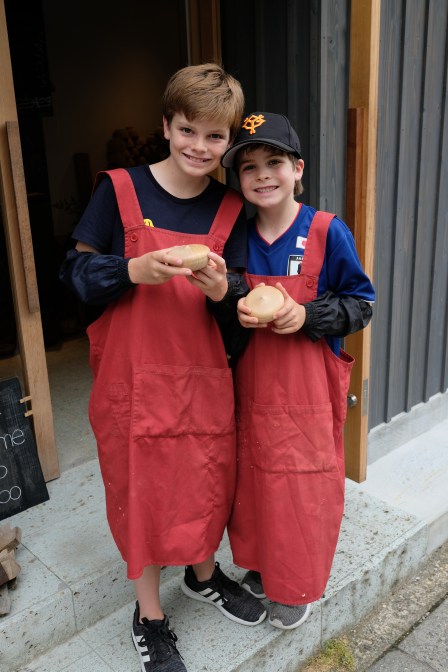
The trail then deposits you in the middle of a really nice shopping district. From there, you can either hop in a taxi, or walk though the town back to the start of the original trail. When we were in the shopping part of town, Elliot and I had a really interesting wood lathing experience where we got to make beautiful wooden boxes with the real machines. You could say the ryokan’s location is pretty much prime-time.

DSCF3547


DSCF3667

I have to say that we were really sad when we left our digs. It might very well be our best lodging place in Japan. It certainly topped all of the inns that we have gone to before.

DSCF3518

A Day in Nara (Elliot)

Over the past few weeks, I have visited many Japanese cities. Ranking them, I would say that my favorite has been Tokyo with Kyoto, Nara, and Hiroshima closely behind. (We also went to Kanazawa, but it doesn’t make the cut.) Why I put the big cities at the top is because you can marvel for a long time how clean everything is, how few cars there are, and the metro system. Using it, you can get anywhere in the city in twenty-five minutes or less! In addition, the people throughout Japan have been very nice. If you ask them for directions, such as how to get to the Kyoto train station, they will gladly answer. In fact, on our first day here in Japan, in the Tokyo metro station, a man walked up to us as we puzzled through how to buy tickets. He generously offered us advice and not only that, but he purchased some tickets for us. On another occasion, we left a backpack in a cab, and the sushi restaurant we cabbed to helped us to track it down and even gave the cab driver a sushi snack for his troubles. (The cab driver himself was so kind that he drove all the way back to the restaurant with the backpack and wouldn’t even accept a tip for the inconvenience!)

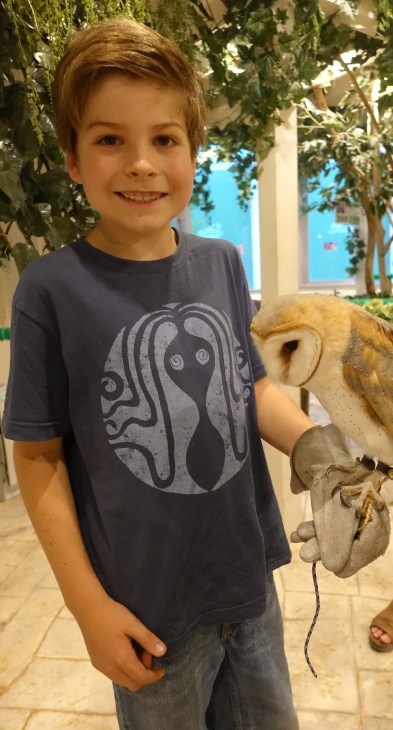
One thing I particularly liked was the Owl cafe. I thought it was cool because you could ask the person there if you could hold the owl, he would say yes, and the next thing you know you’re holding a barn owl. Pretty amazing, right?

dsc03720.jpg

Of the many cities we have been to, although Nara is not necessarily my favorite, it is worth discussing because it’s really cool and we really enjoyed our day trip there from Kyoto. So, here goes.

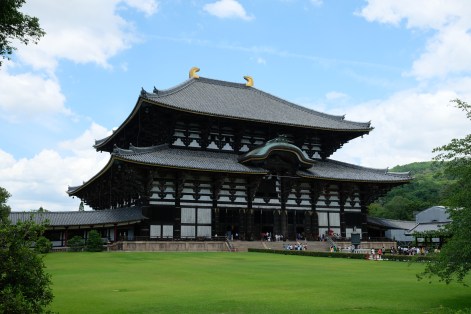
Located about 45 minutes outside of Kyoto, where we lived for nine days. Nara has a giant temple almost as big as the Taj Mahal. I can relate because I’ve been to both places.

DSCF4288

Nara’s history goes back a long way. All the way back to 710 AD, in fact. It was flourishing until 784 because it was capital, but the capital got moved.

Nara is unique because of the temple I talked about earlier, and because of the amazing deer park in the heart of the city. The temple is amazing because there are three giant Buddha statues one being much bigger and the other two being symmetrical and much smaller. The taller one is about one hundred feet tall, and the smaller ones are about seventy-five feet tall. The larger one weighs 500 tons!

DSCF4325

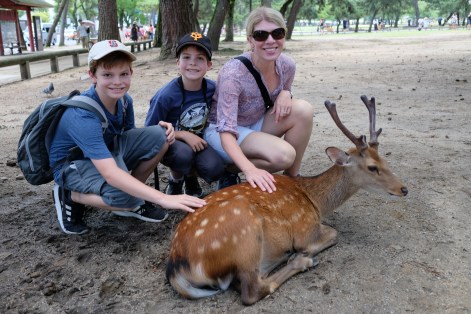
Now, to talk about the deer park. There are over one thousand in this two square mile park, and many vendors that you can buy food from for a dollar per four crackers. Unless the deer is a few weeks old or less, you can walk up, and start petting it. Isn’t that amazing? It was really awesome. You can even touch the males’ antlers or take a deer selfie! I couldn’t believe it when I first heard about it, but if you go there, you’ll see that its true.

DSCF4243

IMG_6393

IMG_6402

Now I will tell you the whole temple experience. First, we got to pet a deer on the way in. Then, when we were through the front gate, we took some pictures of the amazingly decorative architecture of the building. Then, we got to go inside and see the three big Buddhas. After that, we went behind the big Buddhas and got in line to crawl through a hole that runs through one of the poles supporting the roof, which is as big as the biggest Buddha’s nostril.  Supposedly, if you can fit through it, you get enlightenment, which is pretty much living to an old age.

IMG_2254

What I most liked in Nara was definitely the deer park because almost no one gets to pet deer in their lifetime and to do so I thought was really amazing.


Stumbling Along in Darkness in the Land of the Rising Sun – Japan (Nora)

There’s a temple in Nagano with what they call the “dark walk.”  To do it, you walk to the back of the Zenkoji temple and then descend some stairs off to the side of Japan’s oldest Buddha statue.  From there, you enter a tunnel, where you immediately find yourself plunged into total, encompassing darkness.  Stripped of sight, you must travel from one end of the corridor to the other, while groping along for the Key to Paradise.  If you’ve located and laid your hands upon this Key, it is said, you obtain enlightenment and salvation.

We tried it.  We took a train to Nagano, found the temple, and disoriented and uncomfortable (particularly for David, who had to crouch), we stumbled through the long tunnel in a single-file line.  Midway through we found what we think was the Key (it was metallic and cool), though we can’t be sure because of course we couldn’t see, and what was the Key supposed to feel like?

That — that feeling of complete disorientation and discomfort mixed with a little bit of magic — sums up Japan for me.

As I’ve said, I’m reading a lot these days.  One book I’ve read is “Rice, Noodle, Fish:  Deep Travels Through Japan’s Food Culture” which starts with a soulful prolog written by the gone-too-soon Anthony Bordain.  In it, Bordain writes:

In Japan you are confronted constantly, almost violently, with how much you don’t know.  I liked that feeling.  I liked that steep, virtually impossible learning curve.  I liked, it turned out, that feeling of being a stranger in a strange yet wonderful land, not understanding the language, lost.  Every little thing was a discovery.”

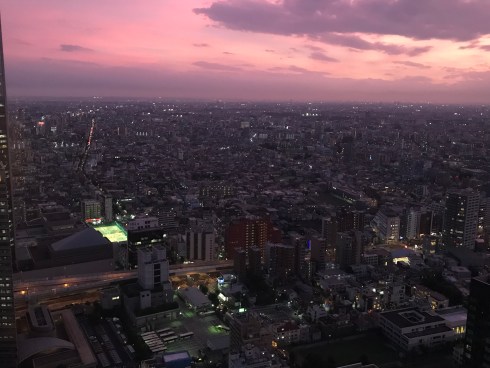
We leave tomorrow morning for Indonesia, and I’m currently sitting in a room in the Tokyo Park Hyatt where, fittingly enough, Sofia Coppola’s “Lost in Translation” was filmed.  (The view from our room, snapped through the window with my iPhone, is pretty nice.)

IMG_2385

As I sit here and reflect upon the past month of travel in Japan, Bordain’s words ring true.  Over the past month I’ve felt discombobulated and at sea.  For better and worse, every little thing has felt new.

Of these myriad discoveries, many have been simply delightful.  For example, it turns out that it’s really fun to wear what feel like pajamas to dinner — and, particularly when trekking, we donned these night after night.IMG_1813Further, there’s a word in Japanese (Zakone) for sleeping all together in a huddle, like fish.   I discovered, I love that too.  It reminded me of being a kid when the electricity went out, and we had to sleep all together by the fire.  Nothing could be cozier.
IMG_1844

What else?

I hadn’t heard of onsens until this trip, and I’m now officially a big onsen fan, particularly after a long day hiking.

IMG_1803

The fact that many of Japan’s most historic sites are positively teeming with tame deer =  so strange and otherworldly and very, very cool.

The safety = so unusual, even for someone who lives in the bubble of the Stanford Campus, which is extraordinarily safe by American standards.  I can’t get over the fact that, even in the largest cities, there’s no need even to lock your bike.

IMG_2129

Next up, the insistent juxtaposition of old and new = extraordinary.  Of course, lots of places intersperse historic sites and high-rises.  But in Japan, the mash up is more pronounced — and both sides of the coin more exaggerated — than any place I’ve ever been.   Witness below the women in traditional garb, in Starbucks, Facetiming.  Need I say more?

IMG_2115 (1)

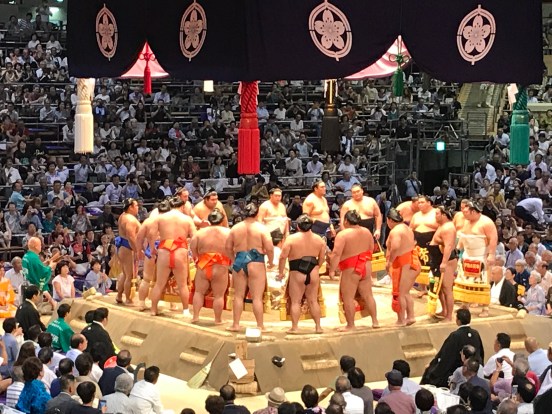
Finally, sumo!  What on earth could be stranger than sumo??  I have to say, when David told me back in March that he had dropped big bucks to get us box seats at one of the year’s biggest sumo tournaments, I thought he had gone mad.  But, guess what?  Worth every penny.  Sumo = super fun.

IMG_2337

But, unlike the others in the family who loved Japan passionately and unreservedly (Connor and David rank Japan as the #1 spot thus far, and for Elliot, Japan comes in at a more-than-respectable #2), I have to confess, I found Japan — and the constant feeling of being such a stranger in a strange land — EXHAUSTING.

For one, THE RULES.  Japan is positively studded with rules of etiquette, some of which are obvious (“don’t touch other people”), and others of which you might find written down (“don’t eat or drink in public”).  But many of these rules (“shoes here not there, though those shoes in there” or “shower like this, not that”) you just learn through trial and  error.

IMG_2373

Particularly during our two homestays, I had a hard time knowing what was required in any given situation, and I had a very hard time trying to ensure that we conformed to expectations (especially when trying not only to comply for myself but to ensure that two shall we say “spirited” boys also didn’t overtly offend).  It all made me feel distinctly off balance.

Indeed, in the same prolog, Bordain writes:

“It’s a minefield of potential offense.  I’m quite certain that at all times every single thing about me is somehow ‘wrong,’ from my posture, the way I hold my chopsticks, bow, pour my drink, sit, cross my legs–and so on.” 

He goes on say:  “But I don’t care.  Japan is just too awesome to not just forge on.”  Fair enough.  But as for me, I do care.  And I found it all vexing.

Second, the food.  Now, this is going to make me sound like a philistine.  But, unlike the rest of the family (who ate even the most unfamiliar items with gusto) and, apparently, the rest of the world (Japanese cuisine, with its pronounced umami flavor, is roundly seen as the finest there is), I had a really hard time with the unfamiliar textures and flavors — and of course the reality that I couldn’t ever be sure what I was getting, in any particular bite.

img_1830.jpg

Finally, as you may have heard, we traveled (hiked, mostly) in the midst of record rainfall, as two or three times more rain fell in a few days than typically falls in the entire month of July (generally, Japan’s rainy season).  Though we weathered the storm well, save for some travel complications (see below), this too, created a sense of uncertainty.  (I don’t have great pics of the rainiest times, as we were hiking without umbrellas, and I couldn’t pull out my phone as it would have been instantly ruined by the deluge.)

IMG_2113

Alas.  Over the past month, I’ve learned a lot — about history, about religion, about my family, and about myself.  I’ve been delighted and challenged, in a place that’s foreign but that also, like a bowling lane with the bumpers up, offers protection from dark alleys and wrong turns.  (What I mean is:  Unlike in most places you travel, even the dumbest decision won’t carry dire consequences.  Japan is too safe, and the Japanese people too kind, for that.)

So, in this strange new land, I’ve gotten my feet wet (literally and figuratively).  I’ve seen and eaten and felt entirely new things.  I’ve been made to feel uncomfortable, ungainly, clueless, and unsure — and I’ve also had numerous transcendent moments and seen other-worldly beauty.

I may not have grasped the Key to enlightenment.  But I feel extraordinarily lucky all the same.

DSCF3337

Italy (Nora)

It was about a week into our month in Italy when David and I enjoyed a short escape from the kiddos (thanks to the fabulous Mary Martin, who was spending some quality cousin time with them), when I floated the following thought:  “You know, maybe we should just cut our losses and head somewhere else?”  Within a few minutes we were huddled over our phones, furiously reviewing maps and looking up distances.  “We could be in Croatia in 10 hours.  I hear it’s nice.”  “Oh!  Would we train, ferry, or fly?”

Why the urge?  Well, because Italy, at first glance, wasn’t what we pictured, expected — or really desired.  I spent a lot of time in Italy as a teenager and then in my 20s — hiking in Cinque Terra long before it was “discovered,” horseback riding in the Italian Alps, swimming in the caves off Positano, and wandering the streets of Florence feeling practically alone.  But in the intervening decades, I have to confess:  I think I’ve aged better than it has.  What once seemed magical now seems crowded, loud, graffitied, and, frankly, sullied.  In Venice, a moment on the sidewalk leaves you jostled by an umbrella-wielding tour guide, and, when walking around Rome, you can go half an hour without hearing a word spoken in a language other than our own native tongue.  Even those super-charming-sounding towns we saw on our 70-mile bike ride through Tuscany (Pienza, Multipulciano, Montalcino) seem spoiled — irretrievably Disneyfied and seemingly bleached of real LIFE.  It’s enough, well, to prompt a girl to get out a map.

Ultimately, though, cooler heads prevailed.  After some more discussion, David and I ditched the escape plan and decided to redouble our efforts to love Italy for what it is, right now — in all its beautiful ruin.

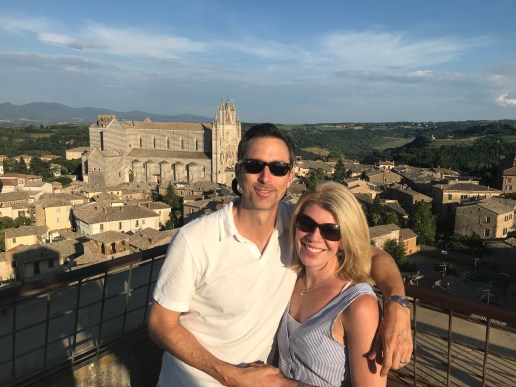
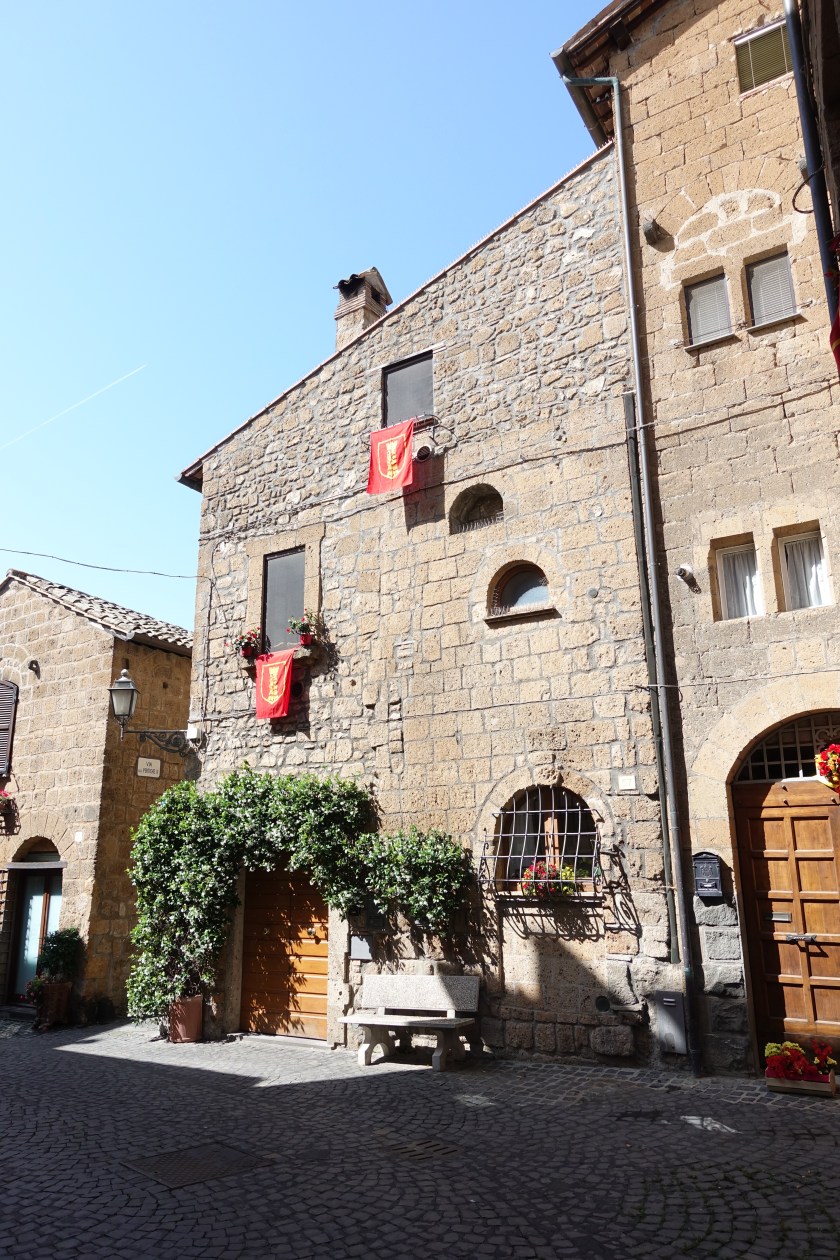
In so doing, we doubled down on Orvieto, the small town in Umbria where we had rented a longterm apartment and decided to call our home base.  We decided to enjoy THAT town — totally new to us both — for what it is (not just for the fact it’s on the train line and is, as a consequence, in close proximity to the rest of Italy).

And what Orvieto is, we discovered once we s-l-o-w-e-d d-o-w-n, is glorious.

For those who haven’t heard of Orvieto (and, until about eight months ago, I would have been in this group), it’s a town of 21,000 perched on a giant rock formation about 90 minutes outside of Rome.  It’s special because it has all the history, beauty, and creature comforts one associates with Tuscany (e.g., truffles, gelato, vineyards, vistas, Medieval cathedrals, winding narrow streets, and a Mediterranean climate), but, since it’s in Umbria, remains unburdened by Tuscany’s cache.  (So, shhhh, don’t tell anybody about it.)

Here’s a glimpse:

IMG_1518

Also this:

IMG_1163

Then, after deciding to plant our flag firmly in Orvieto, we made another radical and crucial decision.  We decided that, instead of trying to explore museums, visit caves, and notch more tourist “must-sees,” we’d just live life.  But leisurely.  And in Italy!  We’d take a break from our break!  I declared Orvieto a “tourism free zone,” and, even in the face of a noted art museum and a well-reviewed cave walk, we stuck to it.

With that plan hatched, we befriended the town’s tennis pro (the talented and extremely patient Giuseppe), got into the sport, and found what we think will be a hobby that we’ll bring back with us to Palo Alto and love, as a family, going forward.  (The fact that the tennis court had expansive views of rolling hills, an historic monastery, vineyards, and the town’s stunning chapel also didn’t hurt.)


I also got a little glimpse of what my life would be like, if, instead of having kids and immediately chasing tenure (starting my current job with a 2-year-old and infant), I had instead chosen a more leisurely path.  Who would I be, if, for the past 12 years, I hadn’t been on the go practically every second?  It turns out, I like that alternate me quite well.

For instance, when we have more time, the kids and I turn into energetic and enthusiastic cooks and bakers, even if our results leave something to be desired.  (Witness our attempt at bread making, which consumed two full afternoons, though, in our defense, I’m not sure we ever really figured out the Italian word for “yeast.”)

When we weren’t torturing flour and water, each evening, we’d crank up Van Morrison and Norah Jones on  iTunes and make delicious pastas, bruschettas, and salads, with ingredients from our local spots, where we got to know the purveyors well (even if communication remained rudimentary).

I also hiked most days, as there was a gorgeous path around the entire “rock” that is Orvieto.  Here are some representative wild flowers.

I also turned into an avid reader, with highlights being the soulful “Less” by Andrew Sean Greer and the equally magnificent (though pitched at the younger set) “A Little History of the World” by E.H. Gombrich.  (We’re reading the latter aloud to the kids and all learning a ton in the process.) Indeed, beyond these, I’ve read nearly two dozen books so far — with recommendations welcome!

In sum, for a couple of weeks there we woke up every day, without any plan.  We’d devour books, watch movies (“Top Gun” and “Mrs. Doubtfire being faves), listen to music, walk, cook, eat, play, and talk.  In short, we’d have the “family time” you plan to have as a family but that, so often get erased by the never-ending stream of seemingly-more-important errands, work e-mails, appointments, housekeeping chores, little league, fall ball, etc. etc. etc.

All told, I think when David and I look back on our days — and the kids look back on their childhood — we’ll think of our weeks in Orvieto as a highlight of all of it.  And nestled somewhere in there, is a lesson for going forward.

IMG_1592 (1)


Orvieto (Connor)

After some hectic days throughout the trip, we are finally settling into our “base” town of Orvieto. We have already established a few things about Orvieto. We even have a local gelato guy.IMG_1612.jpg

One of the things I have most enjoyed about Orvieto is learning to play tennis better. Almost every day, we go the courts overlooking the beautiful town Duomo and play. I have gotten a little better than when we first played. Back then, I was holding my racquet wrong, running in front of dad to volley the ball (and almost getting clocked by a tennis racquet), and having my shot bounce before hitting the net. Needless to say, I was terrible. But after a couple of lessons from Giuseppe, our fabulous and patient tennis instructor, I got to a level where I didn’t epic-fail every time. Now, we play tennis almost every day.
Orvieto has also been our home base for excursion trips out to Florence, Venice, and finally Pompeii and Naples. We have enjoyed every last one of those trips, but we still are happy whenever we return to our hometown.

We have also established a couple of restaurants that we like, and where we go regularly. The first is a Chinese place on the outskirts of town. Now, you may be thinking, Chinese restaurant in Italy? How does that play out? Well, actually pretty well. It’s a nice place that serves some mean dumplings, delicious sweet and sour chicken, and some hot and spicy soup to end all hot and spicy soup. We also have some go to Italian food at a restaurant that we simply call “The Deck Place” Why? Because it just got a new deck. (Laughter sound here.) Anyway, we like to go there for a good pizza every so often.

We have also been cooking in our apartment lately, including the worst attempt at bread that you have ever seen. (I said “bread,” but you could not give it that high of a title.)

Us making the “bread,” and the miserable final product.

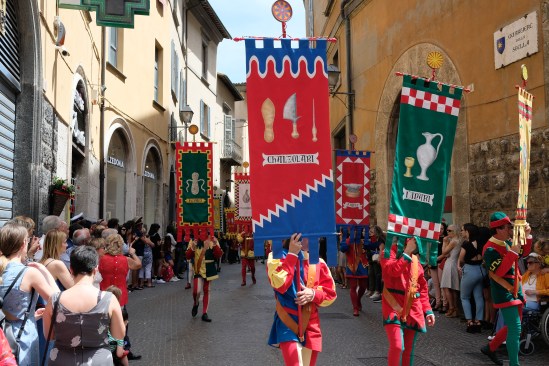
Even after all of those amazing components of Orvieto, there is one that overshadows them all: The Corpus Domani festival. This is an event that only happens once a year. The Corpus Domani is pretty much a solemn procession of kings, flag bearers, drummers, horn players, and the best play-acting military that you have ever seen. It looks too real to be happening.

So, yeah. I love Orvieto, and I would definitely spend more time in it if I could. It is just as good as any other place I’ve been. (Sorry Palo Alto!) I will definitely be sad when we leave, but Japan will also be amazing. It’s like that song; make new friends, but keep the old. But it’s not that. Instead it’s love new places, love the old. One is silver and the other’s gold.

DSC03011

Naples (Connor)

Naples was cool in a lot of ways, but it is fighting a losing battle. In the early ages, Naples was its own kingdom. Centered around trade, and located in the heart of Italy, Naples was really rich. It was a kind of capital city for early Italy. But then, when Italy was united, the title of capital, the trade, the nobles, and the king, all moved to Rome. At that moment, Naples started its decline.

Let’s go back to the start of Naples. This is the time of the Greeks. Naples dates back to roughly 1250 B.C., when the Greeks first settled the land and built a port for trading with nearby Greek cities such as Rhodes. They named their settlement Neapolis. Soon after the settlement’s founding, Neopolis was conquered by the Samnites, and a century later, by the Romans. Soon thereafter, Vesuvius, the big volcano that destroyed Pompeii, erupted. That eruption destroyed many other cities near Naples.

Fast forward a couple of centuries. In about 0 A.D., the Catholic Diocece of Naples was established, about the time when the Catholic religion was sweeping the Roman empire. After that, the final Roman emperor died in Naples. His (weird) name was Romulus Agustulus. After this, Naples was conquered yet again by the Byzantines and the Goths, rebelled against the Goths, and established the independent duchy of Naples.

Then, about 500 A.D., the dark ages began. And (of course) Naples was conquered yet again by the Swabians. Then here come the Spanish and their viceroy, Charles of Anjou. Shortly after the latest conquerors and the Spanish, opera was invented in Naples. And I was right outside the room where it happened!

After all of this Spanish nonsense, the Bourbons took over led by Charles of Bourbon. Quickly, though, in the early 1800s, Napoleon took Naples for the French and gifted it to his brother Joseph. Then, Naples became the capital of the kingdom of the two Sicilys. But that does not last long. The last king of the two Sicilys, Francesco the second, died only fifty years after Naples became the capital.

Then, as we get into the 1900s, 2000s, Naples’s trash collector system was taken over by the mafia, who took a bunch of toxic trash and dumped it into three of the cities surrounding Naples: Acerra, Marigliano, and Nola. These three cities are now known as the triangle of death.

As for the Engstroms visit to Naples, it was fairly short, as we only saw it through a one hour city walk. We did get to see some pretty cool things though. Including a huge cathedral, the mall, the market on Spaccanapoli street, and a couple of other odds and ends. We had a lot of fun in Naples.

Image result for galleria umberto
and finally, the mall.

So yeah. Naples is no great shakes right now, but it has a lot of history. And it is fun to learn about. I know Pompeii is really amazing, but Naples is pretty cool too. Whatever European age you like best, whether it’s the Romans, Greeks, French, Spanish, or the dark ages, Naples was part of it.


Pompeii (Elliot)

This blog post is about Pompeii. Have any of you ever been there? It’s a really cool place. When Mt. Vesuvius erupted in 79 A.D., it covered the sky in ash for 18 hours! The ash covered the city in a blanket that preserved it for a little less than two thousand years. This city is like a time capsule, all the back from August 24, 79 A.D.

DSC03234


One of the many things I liked seeing at Pompeii were the restaurants. They have cool marble counters, which had holes to keep the soup warm. They were really popular in the Roman times because nobody ever had a kitchen in their house. That means that Romans had to go out to eat a lot.

DSC03281

Aside from the fast food places, I also liked the baths. They were cool because there were three different kinds of baths. There were ice baths, steam baths, and hot baths. The ice baths were baths that had ice in them, good if you had just done a sport. A hot bath is what you can imagine. A hot bath! You would use it for when your muscles were sore, or hurting. A steam bath was just for fun, but I thought it was the most interesting kind because a fountain overflowed with cold water on to the hot floor so it steamed. Also, the bath was warm. The steam bath was a lot like a sauna today.  Here is a picture of one of the baths, and also an ancient “locker” where bathers put their things.

Another cool building I saw at Pompeii was the house of the faun. This house was the largest house in Pompeii! It was (and still is) 25,000 square feet! It is named the house of the faun for the small faun statue in a fountain posing at the middle of the courtyard. Another amazing feature of this house is the mosaic in the study. It depicts Alexander the great fighting the great Persian king, Darius, and his Persian troops. In the end of that war, Alexander conquered the Persian empire, and a whole lot more. But I won’t talk about that today.

DSC03293

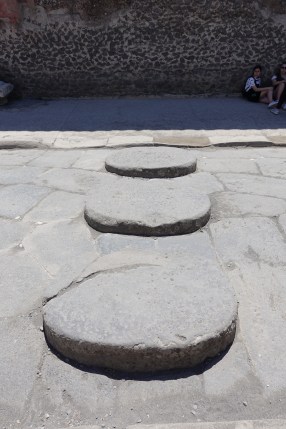
Something else I liked were the roads. There were circular stepping stones in the middle of the street. The stones were there so that, when city officials flooded the streets in order to clean them, people could walk across the streets without getting their sandals wet.

DSC03219

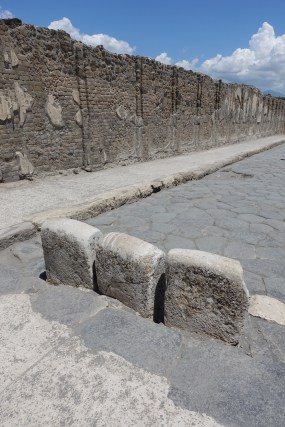
Also, there were stones to stop chariots from going on pedestrian streets, nicknamed “beaver teeth”.

DSC03249

Pompeii is one of the coolest things I have seen yet. Unlike Rome, it isn’t all ruins. Most of it is still very intact. On a one to ten scale for greatness, I give it a definite ten. It is really a peek into what life was like 2,000 years ago.

DSC03231


Food: The Good, the Bad, and the Inedible. (Connor)

Since we are half way through our trip already, and since we have eaten some pretty good food (and, spoiler alert!) some pretty bad food, I decided that I wanted to write about, well, food! The good, the bad, and the ugly.

Let’s start with the good news: We have eaten so much great food, including some delicious chicken tikka masala from India, some seriously good gyros in Greece, and mouth-watering pizza in Italy. I am also looking forward to sushi in Japan.

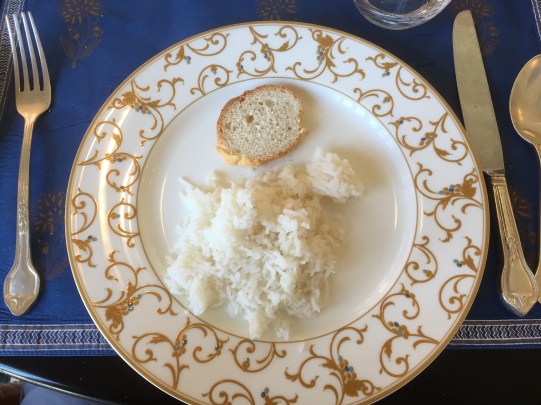
India’s food was not too bad, but since we were all sick, just the thought of saag paneer made me gag. But before all that stomach trouble, the first couple of meals I thought were pretty good! Mostly because we weren’t all throwing up, but also the fact that we weren’t tired of Indian food helped me warm up to the fried spinach, which was actually pretty tasty! After that, once we were all sick, not even Bukhara (reportedly, the best restaurant in India) could get us out of bed. Dad didn’t eat for nearly a week when he was sick, and when he finally managed to force something into his mouth, he only ate plain yogurt, bread, and plain white rice. So yeah. India was not our best stop when it came to food.

fullsizeoutput_ac43.jpeg

But this was only the beginning. Nepal was even worse.

Even though we were all recovering from the heath issue, and actually felt pretty good, we still thought Nepal’s food was disappointing. Nepal is known for a food called momo. Pretty much dumplings. Good momo is delicious, but bad momo is terrible. You can probably guess what we ended up having. Oh, but that’s not all. My lunch during the Annapurna Trek consisted of the following: 2 bags of peanuts (expired in 2010), some soup (spinach and squash), and finally the sorriest excuse for a pizza I have ever seen. On it were canned tomatoes, canned green pepper, some old yak cheese, tomato sauce, and this is the worst part: presumably expired canned corn. Who puts corn on their pizza, anyway?

A little oasis from the Nepal food surroundings was our awesome hotel in Kathmandu called Dwarika’s. There, we had a great casual tavern meal, a yummy Japanese dinner, and finally the best steak I have eaten in a long time. So, yeah. Nepal had some ups and downs. We all pulled through in the end, though.

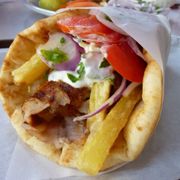
After Nepal, and after all of the physical activity of trekking, we were just dying for some good food to replenish our bodies. Luckily, the next stop was Greece: gyro central. I didn’t have one bad meal in the entirety of Greece, and I don’t think that anyone else in the family had one either. Mom and dad were all over the Greek salad, I was snarfing down two gyros a meal, and Elliot was eating everything in sight. The gyros consisted of shredded pork, tomato, onion, and french fries all slathered with a generous helping of tzatziki sauce. Heaven. A lot of people in the U.S.A. think that the Greeks eat their gyros with lamb. Not true. The Greeks put pork or chicken on theirs.

Image result for gyro pictures authentic greek

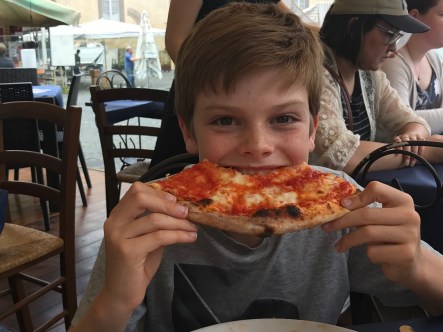
Once we departed Greece, we made it to Italy, where its pizzas would (hopefully) top the pizza we had in Nepal. They did. All of that delicious mozzarella, fresh tomato sauce, and crispy crust. Yum.

IMG_1407.jpeg

But that is not all of the food we had in Italy. In Siena, on dad’s birthday, we went to this amazing restaurant called Casa Tartufo. Or, the House of Truffles. There, we had an incredible 9 course dining experience. 9 courses! Can you believe it? And all of it was crazy good. F.Y.I. All of the courses that we had all came with fresh truffle shavings. If that is not enough, the place came out with a white chocolate mouse with sweet raspberry jam for dad’s birthday. So yeah. That might have been my favorite meal of all time.

One regret about the food in Italy is the bruschetta. You ask for the bruschetta al pomodoro (tomato bruschetta) and you are picturing toasted bread, fresh tomatoes diced carefully, a little garlic, a pinch of salt, olive oil, and a sprig of basil. Remember, this dish costs a dollar to make, and they are selling it for 10 bucks a pop. But, at some places, the waiter comes out with barely-toasted bread, 2 slices of hurriedly-cut tomato, and a splash of olive oil. Lame.  Of course, sometimes, though, the place comes through, and it’s fresh, well-seasoned, and delicious.

IMG_1464[1]

Also on the bright side, we are going to Japan soon, where sushi awaits. Can’t wait!


My likes and dislikes of the trip so far (Elliot)

This post will sum up my likes and dislikes of our trip so far:

First I will start with India.  The things that I liked about India are that when we were there, it was pretty much minute of luxury after minute of luxury.  Here’s the entry to one of the hotels where we stayed:

dscf2011.jpg

Another thing I liked was that we were well handled the whole entire time. What I mean by “well handled” is there was always a person with us, and a car always waiting for us in case we wanted to go home. What I didn’t like was that everything was so dirty and to know that, if someone with a job made one mistake, they might be fired, and probably not be able to help their own family.

What I liked about Nepal was that the trek was super fun, and the camps that we stayed at were really nice.

The one thing I didn’t like was Kathmandu. It was just super dirty.  Here is a view from along the river.  Can you believe that’s even a river?

IMG_1019 (1)

The things that I liked about Greece were that it was nice to just walk around and not to do what everybody told us to do, and have a break from having a butler. I didn’t dislike anything, which is a pretty high praise coming from me.  Instead, it was just beautiful.

In Italy, it’s been much better than I thought it would be because, again, the only thing I didn’t like was one city, out of the more than a dozen Italian towns and urban areas we’ve visited. That city was Rome. There was just something I didn’t like about it everywhere. I mean that, in one block, there would be an overflowing dumpster, and then, on the next, a bunch of cigarettes in a pile. But then, we went to Tuscany, and had the bike trip.  That made Italy look up a lot more.

And then, my cousin Mary came to join us for 8 days.

DSC02738

Above is a picture of Mary in Serano, a beautiful town perched on a cliff.

IMG_1221.jpg

And above, there is a picture of us with Mary in Florence.

Having Mary with us was great because she injected new energy.  Further, because she was straight from Yale, she brought deep knowledge of history.  Even better, she had just taken a class about the Parthenon so we talked about that. Did you know that archeologists are trying to remake wooden tools because our modern ones can’t fix the parts of the Parthenon that got blown up? She also brought many jokes with her. One of them that I memorized is this: There are two muffins in the oven. One says, “whew, it’s getting hot in here!” The other one says, “ah! A talking muffin!” She also brought this awesome card game called Flux, and she let us keep it until we see her again. It’s really hard to play and teach because some cards change the rules!

Now, we are in Orvieto, and it probably is the best place so far on the entire trip.  We’ve had an apartment here for three weeks, and each day has been great.

Something I like about Orvieto is that it is not dirty like Delhi, or Kathmandu, and there is a tennis club that we’ve been playing at, and I’ve learned a lot and really improved my game. The tennis club is really nice. I like it because there are only two courts so it is never really very busy, which is awesome. Another thing I like is there is an English-speaking pro that teaches private lessons, and he is really good at the basics.  He’s taught me all of them, so now, I’ve got the basics down! What we like to do is reserve one court, and also get a lesson so we can do Canadian doubles, and have one person doing a lesson, and then reserve the court for thirty minutes longer so the person doing a lesson doesn’t have to do only a lesson and has time to do doubles.

A couple days ago, last Saturday, to be exact, there was a procession that had mostly women, and on Sunday, one with mostly men. They were both really cool. They were really long, too. We saw the first one while just walking around, and then the second one from the balcony on our apartment. When we saw it from our balcony, it was really cool because we could just get up, put some clothes on, and watch the procession go by. In the first one, we saw mostly peasants, flag bearers, and a couple people with swords, and nobles. Then in the second procession, it was a lot of crossbowmen, people with swords, archers, and other people from the army, and then some nobles, and some flag bearers. We’re pretty sure that it was supposed to be a religious thing, or for Republica Day, but we’re not totally sure. Republica Day is celebrated all throughout Italy, and celebrates the day when Italy became a republic. The other thing that it could have been celebrating, though, is that it could have been for a relic from the church in Orvieto. The church is called the Duomo.

DSCF2708
Yesterday, we had a pretty busy day. At about nine or ten, Mom and I decided to go on a walk, which was called walk around the rock. It was called that because you basically walk around the rock that most of Orvieto is on. Here are the wild flowers that grow all along the path.


Then, we went to a little seafood/Italian place, and I got a Margherita pizza, and it was really good. Then, we went to tennis, and I got a lesson. After that, we came home, and started cooking the ravioli, bruschetta, and meatballs that we had for dinner. It was really good. Then, we got gelato, and then went to sleep. Tomorrow we leave to visit Pompeii, which I think will be spooky, but also fun.

I know school is out which is a relief for all the readers at fifteen and under out there. It’s also a relief for me, because I had to do homeschooling, which was annoying especially when I wanted to take a dip in the pool. In a couple days, we leave to go to Japan, and then a month later, to Indonesia for a month, and then Hawaii for a week. Then, we come back home to Palo Alto!