Ode to Greece, Elliot (David)

We limped out of the Asian sub-continent and quickly fell in love with Greece.  Was it just Western familiarity?  Rediscovering tap water and fresh fruit and vegetables?  Cheap and delicious Greek salads and gyros at every turn?  Freedom from the draining crush of hyper-obsequious service providers?  (Let slip that you’re not feeling well at the […]

We limped out of the Asian sub-continent and quickly fell in love with Greece.  Was it just Western familiarity?  Rediscovering tap water and fresh fruit and vegetables?  Cheap and delicious Greek salads and gyros at every turn?  Freedom from the draining crush of hyper-obsequious service providers?  (Let slip that you’re not feeling well at the hotel restaurant, and you return to your room with “Get well soon” spelled out in rose petals on your bed, then receive manager visits to your room and breakfast table the next morning.)  Surely these were all part of the story, but Greece stood on its own.

We started with two days in Athens, which delivered in every possible way.  Antiquity Athens is surprisingly compact:  Virtually everything of interest is right around the Acropolis, and its constant presence, lurking around every corner of every winding street, both inspires and makes it easy to navigate.  On Day One, Elliot and I woke up early (more on this later – my pleasure, my pain) and had breakfast at the rooftop restaurant of our hotel below the Acropolis.
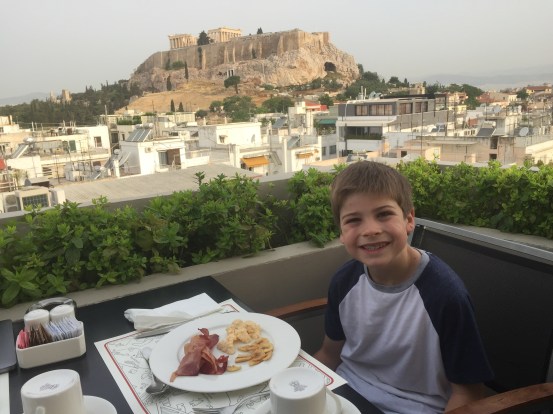
IMG_4427

Then we went on a “lost walk,” in which we alternate making decisions at each possible turn or other decision point we come to.  We ended up working our way around the base of the Acropolis, with a stop to climb the Areopagus, the hill next door to the Acropolis where Athenians held trials for severe crimes, and where St. Paul once preached to the Greeks (and occupying Romans) in what was likely a combination of a sermon and a trial.

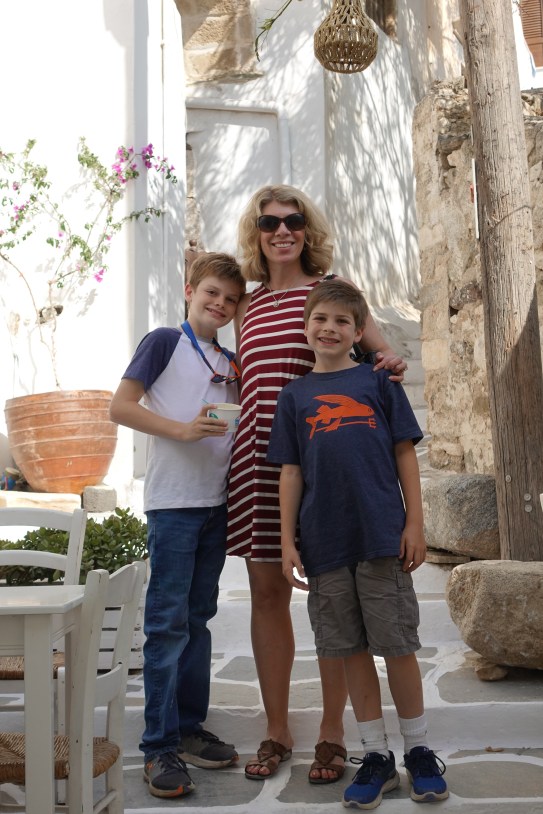
In the afternoon, Elliot and I continued our quality time together with a “2 and 2,” in which Nora and I each go off with a kid in search of adventure.  Elliot and I had a spectacular lunch in Anofiotika (a quiet neighborhood off the right shoulder of the Acropolis) at a little taverna next to a Byzantine church along a picturesque winding and cobbled street – and at a table next to a Greek Orthodox priest, so plenty authentic and far from the tourist hordes.  Then we jumped back into tourism with both feet with a full circuit on a surprisingly good “Big Bus” tour – one of those “hop on, hop off” deals –which gave us a solid overview of the city and filled us with facts and useful perspective on Greece as the birthplace of democracy and theater.  (This was great because it helped to convey to Elliot, I think, that lots of things just spring from people’s minds; it’s turtles all the way down!)  We got off the bus long enough to visit the National Archaeological Museum, where we gazed at many a kouri, statue of mythological figures, and frescoes from ruins we would soon visit on Santorini and Crete.  More on this in a moment.

Day Two was even better.  We were Connor-less (stomach ache, but maybe just needing some alone time), but Nora, Elliot, and I crawled all over the Acropolis with a terrific guide who had plenty to say about the Parthenon itself, which delivers.
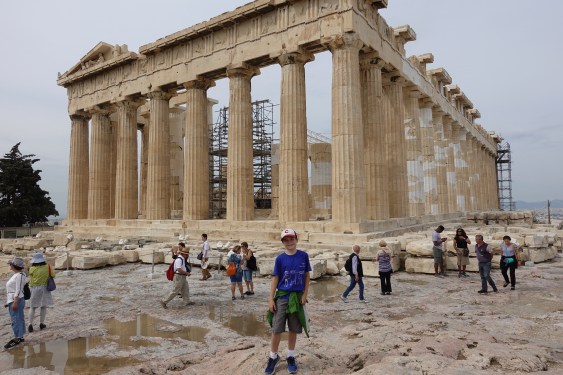
DSC01006

But she also directed our attention away from it, to the equally spectacular and in some ways neater Erechtheion, with its split-level design and columns carved into figures of maidens.

dsc01044-e1528667054878.jpg

The showstopper, I’m a little embarrassed to say, was not the Acropolis itself, but the breathtaking Acropolis Museum that sits below it.  Four things that wowed me:

  • The museum’s floors are glass so you can see all the way down to the archaeological dig going on beneath it, first unearthed during the building process (as apparently consistently happens during construction of any significance in Athens).
  • The museum’s first floor is dotted with statuary that shows that the Acropolis was actually full of smaller-scale ornamentation, contributed by leading (status-conscious?) community members.
  • The second floor is the precise size of the Parthenon and lays out the sculpture and relief carvings of its frieze, metopes, and pediments, at least the parts that have survived the ages and the plundering of the Brits. White new plaster fills out broken pieces of sculpture and reliefs based on historical photos.  Snarky outlines mark where original marbles plundered by the Brits will sit once (if?) ever returned.  And as you walk around this perimeter and enjoy the up-close view of the ornamentation that would otherwise be fifty feet above you, you can look up and out the vast windows and see the actual Parthenon sitting atop the Acropolis.
  • An ingenious movie shows the Parthenon thru the ages, including animations detailing the various transformations of its interior and exterior over time as Christians and Muslims took control of Athens.
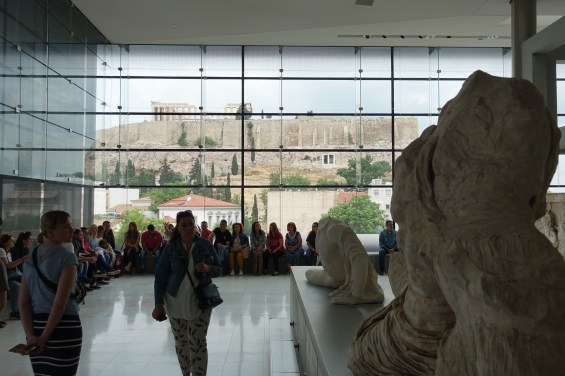
DSC01090

The quality of the museum rankles because the Brits apparently have said they will return the marbles once there’s a suitable museum to house them.  It seems like one of my very favorite museums in the world should qualify, no?

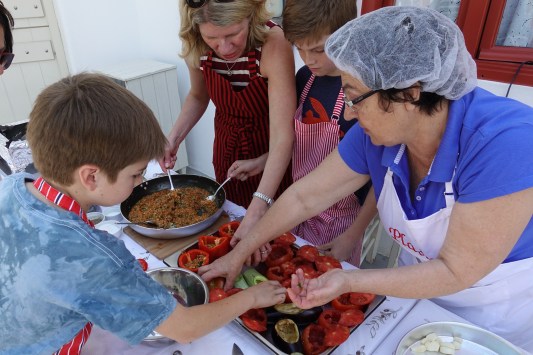
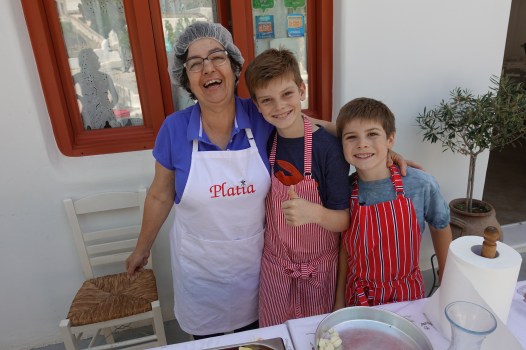
After Athens came two or three days on each of three Greek Islands – Naxos, Santorini, and Crete.  Naxos was laid back – which is saying something in a part of the world that specializes in laid back.  Tourist season hadn’t begun yet, and most shopkeepers and taverna owners were sweetly painting and prepping their spaces.  With few other tourists, we had the run of the island in our little light-blue convertible Fiat – an awesome feeling of independence after being so thoroughly handled in India and Nepal.  The highlight was a terrific cooking class at a taverna in a tiny town in the island’s interior, presided over by the matronly, joyous, hugging-and-kissing, non-English-speaking owner.
dsc01176.jpgDSC01208

She quickly sold the kids on the enterprise, and everyone was soon prepping and constructing a vegetarian moussaka and making fresh tzatziki, among other delights.  Then we sat and ate the meal after a quick tour of the gardens in the back of the house that had produced all the ingredients, including the staggering amount of olive oil used.

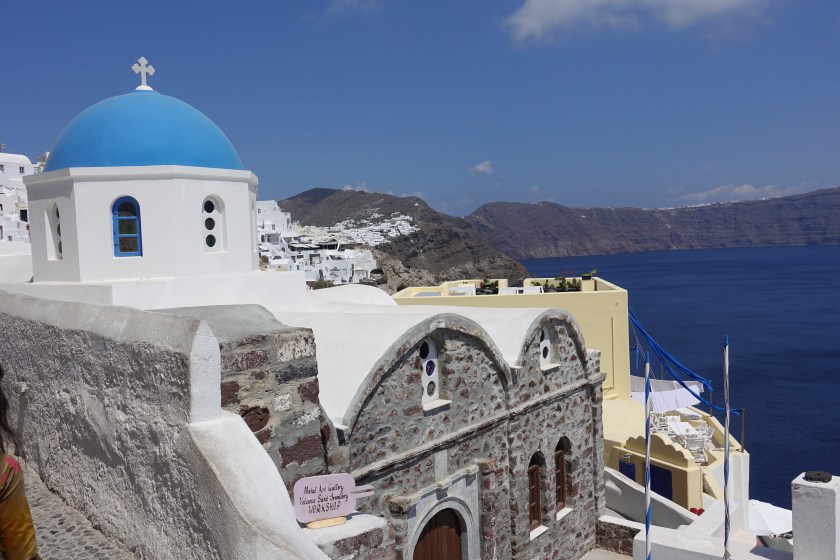
After Naxos, Santorini was a let-down at first:  filled with tourists of the worst Chinese (can I say that?) and cruise-ship variety, the constant buzz of Euro-trash (can I say that?) house cover music in virtually every establishment.  (On the latter, no musical sacrilege is too great.  The nadir for me was a house remix of Bruce Springsteen’s “I’m Goin’ Down.”)  But Santorini really grew on me.  There’s the sheer implausibility of multiple beautiful whitewashed towns hugging the cliffs overlooking the volcano-made caldera, and the gorgeous sailing trip we took along the entire caldera in one of those fancy catamaran sailboats.

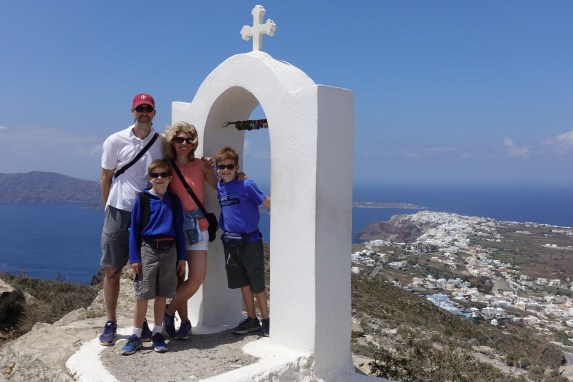
There was the hike we took from Thera, the main town at the middle of the island where our hotel was located, to Oia, the picturesque town at its northern tip.
DSC01719

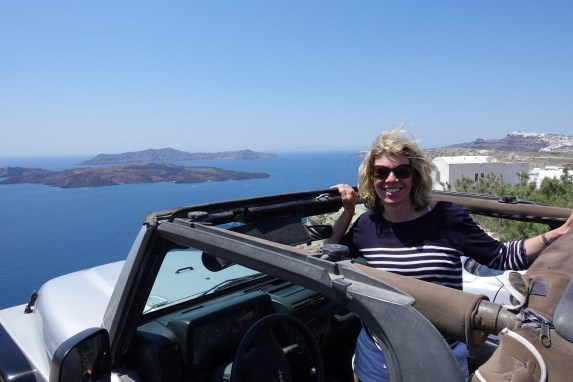
The hike was terrific, but it was made even better by yet another great guide — an expat American who, in addition to being the most perfectly realized hipster in hipster history (really? a porkpie hat, pointy beard, little red new balance shoes, *and* opening a vinyl record store next week?), was engaging and, given his expat status, spoke perfect English and so we could effortlessly take on-board all the interesting things he had to say.  (One of my favorites was his lecture on Santorini agriculture.  With no water on the island, crops are irrigated entirely by morning fog as the humidity that has seeped the night before into the pumice stone that makes up the island emerges.)  There was the pure fun of renting an open-top jeep to get mom over to a Mother’s Day massage at a spa run out of cliffside caves. . .
DSC01869

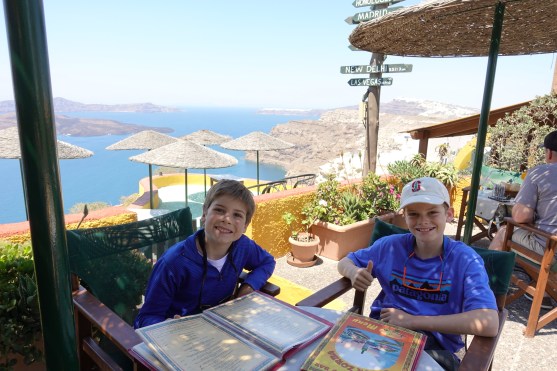
. . . and then taking a boys-only drive down to the Minoan ruin of Akrotiri at the southern tip of the island before picking up mom and stumbling upon a Mexican restaurant, of all things, with the most stunning view.
DSC01863

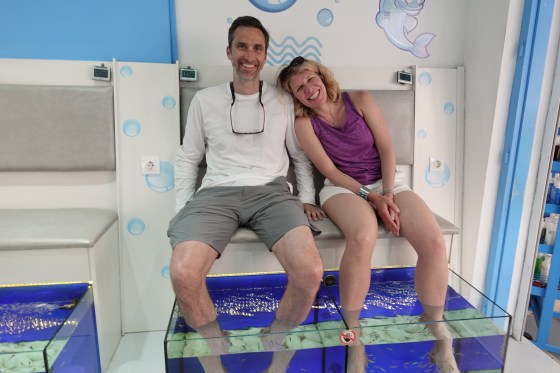
But most important of all, we hit our stride as a traveling family and simply rolled with it – witness, for instance, the fish spa experience Nora and I did, on a dare from our children. . .
DSC01611

. . . or the gyros and brown-bag-wine dinners we learned to enjoy in the park near our hotel gazing at the sunset over the caldera rather than dropping another $150 on dinner.

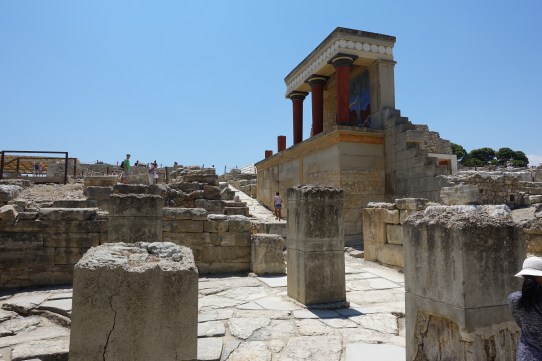
Crete?  The Palace of Knossus and the accompanying museum downtown in Heraklion – explored with another great guide – were awesome and filled out our understanding of the Minoans.  It also, I think, set the hook of an interest in ancient history that has been a central and inevitable theme of our trip.
DSC01932

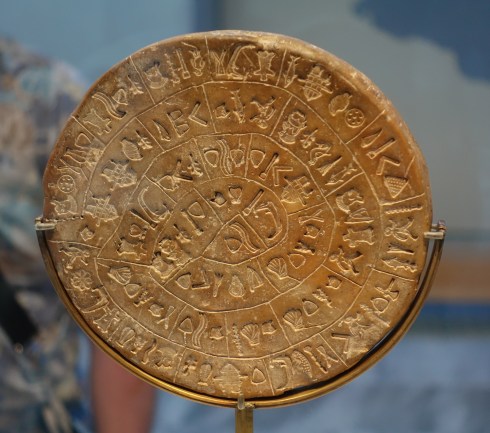
The highlight of the museum was the Phaistos Disk, found at another Cretan palace and one of the world’s great archaeological mysteries.  It sports 241 hieroglyphic symbols arranged in a spiral pattern.  And yet, because we lack a Rosetta Stone equivalent for the Minoans, no one has been able to crack the code.
dsc01939.jpg

Perhaps best of all, I read a terrific book as part of my effort to engage in at least some in situ reading during each leg of our trip.  In Greece, the book was Eurydice Street, by Sofia Zinovieff, which is an account of the first couple of years of a British anthropologist’s relocation to Greece after marrying a Greek guy.  Its chapters are loosely organized around a particular topic (family culture, politics, religion, ancient and then more recent Greek history, the Greek economy, etc.) and is beautifully done.  Highlights are an exquisite account of the place of the Acropolis in the cultural imagination likening it to a female body as:

violated, venerated, and exploited.  It is picked over by scholars, trampled over by tourists, and reproduced as gaudy plaster mementoes and as tacky ouzo bottles.  As a symbol, this hill can be a saint and a goddess, a virgin and a whore, a mother and a daughter.  It is used as a backdrop by romantics and cynics, by revolutionaries and dictators, and by men of the Church and visiting film stars.

There are many other gems, including her explanations of:  the linguistic politics of demotic versus classical Greek, which I had never fully understood; Greece’s class and ethnic politics, with rural Greeks, Albanians, and a Filipino servant class at the bottom, and an intelligentsia, a class of Northern European royalty (left over from the short-lived installation by the Western powers of a Bavarian monarch in 1832), and the great shipping magnates at the top; Athens’s post-war growth and architectural transformation as the result of a policy encouraging developers to buy up large residential properties from cash-poor owners, who would then build apartment buildings with one of the units reserved in perpetuity for the owners; and the roots of the hyper-masculine, devil-may-care Greek personality, born of Spartan feats of derring-do in battle followed by several centuries of occupation and economic woes.  The book was more insightful, and had more of a personal story and heart, than a conceptually similar book I read in India, Edward Luce’s In Spite of the Gods, with its mostly geopolitical focus.  Eurydice was also frankly less weird than my Nepal read, the cult classic The Snow Leopard by Peter Mathiessen, which is unique and memorable but, as a travelogue of a Nepal expedition by a hippy scientist Buddhist mourning the recent loss of his wife, was also less accessible to a spiritual simpleton like me.

Here’s the other thing that happened in Greece:  I fell in love with traveling with Elliot.  Nora and I have long referred to him as our “pleasure and pain,” a reference to the climactic deathbed scene in The Descendants in which George Clooney says goodbye to his estranged, philandering wife.  But many of Elliot’s personality traits, which are so exhausting in Palo Alto, turn out to be virtues on an around-the-world trip.  First off, Elliot’s a morning person – a nightmare on a California weekend, but on an around-the-world trip means there’s no crowbarring him out of bed, like a certain pre-teen of ours.  In addition, he’s got superhuman physical stamina, proven during four days of watching him bound up Nepal mountain trails as the porters hustled to keep up.  He’s got his usual and goofy sense of humor, which keeps things light when we’re hungry or tired or homesick.  He loves to tell jokes (his current favorite, courtesy of his cousin Mary:  “Two muffins are in an oven.  One says, “It’s hot in here.”  The other says, “AHHHHHH, TALKING MUFFIN!”), and he loves more general goofing, including many a bedtime turn as Captain Underpants, lots of time spent perfecting his coy sunglasses look, and sometimes doing both at the same time.

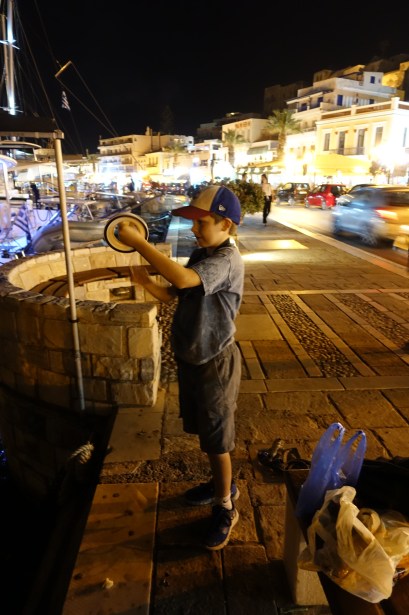
His pliable young brain comes up with the most evocative descriptions and connections.  A recent favorite is “That bathroom smelled like a seal enclosure” — a reference, when we asked him, to a visit to the Seattle Aquarium a couple of years ago.  Best of all is his boundless curiosity – as evidenced by his devouring of dozens of books since we left in mid-April, and his persistent and sometimes sweetly challenging questions to guides (“You said X.  But how can that be given that you also said Y?”) – combined with his raw, irrepressible enthusiasm.  The combination came through most strongly for me at the National Archeological Museum in Athens where, to the consternation of the guards charged with protecting the exhibits, he ran from sculpture to sculpture in search of new mythological figures that he could then lecture me on.  The combination also takes you places you’d never expect, such as night-fishing (at 11:00 p.m.!) in the Naxos harbor without a prayer of actually catching a fish — and yet one of my favorite experiences of the trip thus far.
DSC01301

The most perfect crystallization, though, captured in a video (which hopefully works), is Elliot eagerly peering over the counter as they cook him a “fish cone” – a mix of fried calamari, shrimp, and fish in a newspaper cone that he loved eating on Santorini – and mindlessly doing a dance that reminds me of the old Steve Martin “happy feet” routine.


Our Bike Trip in Tuscany (Connor)

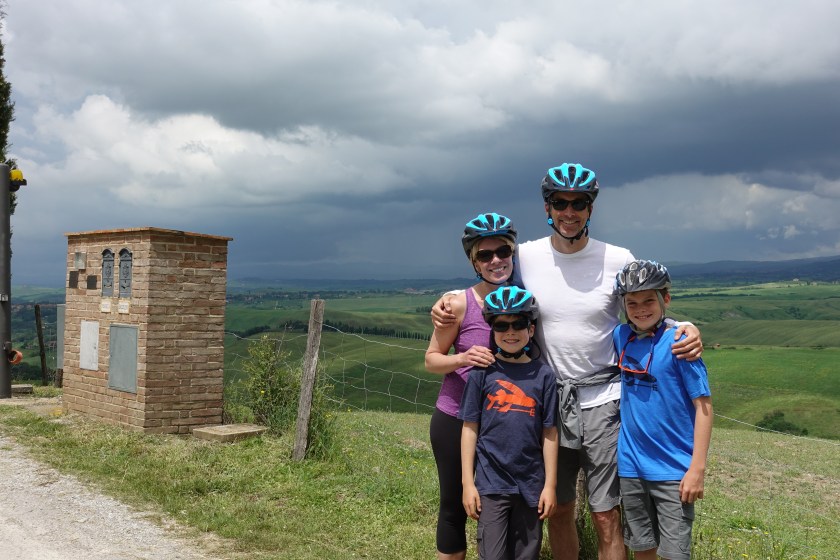
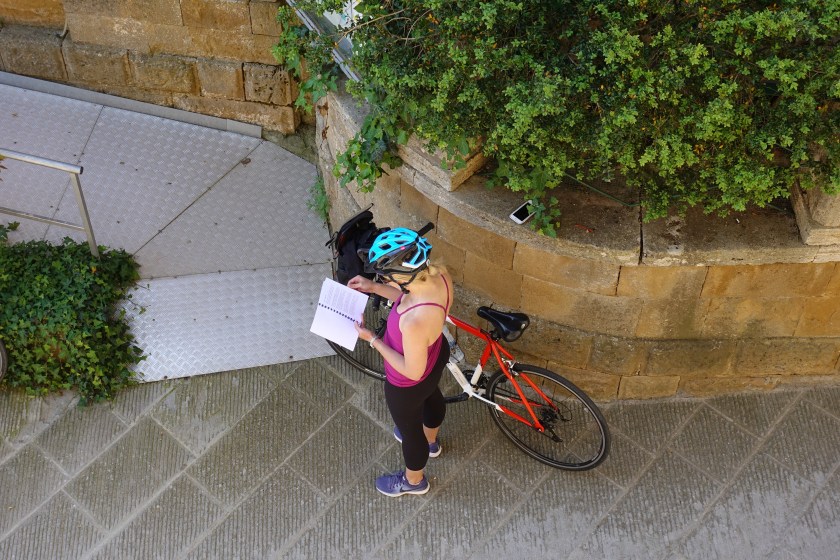
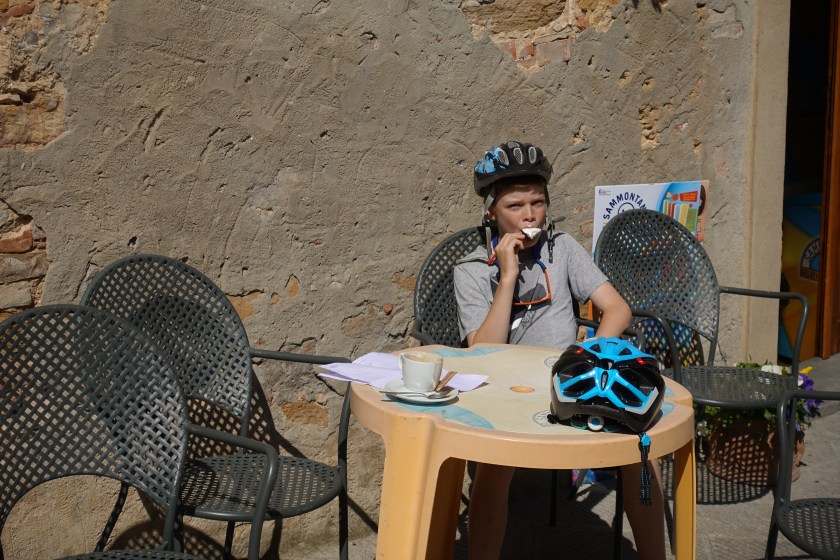
We have just finished our bike trip, and we are soon moving to Orvieto, where we will take a break from the hustle and bustle, and recline in the lap of relaxation. (We’ll also have an opportunity to focus on homeschooling, which mom seems “surprisingly” pleased about.)

What I liked most about the bike trip was that it really made me work hard! We biked 10 miles the first day, 25 on the second, 20 on the third, and a quick(er) 15 on the fourth. In all, we biked a good 70 miles in four mornings, all in the midst of beautiful rolling hills. Dang you Italians! Why do you have to make all of your towns on hills? I know that in the middle ages, it might have been useful, but it is super inconvenient when bike riding.

DSC02401

On our 25 mile day, when we rolled into the next town for lunch, I don’t think pizza has ever tasted so delicious to me in my entire life.

Our rides were awesome road bikes with 27 gears, and great wheels. My top speed going down hills was 40mph. Mom got pretty scared when I got up to that speed. Mostly because she set a limit on how fast I could go (30mph), but I did it anyway. (Sorry mom!) We also saw three really cool abbeys, the first one being the best, and the last one being the worst. None were as good as the Sistine Chapel, though. But if anything is better than that buildings ceiling, it is not on this planet.DSC02396.JPG

On the last church, we saw a lot of doctors getting a lecture near the church on some sort of study abroad. Then, mom dared me to say really loudly; “I’m short of breath! Is there a doctor in the house?” I declined. Still, I really liked the experience. Bike trip overall rating: Pretty darn good. That being said, though, I can’t wait to slow things down in Orvieto. (And can’t wait to eat a lot of gelato!) Man, I can’t wait for some peace and quiet.

DSC02504


Roaming in Rome (Connor)

Just because they’re naked doesn’t mean they’re not cool!

In the past week, I have seen so many cool things including the Sistine Chapel, St. Peters Basilica, the Coliseum, and the Roman Forum. As you probably guessed, we just departed Rome. We managed to see most of the big things, but we didn’t make it up on Palatine Hill. Palatine Hill is where it all started. Yep. It is the very place where Rome was founded.

My favorite part of what we did see was the Sistine Chapel. Perfectly preserved from 16th century, and painted by possibly the best artist ever, Michelangelo, just being in there makes you want to gaze up in awe at all of the amazing paintings. (You also get to see God’s naked behind, which is kind of funny too!) It also kind of makes you want to laugh. Still, even with so many exposed parts, it is one of the best things I have seen on this trip. The right side of the chapel is the Old Testament. (Pre Jesus) The left is the New Testament. (Post Jesus) On the front wall, there is a painting called “The Last Judgment” which is when Jesus looked on as good people ascended to Heaven, and the bad people were consigned to Hell. That part of the Chapel is pretty inappropriate, mostly because in the Hell part, one of the demons is getting bit in the nuts by a snake. Ouch. Remember, this is in a holy place. Double ouch. And this is also the chapel where the Pope goes to pray. Triple ouch. But the pope in that time, Pope Julius II, let it slide anyway.

Image result for sistine chapel

Here is the Sistine Chapel ceiling.

Even though the Sistine Chapel surpassed all others on the wow factor, St. Peters basilica was pretty awesome too. St. Peters is the church where services happen inside the Vatican. That means all of the big names in the Catholic Church go there to hear sermons. That means you have the Cardinals, the Swiss Guard, and even sometimes the Pope, all in one place. One fact about St. Peters: It is big. St. Peters is actually the largest church in the world. It is kind of crazy to think that the whole thing was built in just 6 years. That is a minuscule amount of time to build the bulkiest and most beautiful church on earth. There were also some paintings of uncovered babies and whatnot in the building, but it wasn’t overwhelming.

There is usually a three-hour line to even get tickets to St. Peters! Not to mention the security check before you are allowed to go in. That is just how awesome it is.

What I loved most about it was that it was huge, but still really nice. There is a palace just outside of the Vatican, that the locals call the “Ugly Palace” because it is too big compared to all of the other buildings in the area. But St. Peters fits right in!

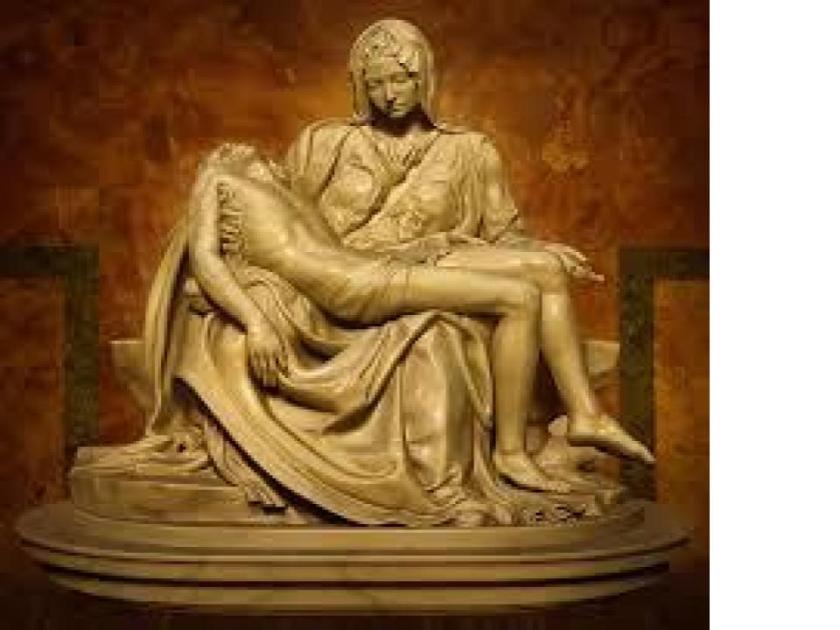
There are some really amazing statues and paintings in St. Peters, including one of mom’s favorites, the Pieta. The Pieta depicts Mary holding Jesus at his death, but also with her legs spread like she is giving birth. So the Pieta is pretty much Mary giving birth, as well as holding Jesus in his death. This statue was another masterpiece by Michelangelo, so just taking it all in is hard.

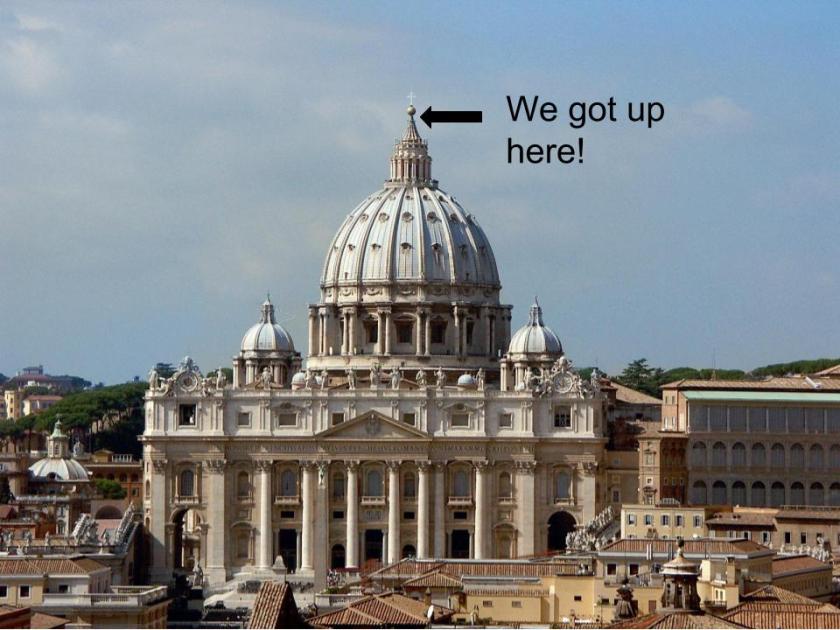
After gazing at the Pieta, we went to the very top of St. Peters’s dome, right under the cross and the golden sphere. You can get a view of all of the Vatican, and all of Rome from there. Really cool.

Untitled drawing

This is St. Peters Basilica

Untitled drawing (1)

Here is the Pieta.

Dating back to 70 AD, the Coliseum was a little less impressive insofar as there are almost no remains of any statues, paintings, or swords. You name it. All that is left is the building, and the rear-end of a horse. Not very impressive. A lot of people think the Coliseum is one of the coolest things they have ever seen, but it actually isn’t that wowing. Also, 400,000 gladiators and 1,000,000 animals died in the course of the Coliseum’s career, including scores of elephants, lions, tigers, and leopards. So, yeah. It wasn’t as awesome as I expected.  Mom thought it was gross.

Image result for are there any statues left in the coliseum

Here is the Coliseum in all of its “glory.” If you think about it, glory sounds a lot like gory. Coincidence?

Unlike the Coliseum, the Roman Forum featured cool ruins everywhere you step. You can literally sit down on a 2,000 year-old piece of marble and think: “I want a cheeseburger.” Really cool. In the Forum, I saw 5 temples, including one to Saturn. Apparently, “Saturn day,” which occurred on December 17, was the ancient version of opposite day. That means masters serve slaves, prisoners stop getting tortured, and women got to call the shots. (Mom would have liked that one.)  There were also tombs and market buildings. One of the tombs that I saw belonged to Julius Caesar, which is pretty cool. But sadly, since I had a stomachache, and since it was approximately 300 degrees, we only saw the important things. I would have liked to see more of the Forum, but I am still excited for what is to come. Our amazing time in Rome is done, and we’re moving on to our bike trip in Tuscany.

Image result for roman forum

Here is what the Forum used to look like

Image result for roman forum

Here is what it looks like today.  Arrivederci for now!

One Month In – Traveling by the Numbers (Nora)

We have now been on the road for a little over a month, so it’s a good time to look back and take stock.  To organize, I’ll offer our trip so far by the numbers:

Near death experiences:  1.  For readers of the blog, you already know all about the David-plunging-off-the-cliff thing.  Happy to report, that remains our only close call thus far.

Loads of laundry completed:  2.  You might be thinking: 30 days, 4 pair of underwear each for the boys, 2 loads of laundry.  How does that work out?  Answer:  Not prettily.  We are limping, limping to Rome, where rumor has it that our Airbnb has a washer.  Vatican shmatican.  This mama is excited about some non-smelly socks.

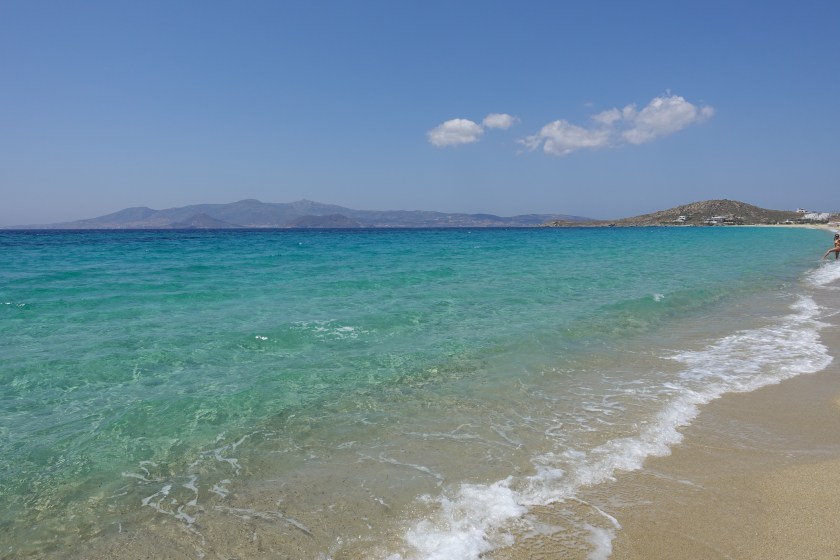
Islands visited in Greece:  3 – Naxos, Santorini, and Crete.  Of these, Naxos was definitely my fave.  It’s kind of like a really toned down Napa with the bonus that it’s on the beach — and a gorgeous one at that — and the EXTRA bonus that there are no crowds (or at least there weren’t in April, when we visited).  Santorini, on the other hand, was stunning but SO HEPPED UP.  Kind of like a mash up of the French riviera + St. Barths, with prices to match. (Granted, I haven’t visited the former and I visited the latter as a teenager, so a good quarter-century ago, but it’s what I envision, so let’s roll with it.)

DSC01313
Naxos
DSC01762
Santorini
DSC01354
Crete


Truly dreadful meals:  4.  Kind of impressive that all the others have existed in that very broad realm between between passable and awesome.  The “biggest dud” award belongs to the McDonalds in the Delhi airport.  The whole idea of a McDonalds in a country that doesn’t eat beef should have been enough to scare us off, but when we got to the Delhi airport (for the second time, after spending 2 weeks in India and on our way to Nepal),  the golden arches were inexplicably irresistible.  Alas, McDonalds in Delhi is just as awful as it sounds — perhaps worse.  Some other lowlights were “pizza” during the trek (don’t ask), and a terrible missed opportunity at the worst kind of tourist trap in Crete.  (Missed opportunity because every other meal in Greece was spectacular, and picking this abomination represented just an unforgivable lapse in judgment because the place was practically SCREAMING tourist trap — I mean the menu was 30 pages long and printed in 8 languages, and, if that weren’t enough, they had a staffer standing BY that menu touting their wares.  But I somehow disregarded those signs and insisted that it looked good.)

Okay, now the speed round:

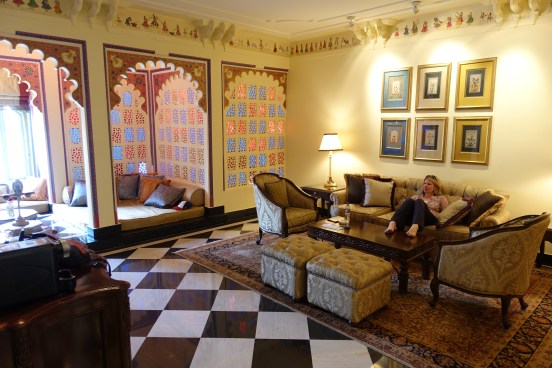
Places we’ve stayed:  14 (14 places in 31 days means lots of packing and unpacking but also means we’ve gotten to rest our heads in some truly gorgeous spots — everything from the finest luxury in Udaipur to simple guest houses during our trek).  Here’s still the most decadent — the “Mahal” suite at the Taj Palace.  I assure you, they put us there entirely by accident.

DSC00310

Longest flight delay:  7 hours.  Other than that, which we encountered in Nepal when the runway was “broke,” we’ve been super lucky with air travel, knock on wood.

Stuff we’ve lost:  5 items.  The biggest bummer was some Bose noise-cancelling headphones but also a pair of shoes, a charger, some sunscreen, etc.  Trying to cut ourselves some slack, given all the packing and unpacking, as evidenced in the above.  But still, could do without this.

Public vomiting:  13.  Total vomiting:  22.  Could do without this too.

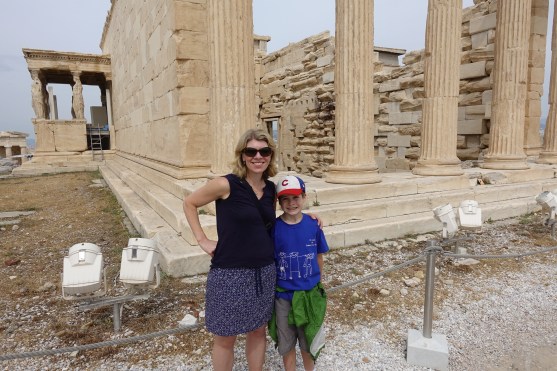
Ancient civilizations studied so far:  2.  We feel like, when we were in Greece, we really got a great education on the ancient Greeks and Minoans.  Here we are at the Parthenon, where we (minus C, who was sick that day, poor guy), had an awesome tour guide and wonderful time:

DSC01022

And, here we are with our guide, Vasa, who did a fabulous job teaching us about the Minoans on Crete (which followed up on the boys’ trip to the Minoan ruin of Akrotiri on Santorini):

DSC01955

Ancient civilizations we will have studied by this time next week:  3.  Excited to be headed to Rome (and then Renaissance-era Florence) to round out the progression.

Cousins who will be traveling with us:  2.  Thrilled that cousin/niece Mary will be joining us in about 10 days in Italy and also delighted that cousin/nephew John will be joining us to trek in Japan.

Vehicles rented:  2.  We rented a little Fiat convertible in Naxos and a jeep in Santorini and had a blast tooling around both islands.

Cooking classes attended:  1.  A highlight in Naxos was a day cooking with a Greek Grandma right out of central casting.  She kissed each boy (my husband included) about 12 times over the course of the afternoon and just exuded goodness and warmth.  Also, she was a FABULOUS chef and, though she spoke no English, taught us a ton about Greek cuisine.  On the bottom right, you’ll see the ingredients we used to make vegetarian moussaka.

And now for a few things that are countless:

Times Elliot has lightened the mood and plunged us into fits of giggles.  Here he is doing his patented “butt dance.”

P1000270

Beautiful sights we have seen.  Here’s a fave:

DSC01481

And, last but not least, number of times when I’ve felt so grateful to be with my three boys on this extraordinary adventure.

The Minoans (Elliot)

The Minoan Civilization on Crete and Santorini

We are having a good time on Crete, and had a good time in Athens, Naxos, and Santorini, but we leave early in the morning tomorrow for Rome, Italy

Why this post is about the Minoans is because we have gone to an ancient Minoan city, which is on the island of Santorini, and an ancient Minoan palace on the island of Crete.

The palace on Crete, called Knossos, dates back to 1900 BC, so it is nearly 4000 years old. Knossos was most likely home to King Minos, which you probably know about because of his labyrinth and Minotaur. In and around the palace, there were a lot of “firsts.” For example, the oldest road in Europe leads to the palace, and the first throne of Europe is in the palace, made of alabaster. They also had the first flushing toilet ever; it was even linked to a water system. Outside, the palace had 3 big holes, called kouloures, that may have been storage holes, or houses. The evidence of each hypothesis maybe being true is because there are the remains of steps in the holes, which may have been leading into a storage room, or a house. Each one was about 9 by 9 feet across, and 15 or so feet down. Some people think that the palace was the labyrinth, because it kind of looks a lot like one because there are lots of hallways, and the courtyard may have been where the Minotaur was but that wouldn’t make sense because it could run away. Also, no one has discovered any labyrinth on Crete, because that’s where it would have been.

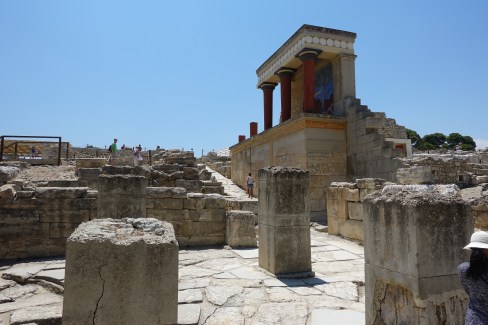
Here is a picture of the Palace Knossos site:

DSC01932

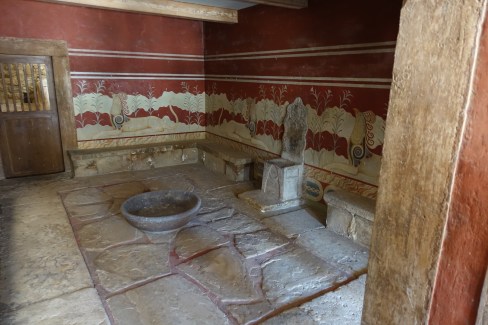
Here is Europe’s first throne:

DSC01910

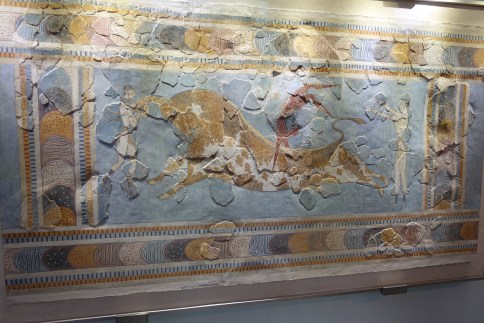
Here is a picture of a mural, depicting bull acrobats, from the Palace Knossos at the museum in nearby Heraklion. The 3-D bits are the real pieces, and the non 3-D was the archeologists’ best guess on how it would have looked:

DSC01940

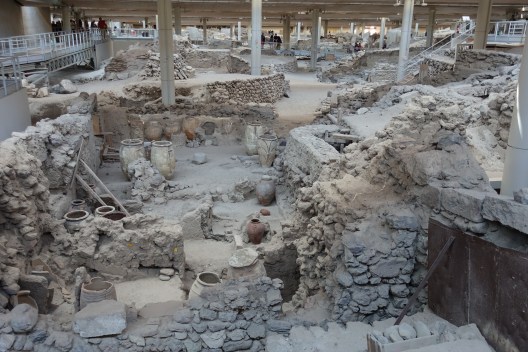
The Bronze Age city on Santorini, known as Akrotiri, is 90 miles north of Crete. There were baths, storage rooms, pots, houses, roads, squares, places where murals would have been, bathrooms, pretty much everything! Recently, archeologists have constructed a roof over the ancient city that keeps things at a pretty cold temperature at night, yet shields it from the sun. Archeologists have also constructed walkways on top of the buildings and around the town, as well as stairs leading down into the city that led you through the streets of the city, which was really cool. At one point, the path let you go through one of the houses! There was this really cool house that would have been a three-storied building, but the top floors fell off, and most of the bottom floor was not there because a mudslide had destroyed most of it. It was called the lady house, because there were signs that women had lived in it. It had had 2 big paintings, which were taken off and now are in the Athens archeological museum, so more people can see them. (My Dad and I went to the Athens museum and saw the paintings before we visited Akrotiri.)

Here is a picture of the Akrotiri dig:

DSC01830

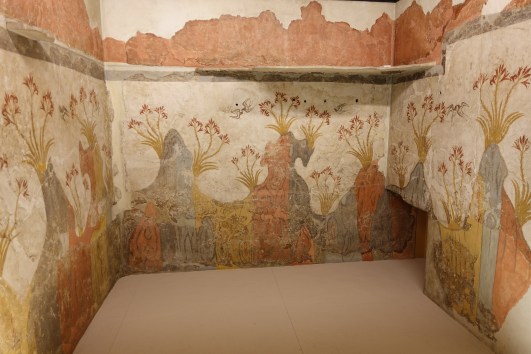
Here are the Akrotiri murals we saw in Athens. This one is called the spring fresco:

DSC00950

The ancient city of Akrotiri was destroyed when one of the largest volcanic eruptions in the history all of the world happened and blew up the island. Santorini used to be a circular island, but now, it is only a thin crescent. When the volcano erupted, ash covered the city of Akrotiri, destroying it, yet also preserving it. The two floors that got smashed on the lady house got smashed because rocks got lifted into the sky by air currents from the ground caused by the eruption, and fell down on the houses and destroyed a lot of them. The date that the eruption happened is 1627 BC. The explosion was so huge, layers of ash got as far as China!

The Iliad (Connor)

The Iliad is a poem written by the famous poet Homer, and my version was translated by Robert Fagles. The Iliad is about the Trojan war. The Trojan war was a conflict between the Trojans and the Greeks in the 12th century BC. The war started when a Trojan prince named Paris stole Helen, a beautiful young woman, from the Achaeans, AKA the Greeks. The Greeks then, being upset and all, went to Troy to try to take Helen back. They spent 9 years laying siege to Troy. Achilles didn’t participate, though, because the Achaean commander, Agamemnon, took his wife to be given as tribute to the god Apollo. Apollo is the god of medicine and archery. He was plaguing the ships because Agamemnon had scorned a priest of Apollo, who then told Apollo to plague the ships of the Greeks. Achilles had been sulking for 9 years and was still upset about Agamemnon. He was also irritated that Agamemnon did not fight in battles, even though he was the commander of the Achaean army.

One night, Achilles went out to the Ocean and prayed to his mother, the goddess Thetis. He asked her to do her best to drive the Achaeans against their ships, so that they would need him to help and would give him great rewards.

Meanwhile, though, while Achilles was still busy sulking, the Achaeans were making a truce with the Trojans. The formally warring parties had decided that Helen’s two husbands — Paris, Prince of Troy, and Menelaus, her former husband in Achaea — should fight it out by themselves. Then, the clash commenced. Paris threw his spear first and hit center. However, Paris’s spear did not penetrate Menelaus’s shield. Next, Menelaus threw his spear and broke Paris’s shield; however, Paris himself dodged the blow. Next, Menelaus charged with his sword, which quickly broke. Then, when Menelaus started to strangle Paris, the goddess Aphrodite intervened to save Paris, and dropped him in his bedroom, safe inside the walls of Troy. While Menelaus was screaming at the Trojans, an archer let fly, and hit Menelaus in the shoulder. The brief truce was broken, and the armies resumed their conflict.

The Greeks initially had the upper hand, because they were fueled by the goddess Athena. One man in particular was helped even more than the others: the captain Diomedes. He attacked and killed many Trojans, before the war god Ares intervened. However, Athena stood with Diomedes, and while Athena blocked Ares’s spear, Diomedes stabbed the war god in the chest. But then the king of the gods, Zeus, intervened.

Zeus gave another Trojan prince and the Trojan’s best fighter, Hector, incredible strength. So fortified, Hector challenged all of the Greek captains to a duel with him. Before fighting the others, Hector and Ajax battled. Ajax was a shield-man, and one of the best fighters for the Greeks. But the most amazing part about him was his size. Ajax loomed over all of the other Greeks or Trojans by a good two feet. Ajax and Hector battled until night — Hector attacking Ajax, and Ajax blocking the blows with his gargantuan shield. Once night had fallen, Ajax and Hector stopped fighting, and both sides made camp.

That night, the Trojans lit 1,000 watch fires and slept just a little beyond the Greek ships. Nestor, one of the Greek captains, proposed that the troops work through the night to construct fortifications between the Trojans and the Greek ships. Agamemnon agreed, and so fortifications were built. While the building was taking place, Agamemnon decided that he wanted Achilles in the battle against the Trojans. So he called the captains Ajax and Odysseus to go and offer rewards to Achilles if he would fight. The rewards were as follows: seven tripods never touched by fire, ten bars of gold, twenty burnished cauldrons, a dozen massive stallions, racers who earned him trophies with their speed, seven women, including his wife, half the loot of Troy, twenty Trojan women, marriage to one of Agamemnon’s daughters, and seven citadels. Achilles declined.

Agamemnon decided to fight the next day. When dawn broke, the Trojans attacked the fortifications. Zeus told Hector to not enter the battle until Agamemnon was wounded. Agamemnon fought well and killed many Trojans. However, an archer shot him in the leg, causing Agamemnon to exit the battle. With Agamemnon out, Hector entered the fray.

Hector immediately broke through the fortifications and killed a lot of Greeks. Ajax and Menelaus were the only ones standing in his way to the ships. The rest of the Greeks had cut and run. The duo held for a long time, but, eventually, Menelaus got wounded, and Ajax was overwhelmed. Then, by the persuasion of his best friend, Patroclus, Achilles exited the ships where he had been sulking, and let loose his battle cry.

Achilles’s yell killed twelve Trojans, because they were so afraid that they either stabbed themselves or their friends. Then, Patroclus donned the armor of Achilles and rallied the Greeks. Patroclus was a great fighter and drove the Trojans back to the plain where they had originally been fighting. But sadly, he came up against Hector. Hector killed him and put on Patroclus’s armor. Then, night came again and the Trojans and Greeks made camp.

That night, Achilles finally decided he was going to join the battle. His mother, Thetis, determined that she wanted her son to have the best armor and the best shield, so he could stay safe in battle. Thetis went up to Hephaestus, the blacksmith god, and asked him to make her son armor and a shield better than all others of its kind. Hephaestus agreed and made Thetis the armor and shield.

Then, before dawn, Zeus called all of the gods together and told them that they could intercede, pick a side, and fight for the Trojans or the Greeks. For Troy were Apollo, Artemis, Ares, Aphrodite, and Leto. For the Greeks were Athena, Hera, Poseidon, and Hermes. Neutral gods were Hephaestus, Zeus, Demeter, and Dionysos. The gods and mortals battled, and in time, Artemis, Hermes, Ares, Aphrodite, and Apollo were defeated. Meanwhile Achilles was fighting the river god Scamander. Scamander was winning, but then Hera decided to send her son Hephaestus down to help Achilles survive. Hephaestus, the god of fire, burned the river until Scamander swore that he would not stop Achilles from taking the walls of Troy.

Overwhelmed by Achilles, the Trojans decided to retreat to within their walls. All except Hector. He stayed to face Achilles alone. Achilles chased him three times around the walls of Troy before Athena granted him the strength to kill him. After this, Achilles had a grand funeral for Patroclus, and didn’t eat for three days. Then, Priam, the king of Troy, wanted to have his son Hector back, so he could have a funeral too. He brought treasures which he gave to Achilles in return for Hector. Achilles gave Priam lodging in his cabin and nine days to hold the funeral of Hector.

I really enjoyed this book because Greek mythology is really unbelievable (get it?) and sometimes funny. Homer explains things a lot better than I have explained them, mostly because he had more pages in the Iliad than I have words of this book report. This book teaches you to never get too angry because if Achilles had not sulked, he would have killed Hector a lot earlier and saved a lot of Achaean lives. You would think that sometimes Achilles would see the bright side. And if not, he should at least see the bright angle. The Iliad is my favorite book that I have read so far on this trip. It is truly stunning.

Top Fives on Leaving India and Nepal (Elliot)

The Five Things I Found Most Surprising About India and Nepal

The five things I found most surprising were the dirtiness, that it was very well populated, people were nice, no hamburgers, and how cheap everything was.

The Worst Things About Traveling Thus Far

The worst things about traveling so far are the dirtiness, plane travel (because I feel weird on a plane), the poor people, the cars, and the crowdyness.

The Best Things About Traveling Thus Far

The best things about traveling are the hotels, hiking, sightseeing, playing, and eating because I have had fun doing them. I particularly enjoyed sightseeing while we were trekking because you could see the mountains.

How Is Life In India or Nepal Like Life in the United States?

Life in Nepal and the U.S. is the same because there are humans, there are animals, people eat, there are nice hotels, and it is hustle and bustle.

How is Life in India or Nepal Like Different From Life in the United States?

It is different because the things are not as fancy, there is better art, good souvenirs, and more people, and there are interesting animals, such as rats, monkeys, and dogs. Also, there are busier streets, bigger mountains, more smokers, more people in general, and more beggars/homeless people.

What Do You Think Greece Will Be Like?

I think Greece will be about the same as Nepal or India but a little bit cleaner meaning less dirt, no rats’ nest of telephone wires, no dirty shops, no dead dogs, etc.

What Are you Most Excited about Greece?

I am most exited about mythology, the ancient sites, beaches, sports, and sightseeing.

Yak Girl-Book Report (Elliot)

Yak Girl

By Dorje Dolma

This book is about a girl named Dorje Dolma with scoliosis, living in the remote Dolpo region, in Nepal. This book is a compilation book meaning that it is a book with a lot of stories in one big story. In this summary, I will tell you about the stories that I found most interesting.

One of the stories, when Dorje was about 5, was about her sister, Sumchog. The story of what happened to Sumchog goes like this. One night, Dorje’s mom went out to greet some visitors. She told Dorje to stay with Sumchog while she went out to greet the visitors to the house. At the time she was 5 and Sumchog was 2. Their house is 2 floors, the first floor as the storage room and the second as the living area. Her mother did not come in for a long time, so Dorje decided to go looking for her mother, which seems sensible. As she was walking out the door, she heard a scream from inside the house. She froze, then ran back in. What she saw was a terrible sight. Sumchog had fallen into the fire! Her head was in a nest of hot coals, and was steaming! Dorje quickly pulled her out and went outside to find her mother. When she found her mother, she showed her Sumchog. Her mother screamed and started tending to Sumchog. She survived, but didn’t have good balance and didn’t have hair until she got treatment about 7 years later.

Another story is one about her when she was herding, as her job was to be a herder from age 5 to 9.  One day, she went out with the hundred or so sheep and goats. She went out with her friend, Yuden. They were really good friends, yet their parents didn’t allow them to stay with each other. It looked like a clear day, and they met somewhere in the mountains. The day before this one, it had snowed and there was still fresh snow on the ground. Then they heard an animal cry and saw their goats and sheep crowding together in small groups. Then they saw a snow leopard killing their animals! Yuden stayed away, but Dorje was mad. She ran after the snow leopard and threw sticks and rocks at it. It ran away, but 3 of Yuden’s goats and one of Dorje’s goats did not make it. They got back to their houses later and got scolded for letting their animals die.

A third story comes later in the book, and it is about what happened when her case of scoliosis got bad enough that they had to go to Kathmandu, a city about 100 miles away from where she lived. It took them a month to get there from her house, and when she got there, they had to live homeless for a few days. Then, when her aunt was ready to take their family in, they moved to her house. That night, when she was ten, was the first time she slept in a real bed. She stayed there for a long time, until the rest of her family left to return to their mountain village, and she stayed because  a soup kitchen that doubled as a boarding school was able to take her in. She stayed at the boarding school a long time until someone from America came and said that they would adopt her. It took a long time to make her passport, and then her new family picked her up one day, and then the next day, they took a flight to first Bangkok, Thailand, from there to Los Angeles, California, and finally to Denver, Colorado. Near Boulder is where her new parents live, and, where she would get the operation on her back to improve her scoliosis. There, she lived, until she went to college and got a masters degree in arts.

The main thing I learned from this book was that some countries are very different, because they are richer, or poorer, and some are different because it is just a different landscape. Dorje had never ridden in a plane until she went to Bangkok, when she was ten showing that Nepal is not a very rich country. However, it is a very interesting country.

I truly recommend this book to all readers, especially ones who like adventure stories.

Into Thin Air-Book Report (Connor)


A Book Report By: Connor

I just finished the book Into Thin Air. Into Thin Air is about an Everest expedition, narrated by a journalist who was on the journey but lives in Seattle, Washington. At the start of the journey, there are 11 people from his expedition who go up the mountain. Only 6 come down. Some of the important ones are Beck Weathers, a forty year old from Texas; Sandy Pittman; Rob Hall, the leader of the expedition and a good friend of Krakauer’s; Andy Harris, one of the guides on the expedition who Krakauer gets attached to; and of course, Krakauer himself.

The expedition starts in Kathmandu, where they take a helicopter to a point at which they begin hiking to the Everest base camp. After they walk to the launching point for the climb, they set up their expedition tent among the many others in the area. Base camp is really crowded because some expeditions keep their tents up year round, and with so many companies heading climbs, it gets a little busy. After an abnormally long ten-day stay in base camp (you usually only stay at base camp for three days, but they had to stay longer because a Sherpa fell off of a glacial face), they walked beside the Kashung face, a teetering cliff ready to fall down at any minute. From there, they preceded to camp two, where they stayed the night and then walked up to camp three, 3,000 meters above. By that point, Krakauer had established who the best and worst climbers were. Doug Hansen was not as strong. However, Krakauer himself was pretty fast, and he usually climbed with Andy Harris, another one of the stronger climbers and one of the guides. They developed a bond after spending so much time together on the trail, and continued to hike together up to camp four on the south Col, a flat piece of ice about a 10 hour’s walk from the summit.

Once they made it to the high camp on the Col, they rested for a few hours before being roused to start the hike to the summit. Hall, a very strict enforcer of rules and safety on the mountain, instructed everybody to not get too far ahead because he wanted to supervise everybody on the stretch leading up to the part on the mountain just under the summit called the Hillary step. The notorious step is named after Sir Edmund Hillary, the first climber to summit Everest without supplemental oxygen. He took a route along a precarious ridge to do it. Now, everybody calls that ridge the Hillary step. The rendezvous point that Hall was talking about was a common meeting place called The Balcony, a ledge that is kind of the launching point before going up the Hillary step and then to the summit. Krakauer and one of Hall’s most trusted Sherpa’s, Ang Dorje, went ahead to wait for the others at The Balcony.

After everybody else, including Hall, got up to The Balcony, Krakauer and Dorje scrambled up the Hillary step and summited Everest. They only stayed on the summit for a few minutes, though, because the amount of fatigue that you feel in your legs when you reach the summit is nothing short of unbearable. And the climb is not the hardest part of Everest. Getting down is even harder. As Krakauer was trekking down to the Hillary step, his supplemental oxygen ran out. Then, things went from bad to worse. There was a traffic jam on the Hillary step. Two more expeditions were climbing up the step. One was a Taiwanese expedition, led by Makalu Gau. The second was a documentary expedition. At the helm of this climb, was Scott Fisher. The two expeditions coming up were a problem because the Hillary step can only hold one singe-file line, and if you try to make it a two-lane street, somebody is going to die.

Once it finally cleared up, Krakauer managed to get to the South Peak, where more oxygen was waiting for him. Once he had more oxygen, he used his crampons to get down a smooth sheet of ice, and back to the south Col. There, he got to his tent, and, thoroughly wasted from the climb, lost consciousness.

While he was asleep, the storm hit the mountain. Rob Hall and Doug Hansen were stranded on the peak in -100 degree wind chill, and 40 knots of it. Doug died right away, but Hall held out longer. He initially survived for twelve days without food or supplemental oxygen at 29,700 feet when the temperature was 125 below zero. Rescue attempts were made to try to save him, but nobody could get up or down the Hillary step with the storm blowing faster than a car on the highway. Hall eventually perished under the conditions.

There was another casualty when a group of people on the documentary team could not find the south Col camp, and they were forced to try and wait the storm out on the east side of the south Col, right next to a sheer cliff of ice, with a deep canyon at the bottom. Eventually, the strongest people in the group (A.K.A. the guides) started wandering and trying to find the camp to get help. Eventually, they did manage to locate the camp, but there was no help available. Everybody was too tired, too cold, or too busy keeping him or herself from dying. Eventually, over the course of five days, people started to regain some strength and started to rescue some of the survivors. Two of them were hours away from dead and coated in a three-inch thick layer of ice that you had to hack with a pickaxe to get off. One of them was Beck. They painfully made the decision to let nature run it’s course, and to leave them to die. However, when everybody was trying to get Hall away from the summit and down safely, Beck walked into the camp, ice and all. They got doctors and medical treatment immediately, and started thawing Beck’s limbs.

After 5 more days, some of the assistant guides that had survived decided to launch an evacuation of Everest high camp on the south Col. Beck managed to walk down to camp three where an army helicopter from the Nepalese air force would pick the worst of them up, one at a time and take them to Kathmandu for medical treatment. First went Gau, the leader of the Taiwanese expedition. He had critical frostbite and a bad case of hypothermia. Close to death, he was lifted to the Nepalese capital, and managed to survive. Next, Beck was taken to Kathmandu where he also lived to fight another day.

The rest of the sad little group walked down to base camp, with the assistance of Sherpas from other climbs, who wanted to help them. One of the Sherpas got beaned twice in the back of the skull with rocks falling from a light avalanche. He was (luckily) okay.

Stepping back, I think that one of the main ideas of this book is that you should never give up on something or someone. The book showed this because everybody gave up on Beck, but he was able to walk out of the freezing cold in hurricane force winds when he was pretty much a walking corpse. I really enjoyed this book because it is a fast-paced adventure novel with a lot of good suspense. It has a lot of humor, but some curse words. On the whole, it was one of the best books I have read.


My First Day in Greece (Connor Ω)

To start the day, I slept. We had had a half day of travel two days ago, and then a full-and-a-half day of travel the next. I can’t sleep on planes. I just can’t. So I had been awake for the past exhausting day-and-a-half. Needless to say, I wanted my rest. After I slept in to about 10:00, I finally got up for breakfast, which, for me, consisted of some toast, and corn flakes. After my breakfast of champions, mom and I decided that we wanted to walk around for a few hours to see what we could see, and to buy some souvenirs. We wound our way through the endless streets and alleys, looking into shops that showed any promise for souvenir buyers like us. As fate would have it, we went on a little side street, that took us directly to the base of the Acropolis. After gazing at the Parthenon, we decided to make a decision. We went to lunch. After three weeks in Hindu countries, where cows are sacred and beef is taboo, I got a hamburger. Note: It was a hamburger that I couldn’t even take a bite out of because it was so big. It was the piece of beef to end all pieces of beef, a tomato the size of 3 hot wheels cars, and a bun that would make Godzilla want to sprinkle salt in his shoes. It was a big hamburger. I ate three-quarters of it. After we were weighed down by our lunch, we didn’t really want to walk anymore. So we hopped on a tour bus and got to see some cool sites. Including:

The Parthenon

Image

The Temple of Zeus

Image result for temple of zeus

And the National Library

Imag result for greek national library

All of the ruins are so amazing! And if you have read Percy Jackson, it will become even more so. I can’t wait to spend two more days here. I really love this place.