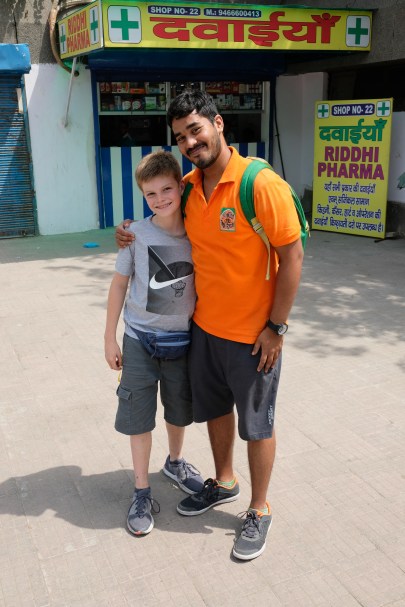
What I Know For Sure – 20 Days In (Nora)

When you are hiking, day after day, hour after hour and often far at the back of your convoy, as I was, and particularly when you are consuming relatively little, in terms of media and news, it turns out that what you do read embeds itself in your consciousness.  You have time to mull it over and over (and over, again).  For me, then, I’ve spent LOTS of time chuckling about this recent New Yorker piece—relating to, and charmed by, all of it.   (“I have all the pizza“)  And I’ve been a little caught up in the Oprah theme.  So, with that in mind, after roughly 20 days on the road, and particularly the last week trekking with a 9-year-old and an 11-year-old on the Annapurna trail, here, as Oprah would say, is what I know for sure:

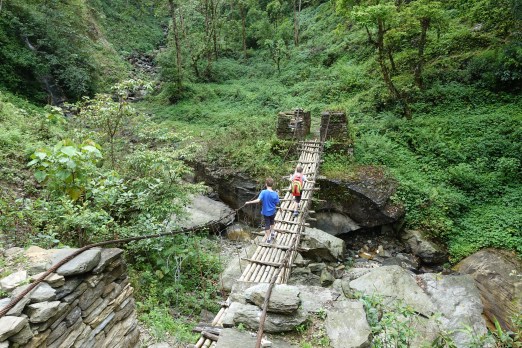
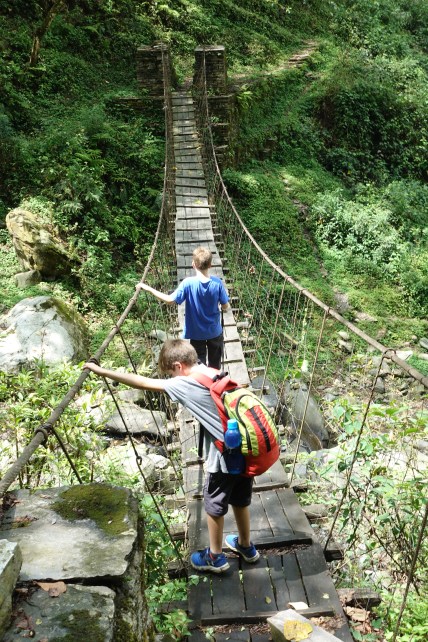
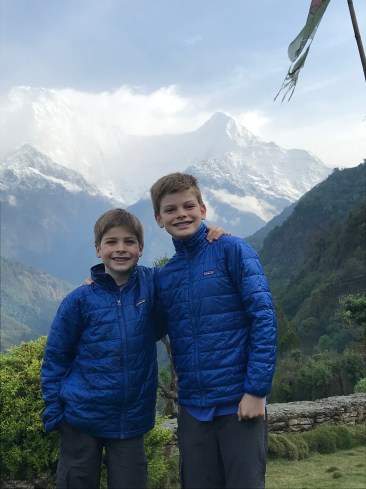
1.  My kids are basically cooked.  What I mean is, David and I have approached parenting with a clear philosophy:  Our primary job is to teach Connor and Elliot to be resilient and persistent, as the other stuff (brains and empathy, most notably), for them, comes pretty naturally.  BUT, resilience and persistence are trickier, particularly since they are raised in the bubble (Campus) inside the bubble of Palo Alto (median home price, $3.3M), where the sun always shines, we never keep score lest somebody lose, and kids get medals just for showing up.  So, our parenting M.O. is, and has been, to try to hurl our kids into tough situations and try to instill in them those two attributes we view as so crucial but hard to develop.  Hence our decision to drag our kids on 5 days of the Annapurna, over roughly 50 miles of extremely steep and slippery terrain, eating unfamiliar food, in variously too-hot and too-cold conditions.  (And when I say extremely steep, it really was—basically all rock steps, with about a 1-foot rise, hour after hour, day after day; I kept picturing climbing all the stairs in the Empire State Building, getting to the top, and either having somebody say to take the elevator back down and start over or having that person tell me to climb down and then start over. )

But, can you believe, the kiddos could do it?  From my spot, far in the back of the convoy, I was in abject awe of their toughness, tenacity, and good humor.  So, starting now, I still have to feed them and chat with them—and keep them in fitting shoes, which is no mean feat (Connor and I actually need to go shoe shopping this afternoon)—but mostly, as a mom, my work is done….at least until they are teenagers.
IMG_0953

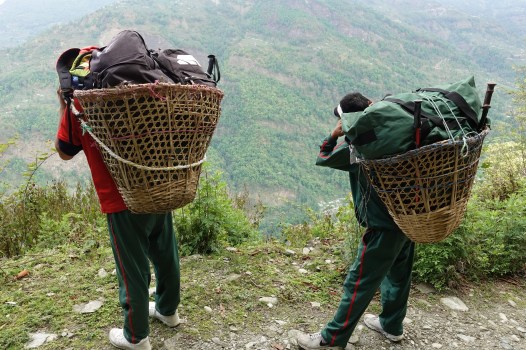
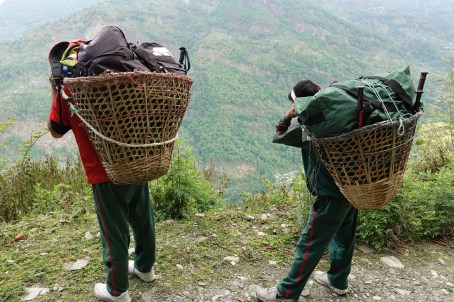
2.  I will go to my grave not knowing the proper tip for our porters. As Connor pointed out in his blog post, these guys carried super heavy loads of our stuff, which we didn’t do a great job winnowing. (For example, David packed a bicycle pump. Long story.)
DSC00789

And they did it though they are small in stature.
IMG_0990
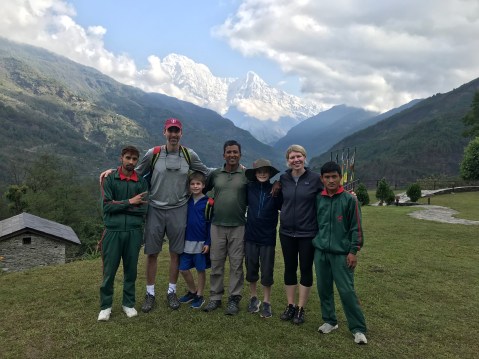
Notice, by  comparison, I look like a giant and David looks like Goliath.

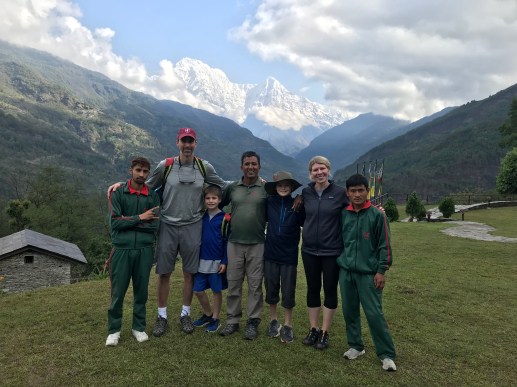
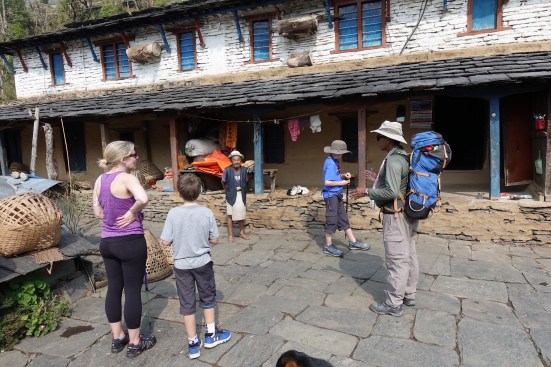
And they did it though they were wearing crappy flat-bottomed shoes. Then, there were the extra little niceties, like when they pulled my husband out of stinging nettles, when he had fallen off a cliff, head first—and if he hadn’t been pulled out, might have plunged to his death. (Further, let’s face it, though they never complained about the nettles, they had to have gotten stung too.  I just got close to David right after the fall, and I got nettle “bites” on both my hands, and they swelled, tingled, and burned like fire for the next 24-hours.) Further, there was even help beyond that: When we split up because I was slower than the rest, one kept up with Connor and Elliot and essentially acted like an all-day babysitter. Or, on another occasion, the porter stationed behind me grabbed my hand and helped me across a river, when I got weak-kneed, after realizing I was scrambling across boulders spread out over rough-running water—and one wrong step could cause me to fall—which was a problem because we were at the high mouth of a pretty impressive waterfall. And then, my personal favorite—that same day, the same porter said about 200 times, “Excuse me, Madam.” Then, every time, he would lean over (difficult with a load so heavy) and delicately pull leeches off my calves and ankles. So, what do you give those guys? The guidance we had said $4 to $6 dollars a day, basically what you’d tip a bartender for pouring you a half-way decent glass of chardonnay. We didn’t follow that guidance, needless to say…but it’s had to know that any sum would have really been adequate.

3.  Both Nepal and India really have a trash problem.  It’s endemic.  Trash is everywhere and choking everything and marring every landscape.  On our first day of hiking, an hour or so in, I challenged Elliot to pick up all the debris he saw and even offered to pay $.25 for each piece, which I figured would give him $10 or $15 extra to spend on souvenirs—win, win.  But, within a couple of hours, his back was hurting and he had actually earned $60—a disgusting sum, given the realities above—and we suspended the challenge.  (With absolutely no arm twisted, Elliot ultimately chose to give the $60 to the porters.)Image result for trash in kathmandu


4.  After spending a week in Nepal, landing back in Delhi (we had to, overnight, prior to our trip to Greece), felt like landing in Miami.  It was such a contrast to compare how we felt initially upon landing in Delhi (It smells!  The air feels so polluted!  It’s so chaotic!  No one is obeying traffic signals!) to our perception of the place post one-week in Nepal (How orderly and spiffy! Everyone looks so fancy! Look at that landscaping!).  What a difference a week makes.

Now, to conclude, here are a few of the sentences I spoke or heard over the past three weeks, that I never thought I’d say or hear:

-“Connor, pick up your barf bag!”  [Spoken one of the days Connor felt crappy and spent all day clutching a barf bag I had purloined off an airplane; I currently keep 3 such bags on my person at all times.]

-“Get him!!!!”  [Me to guide and porters, when David was hanging on the side of the cliff, feet up, head down.]

-“The problem is that the runway in Kathmandu is broke.”  [Official explanation for why, for six hours, no planes took off from the Pokhora airport.  Hard to argue with the logic, but none of it instilled confidence.]

-“It’s getting pretty Superdome-y in here.”  [Me to David at said Pokhora airport.]

-“If you get spooked in the middle of the night, just come down the hall to our room or call the butler.”  [Me to kids, at fanciest hotel in Udaipur, where we, yes, had a butler.]

-“I think I’ll have the chef salad, followed by smoky bites, and fish curry.”  [David, getting a little punchy after all of our stomach problems and food restrictions.]

-“That thing on my leg, is that just another place where a leech got me?”  [Me.  No further explanation needed.  Eeeeek.]
Trekking in Nepal (Connor)

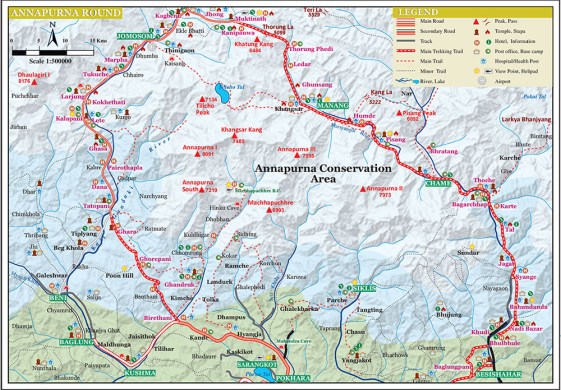
annapurna-circuit-trekking-map

We have just finished our trek on the Annapurna trail. Although it was hard, it was one of the best experiences I have had on this trip. Here is what happened on the great hike:

Day 1:

On the first day of our trek, we were dropped off by car, which was one of the bumpiest and most sickening rides of my life. We got off right next to the start of the trail. There, we got to meet our amazing guide Padam. Padam is incredibly informative and helpful. He is the kind of person who is funny, yet still is a good teacher. We also met our two sherpas. Those guys are so strong. They carried two duffel bags and one backpack each, and then walked 5 hours, going faster than us.

DSC00731

DSC00789

Then, we preceded to walk to the Sanctuary Lodge where we had lunch, and relaxed after our first day of trekking. The walk to the lodge was a total of two and a half hours. The day ended with me pulling out a tooth that my orthodontist said I needed to pull because, if I didn’t do it, I would cause some serious damage to my mouth. Including the news that if I didn’t pull the tooth, another tooth would grow in, on the other side of my retainer. Not a good situation.

Day 2:

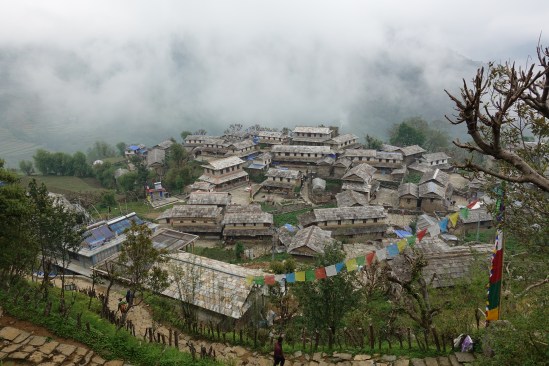
We woke up at six o’clock to begin our second day on the trail. This day was our hardest day, as we climbed 2,000 meters, and we spent 5 hours on the trail. We went through really cool villages built on the hillside. Pretty much every person in those villages had at least 1 water buffalo, 2 cows, a few goats, and 5 chickens. It is kind of crazy to think that you would own all of those animals! Most kids in America just have one easy, fun, pet. These people have 15. This was also our first day of trouble with leeches, and our most exhausting day of them all. We were pretty much walking up stone stairs for 5 hours. I think this day proved that we could pretty much do any hike that we needed to do. Even if your legs feel like jello. My favorite part of this day was the feeling of accomplishment upon completing the hardest day of the trek.

DSC00407

Day 3:

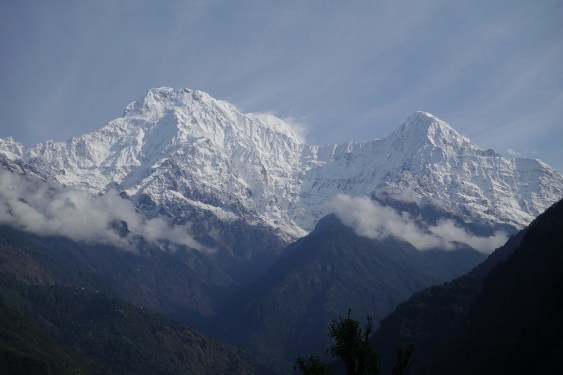
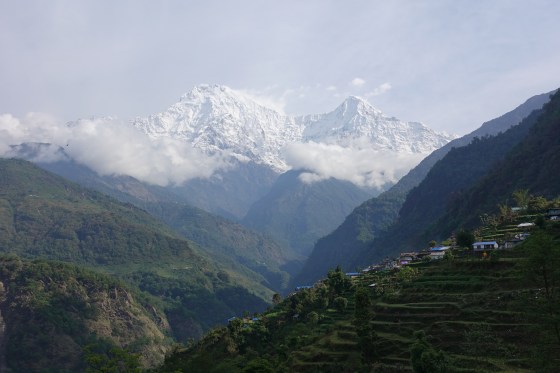
Day three was a day when I woke up at 4:00 to see the sunrise, and Fishtail Mountain, at a towering height of 6,993 meters, which is about 22,942.91 feet. After that, we walked down a really big hill, into a valley, and then right back up another hill to our next lodge. After that whole, tiring day of hiking, I pretty much couldn’t stand up. Did you know the Nepalese only call a mountain a mountain if it has a snow cap, even though some of their “hills” are 9,000 feet above sea level? The real highlight of this day was seeing the incredible snowcap of Fishtail Mountain rising above the clouds.

DSC00708


Day 4:

This day hurt. A lot. To lead it off, no more then twenty minutes in, dad slipped on a slippery stone and fell face first into a patch of stinging nettles. A plant that has white stingers all over the leaves. At the time of the incident, I was running along the trail with Elliot. Then, I heard a yell and turned around to see the flora thrash as dad went down. There was also a worse part. Why was this extra bad? Because stinging nettles burn like fire for a period of twenty-four hours. It was also kind of lucky. Why? Because the stinging nettles saved him from plunging off a cliff. It was also lucky that we had strong sherpas and a great guide, to save dad from falling, pull him out of the stinging nettles, and get him away from the cliff. Right after dad fell, our guide and sherpas rubbed milkweed all over dad’s body. Sadly, it turns out that I am allergic to milkweed. And everybody except Elliot and me, had it on them. Right after everybody washed their hands, and once dad washed his body, I got an asthma attack. On top of all of this trouble, we had a full four hours on the trail. Think about it this way: You have to go down 800 steps, all slippery due to rainfall the previous night, knowing that one misstep could send you plunging to certain death off of a sheer cliff face. But whatever.

Day 5:

On the last day of our trek, and by far the easiest day, we walked to a pickup point that was only one and a half hours away.

I really enjoyed our trek because it was grueling, yet exciting, and, after each day, we had something to be proud of. I also really liked it because we had been spending our time in busy India and Nepal, and it was really nice to have some nature there as well. I think the Annapurna trail will be one of the highlights of the whole trip.

IMG_0990


Elliot’s second post — Trekking in Nepal

This is a post about trekking in Nepal

The Most Interesting Thing I Saw:

The most interesting thing I saw was probably the leaches on the trail because they could stand up on there faces. Leaches are little, long, wormlike things that can suck your blood. They are pretty gross. One got on my ankle, so when I tried to flick it off, it stuck to my fingernail. I was eventually able to get it off, but it took some effort. They are a weird brown color, and they were about 1 to 2 inches long. It may have also been the mountains, because if it was a clear day you could see the tips which were really snowy and white.

DSC00720

The Best Thing I Ate:

The best thing I ate was probably the shrimp tempura I had last night in Pokhara.

Where We Stayed:

When we were trekking, we were in lodges that were pretty small, but nice. They were all one floor, which was nice. They had the most comfortable beds ever, so you could sleep well and get ready for the next hike.

My Favorite Part of the Trip:

My favorite part of the trip was when, after six hours of hiking, I was allowed to jump in bed and relax.

The Hardest Part of the Trip:

The hardest part of the trip was most likely the hiking part because after each leg, you legs would just be spent. The shortest time that we were trekking in one day was 1 and a half hours, and the longest time was around 6 hours. It was also hard because it was always really steep up or down.

DSC00745


The Scariest Part of the Trip:

The scariest part was when dad fell of a cliff, and if not for a large patch of stinging nettles, would have died. Stinging Nettles are plants that are spiky, and have poison that stays in your body for 24 hours. At the time, I was ahead of dad so I didn’t get to see him fall, so I only saw the rustling of the nettles after he fell. The poison makes big red welts on you skin, or, if you put milkweed on it, it will only sting a lot.

The Weather:

The weather was nice because whenever we had just got to another lodge, it started to rain really hard. Still, it was really cloudy while we were hiking.

The Coolest Thing I Saw:

The coolest thing I saw were the leeches because I had never seen them before and it was interesting what they did. It could have been the mountains, though, because they were all white and yellow.

What Villagers’ Homes are Like:

The villagers’ homes are normally made of stone bricks, but some of the poorer peoples’ houses are made of straw. Most families owned animals, like goats, yaks, dzo(cow/yak), or sheep. Most of the houses were pretty small, but it was nice because everyone shared everything including different kinds of crops, animals, or meat. There were also a lot of dogs in villages.

DSC00540


DSC00478


I Fought India and India Won – David

It all started so great:  a bracing and surprisingly energetic three days in Delhi without significant jet lag; a quick overnight trip to Agra to see the incredible Taj Mahal; and then, perhaps best of all, our arrival at the Ravla Khempur (now dubbed the “Best Exotic Marigold Hotel”) outside Udaipur, which I was expecting to be kitschy but was in reality one of the more unique places I’ve stayed, with its stunning architecture, rambling spaces (which we had the run of as the only guests at the very tail end of the tourist season), horse stables, and adjacent village where we were welcomed into homes, a school, and even a wedding.

Then the Indian tourism gods smote me down and I spent the night throwing up every 45 minutes from dusk until dawn.  Since then, I’ve seen two doctors and been on two different kinds of antibiotics.  Yesterday, four days after it all started, here’s a pictoral sum of my total food intake:

But I’ve still loved it.  I’ve loved moving back and forth between the chaos of the streets and the quiet hyper-elegance of the places we’ve been privileged enough to stay at.  I’ve loved the food — at least the parts of it I’ve managed to eat.  I’ve loved a surprising fact that Nora astutely pointed out:  Unlike other places we’ve traveled, India has never, not once, not down the darkest Old Delhi alley, felt menacing.  Most of all I’ve loved the many exchanges we’ve had:  with Stanford alum Sumeet Nair and his lovely wife Gitanjali, who hosted us at their home and shared several hours of conversation about Indian food, culture, and family life; a chance poolside conversation with NYTimes writer John Burns at our Delhi hotel; and then day-long interactions with a spectacular series of guides.

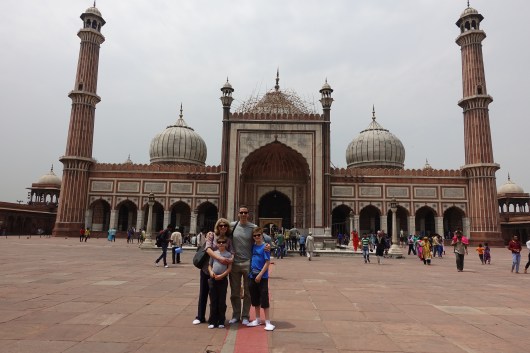
There was Poonam, who told us about the challenges of entering into an unusual interfaith marriage (she’s Hindu; her husband is Sikh) marriage 30 years ago as she walked us around the beautiful Friday Mosque in Old Delhi…

DSC00259

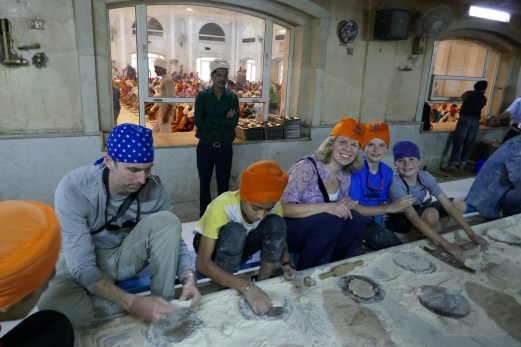
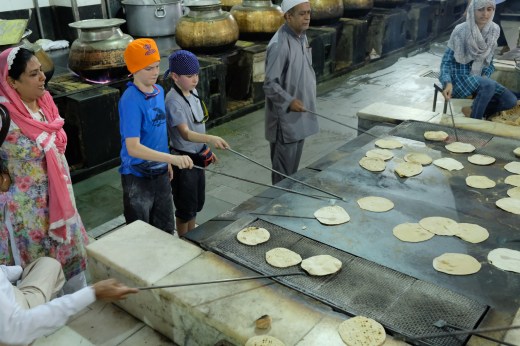
…and then took us to a Sikh temple and put us to work in the soup kitchen that feeds thousands every day.  Connor, Elliot, and I chatted with the boy to my left about sports (we like hoops and baseball; he prefers cricket and kabaddi).

P1000014.JPG

DSCF1401.JPG

There was Anu, who was lousy as a tour guide.  (At the stunning Qutub Minar in South Delhi, which in his defense we asked to see on our way home from Sumeet’s house on the spur of the moment, he could only muster that it was 73 meters tall and kept denying that the monument included a mosque, even though all signs and tour books noted it has one of the oldest mosques in India.)  But he turned into a blur of a quick-moving, fast-talking, bribe-giving, Michael-Clayton-level corporate fixer at the Delhi airport to get us past one of the craziest check-in and security scenes I’ve ever seen in five minutes flat — and thereby provided an important lesson about the workings of Indian society.

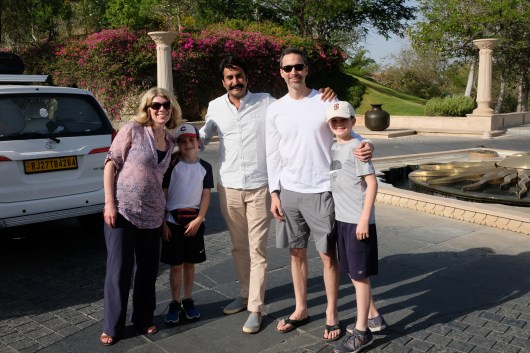
And then there was Mann, the educated, urbane, handlebar-mustachioed former polo player from Udaipur who spoke in paragraphs and gave us the most incredible lectures on Indian politics, the caste system, Hindu-ism, and ancient irrigation systems.  (He was also a true gentleman while overseeing three different roadside vomiting episodes.)

DSCF2002.JPG

It’s been sensational to have such smart and talented company as we try to piece together a composite sense of the politics, economics, and culture of the place.  My favorite economic factoid:  In a country of 1.3 billion people, only 35 million Indians work in what is called the “organized sector” (that is, work for a single, regular, non-seasonal employer), and 21 million of these are government employees.  Then there’s the complicated political interplay of Gandhi-ists, Hindu nationalists, and lower-caste groups vying for control of state power and, with it, the fruits of the world’s largest system of formal political patronage and informal corruption.  And everywhere you look, you see a society with a steadily growing but grossly unequal economy and a recent history of extreme ethnic and religious violence (see today’s NYTimes piece by Jeffrey Gettleman), and yet also just might be a pluralistic beacon of hope in an increasingly divided world.

Moving past all that seriousness, here are a few miscellaneous moments of zen:

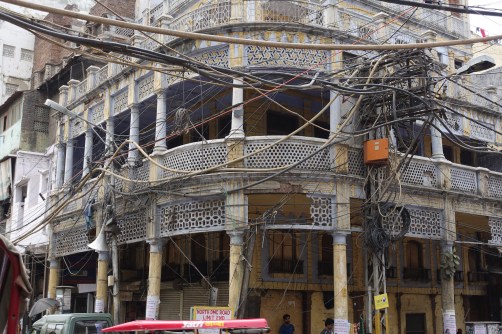
Best Old Delhi jerry-rig:

DSC00266

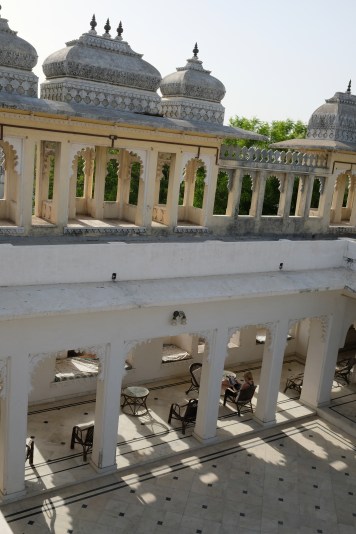
Best afternoon reading spot (at “Marigold”):

DSCF1824.JPG

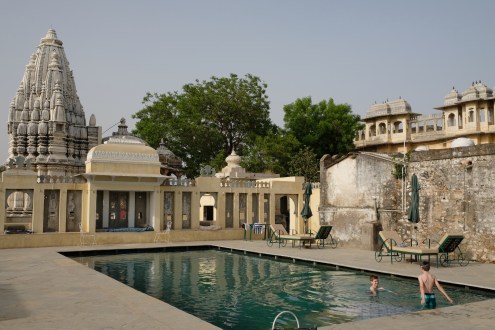
Best swim spot (also “Marigold”):

DSCF1906.JPG

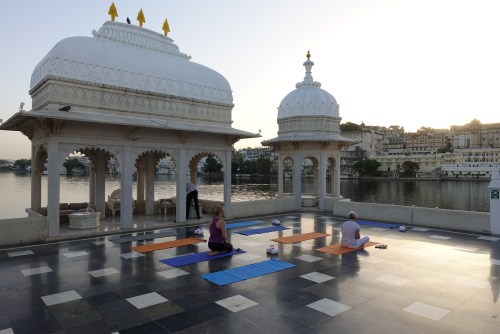
Best yoga spot for undeserving, inflexible, non-yoga people (at Lake Taj):

DSC00336.JPG

Most romantic dinner spot ruined by presence of 9 and 11 year old (also Lake Taj, which was sucking up to us because they canceled part of our reservation when someone bought out the entire hotel for a wedding):

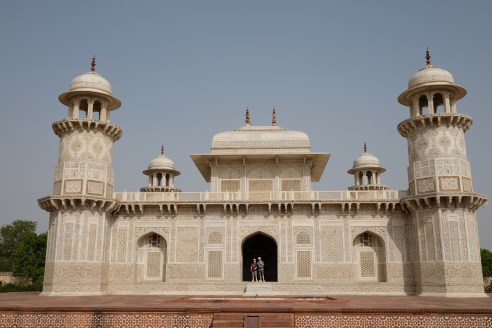
Best it’s-so-hot-no-one-else-is-here spot (at “Baby Taj” in Agra):

DSCF1670.JPG

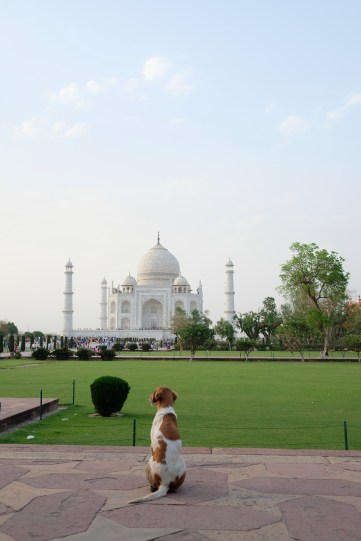
Best bow-wowed by Taj Mahal spot:

DSCF1763.JPG

Today we head to Nepal!


Nine Days In – Nora

We are now 9 days in to our great adventure, having spent 4 days in Delhi, 1 night in Agra, 2 nights outside Udaipur in the rustic countryside, and 2 nights in Udaipur proper, variously in and on the lake.  It’s enough time that we’ve washed one load of laundry, gotten fully adjusted to the time change, already lost track of what day it is (in India, much less in the United States, where it’s 12 hours and a bizarre 30 minutes behind), thrown up in public spaces a grand and gross total of 8 times, and seen enough that we feel overwhelmed by both the beauty and squalor of this chaotic, challenging place.

Here are a few highlights:

P1000161

P1000147


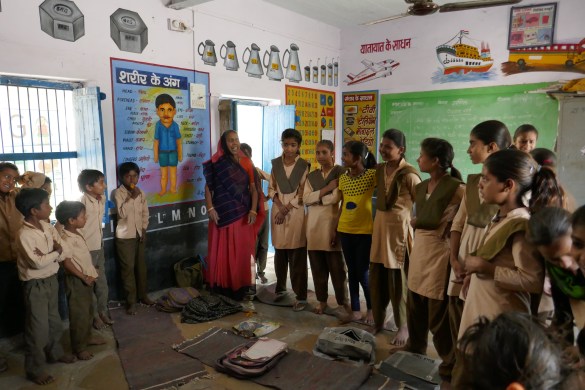
While staying in Khempur (the rural village close to Udaipur), we were invited into a school, where we and the students engaged in a sing-along trading back and forth between the students’ (on-key) local songs and our hilariously off-key and out-of-place rendition of “Jingle Bells.”  Then, guided by the blue sign on the wall on the picture above, we all joined together for a rousing rendition of “Head, Shoulders, Knees, and Toes.”

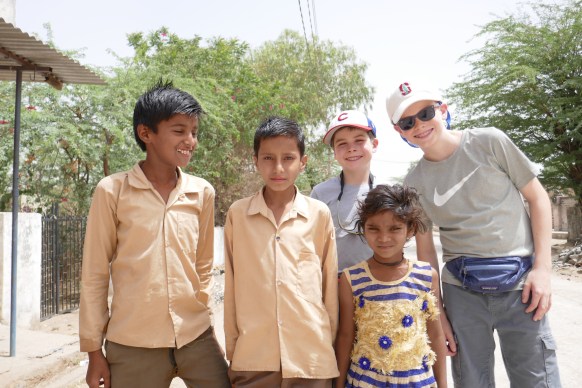
Second, I am in love with the women of India.  They are, almost without exception, drop-dead gorgeous, and they have been so incredibly kind to us.  Adding to the charm, they have been as unabashed in taking pictures of us (we must be starring in Facebook selfies India over) as we’ve been eager to snap photos of them, creating a refreshing reciprocity.  Here are a few of my faves:

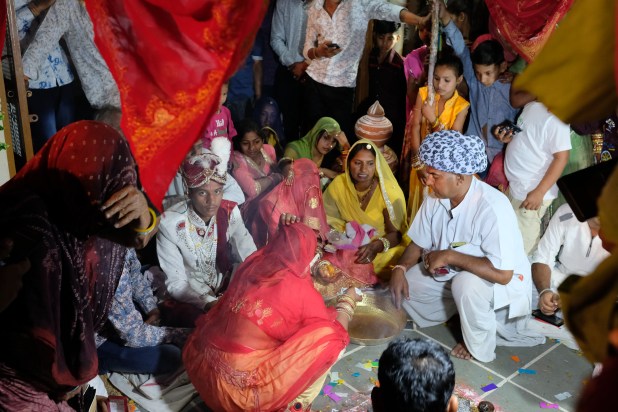
A third highlight was that, on our first night in Khempur, we were invited to a local wedding.  It was an arranged marriage and, as you can see from the photo, the groom looks none too pleased (though perhaps he had just caught a glimpse of us and wondered what the heck we were doing at his nuptials).

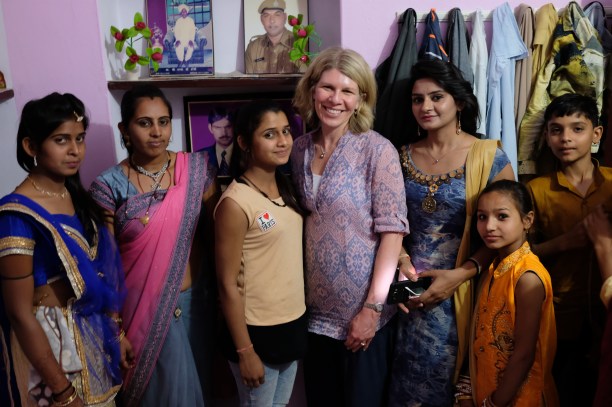
Continuing the theme from above, the women asked me into a private room where we had a cheerful cross-cultural photo shoot.

DSCF1878.JPG

DSCF1872

Finally, over the past 9 days, we’ve gotten a sense of what lies ahead.  And it’s become clear that, even more than the places we’ll see, will be the time we’ll have.  In our hustle-and-bustle lives, time as a family is often in short supply–and I’m feeling so grateful for the weeks and months ahead when we can spend time together at a relaxed pace, without daily distraction.

Elliot’s first post

What I Saw:

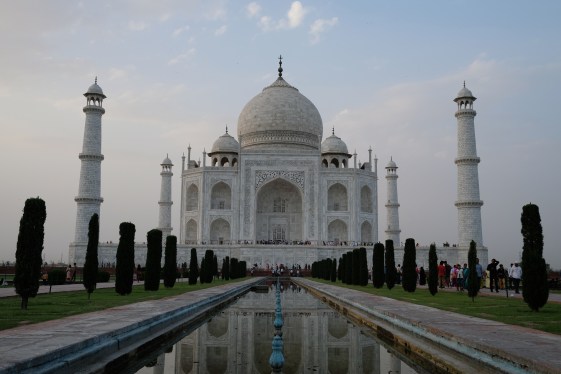
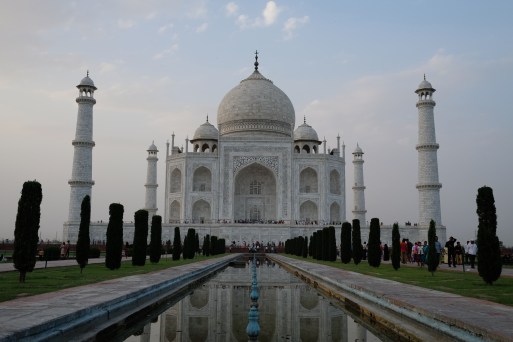
This is a picture of the Taj Mahal, which we went to on Thursday, the twenty-first. It is completely symmetrical and on the inside, there were two tombs that were really big. You couldn’t touch them, though, because there was a wall around it with little holes, so you could see it.


DSCF1770

Best Thing I Ate:

The best thing I ate was the fried rice that I had for lunch that day. It had chicken, eggs, rice, and little pieces of green beans, and I had it at the Trident Hotel.

How We Traveled:

We used a train from Delhi to Agra, and a car ride from the Trident to the Taj Mahal, and back again.

My Favorite Part of the Day:

My favorite part of the day was when we went to the Taj Mahal, which was really beautiful because it was all white and when we went inside there was this stone called cornelian where if you put a flashlight on it, it glowed orange like fire.

Weather:

Today it was hot as always, around 110 degrees Fahrenheit.


The Wonderful Taj Mahal – Connor

You may talk about the seven ancient wonders of the world, and how much you would have liked to see them when they were in their prime. The Hanging Gardens of Babylon, The Temple of Zeus, the Great Pyramids of Giza, and others. People also talk about the modern wonders of the world. The colosseum, blah blah blah. But one that has outlasted any other, is the Taj Mahal. It is an ancient wonder, but it is also a modern wonder. This perfectly symmetrical masterpiece was built by the great emperor Shah Jahan. Fourth in the line of Mogul kingship. It is a monument built out of love, when Shah Jahan’s beloved queen, Mumtaz Mahal, died giving birth to their fourteenth child. It is one of the most expensive wonders of the world, because it is entirely made of white marble, and inlaid with other precious stones by the most skilled craftsman and artisans. But the real reason that made it expensive, is that the marble had to be imported all the way from Udaipur, 375 kilometers away! When Shah Jahan was beginning to grow old, he decided to design and build another Taj Mahal for himself, but entirely black. Facing his queen’s, with just the river Yamuna in between, to symbolize their everlasting love. However,  Shah Jahan’s sons had become strong, and locked him away in the Agra fort. Imprisoning him for the rest of his life. Thus, he was buried next to his queen. In the beautiful white monument. One reason why it is so beautiful? It’s the same color as bird poop. So it can’t be stained.

DSCF1770.JPG

My Awesome Bike Ride Through Delhi – Connor


dscf1503.jpg

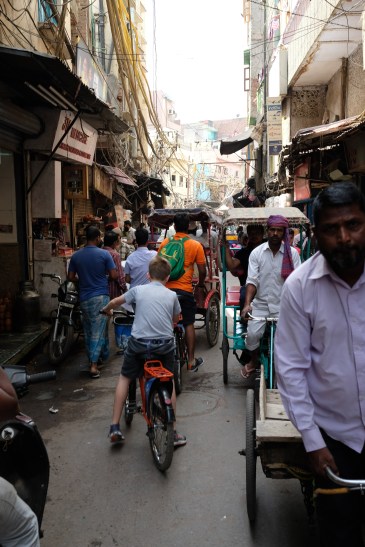
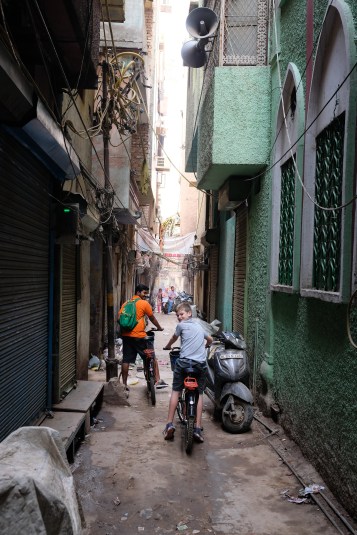
On the second day of our trip, dad and I went on a guided bike ride through old Delhi. I almost got run over maybe 50 times, and I ran into a rickshaw. I also got a flat tire, but it was still amazing. I also learned an Indian saying; You need three things for driving in India. Good gas, good brakes, and good luck. This is an absolutely crazy place.

DSCF1435.JPG
We also went to a spice market and mosque in old Delhi. It really smells interesting and makes you cough because when people are carrying spicy red chilis around the market, some drop and people step on them, releasing the smell into the air.
DSCF1453.JPG
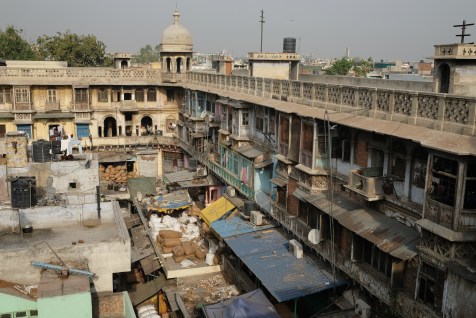
This is our view from the top of the wall surrounding the spice market.
DSCF1467
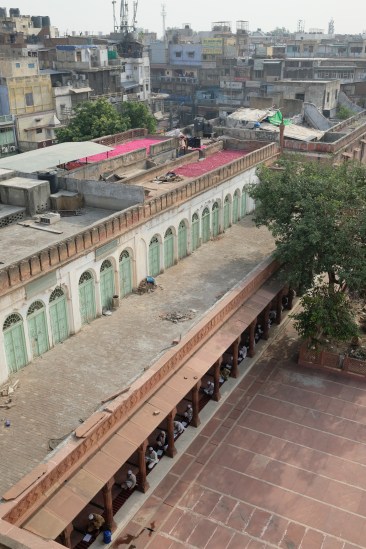
This is the mosque made by one of the queens of Shah Jahan. She was unhappy that he built the Taj Mahal for one of his other wives, so she made this out of expensive red sandstone to make people remember that she was also a queen.
DSCF1471
This is people praying at the mosque. Did you know that in some of the Indian cultures, people believe in the god Allah, and the prophet Muhammed. Muhammed was the most important of the prophets, and was the one that told people about Islam through Allah’s instruction. The birthplace of the prophet Muhammed is a city called Mecca. Mecca is in the Middle East, so people pray in that direction.
This is the delicious breakfast we had at Karim’s. The chef’s  ancestor used to cook at the red fort. This is the restaurant that he made first. It has been standing for over 200 years.
DSCF1509
This is my awesome bike guide Jibbon, who helped us through the whole thing. I really like how he was informative, but didn’t overload your head with information.

Off We Go!

We limped out of Palo Alto after a week of frenzied packing, closing up shop at Nixon and Stanford, saying goodbyes to friends and colleagues, and a Nora choking scare.  But with lots of help from many, we were all ready by the morning of our flights (and we all fit, amazingly enough, into our medium-ish duffles!).

What followed was a 5-hour flight to Newark, then a 14-hour flight to Delhi — and a relentless parade of flower garland necklaces when all we really wanted to do was fall into bed.

Adventures in Delhi await tomorrow!