The middle portion of our time in Italy (more backfilling — sorry!) was dominated by three highlights.
The first was a visit from our niece, the bright-eyed, self-possessed, hilarious, and all-around magnificent Mary Martin. Here’s a shot of her arrival in our adoptive Orvieto, and then saying goodbye in Rome a week later:


We all adored our time with her, but Connor and Elliot were more like puppies, hanging on her every word. And there were many opportunities, as Mary has a gift for taking ideas from her pre-med coursework and making them come alive for all ages and particularly the 9- and 11-year-old set. This was especially welcome because Nora and I, saddled by our 15th century understanding of science, have largely failed to instill in them scientific curiosity. By the end of Mary’s visit, the boys were taking online MCAT-prep biochemistry quizzes with her on the sofa. Mary also gamely and with Job-like patience carried on intense conversations with the boys about the Percy Jackson book series, which she was able to dredge up from her memory but could also supplement with her command of the Iliad and other bits of antiquity history and mythology from Yale’s “Directed Studies” during her freshman year.
Best of all, Mary was a perfect match for the unhurried, rambling brand of tourism we were practicing in Italy after the guide-led forced marches of India, Nepal, and, to some extent, Greece. My favorite day, among many candidates, was truffle hunting outside Sarono with Frederico, the very eager (emphasis on EAGER!) new proprietor of a truffle-hunting business, and his truffle-hunting dog Argo. It was nirvana for Elliot: a dog, a hike in the woods, a sense of mission, and “Bravo Argo!” ringing out among the trees as we chased our furry friend around. Here is a shot of the general scene, the intrepid Argo, and our truffle loot:


After the truffle hunt and a truffle-packed lunch at a local restaurant, we wandered back into Sarono, an out-of-the-way and mostly empty town perched on a cliff. It’s one of the more beautiful places I’ve been, and yet it’s not even listed in our Lonely Planet guide. It’s simply stunning in its mostly-deserted majesty.


Another ramble of a day took us to Lake Tresimo, a few towns over from Orvieto, where we paid to enter one of those European “holiday” campsites that turned out to have the world’s saddest bocce court, mini-golf course, and beach. (My favorite moment was sitting on broken beach chairs next to a muddy beach and watching as a nasty-looking snake slithered by us.) But per usual, we made lemonade, going for a swim off a dock to avoid the muddy, snake-infested beach, and the boys and I threw the baseball.
Florence was overrun with tourists, but we managed to fit in the usual things: the Uffizi museum; a walk across the Ponte Vecchio; the Accademia to see Michelangelo’s David. The latter is truly stunning. I put the David statue, which I saw some 25 years ago in college when Eurailing around, in the same mental drawer as the Taj Mahal: No matter how many times you’ve seen it, whether live or in pictures or the endless remixes and mash-ups of it in our popular culture, it still delivers. There’s just a vigor and an energy to it, and I love its mix of timelessness but also adaptation to its time, with David quite clearly cast by Michelangelo as a civic symbol and protector of Florence.


Our visit to the Accademia also produced my favorite tour-guide moment of the trip. Our Italian tour guide was, on the substance, better than she needed to be, which is refreshing in Italy in particular, where tour guides are largely just vehicles to obtain otherwise sold-out tickets to thronged attractions and to “jump the queue” by not having to wait in line for tickets *and* to gain access to a separate security line. But our guide also spoke into her little microphone in a slow, mournful, creatively phrased English monotone, which came out best as we approached the metal detectors to enter the museum and she surveyed the group to make sure no one was pregnant: “Who…is…waiting…for…a…baby? No… one. No…one…is…waiting…for…a…baby.”
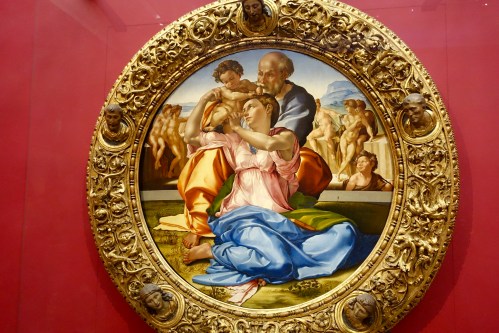
By contrast, the Uffizi was a bit of a disappointment. The art is tremendous. Every room features one or more paintings I could still identify from Art History 1, one of the best classes a kid from Dayton, Ohio who had spent high school riding around in a friend’s Camaro listening to Bon Jovi could take his freshman year at Dartmouth. Then as now, I was especially taken by Michelangelo’s glowing “Doni Tondo” (AKA “Holy Family”), with the happy crew (but isn’t Joseph just a little suspicious?) fully clothed on a raised platform with the naked antiquity pagans looking on from the sunken area behind:
Another one I really like, and was easy to sell to the boys, is Uccello’s “Battle of San Romano,” which is an early effort to play with perspective, using the long lances of the horsemen:

However, the Uffizi is actually quite small compared to the Louvre, and the place is packed shoulder to shoulder with tourists who mostly just want to take a selfie with Botticelli’s “Birth of Venus” (AKA “Venus on the Halfshell,” in Mary’s brilliant phrasing). It was there, in the Botticelli room, that Nora and I both remarked on how crowded Italy was compared to our college-days travels. My theory for why is two-fold. One is the simple fact of steadily increasing global population, wealth, and ease of travel. But I think a big part of it comes at the intersection of the tourism equivalent of the winner-takes-all mentality that has swept the globe and the social media era. The result is an intense focus on relatively few “top” destinations – e.g., Florence – and a relatively few pieces of art contained therein – e.g., Botticelli – by people who will stand in line for hours to see, but mostly to be seen seeing, iconic works but don’t bother to invest in an audio guide to learn a little something about “lesser” works by Cimabue, Giotto, and Caravaggio, and wouldn’t ever think of going to an art museum at home. How’s that for a rant?
That said, the crowded Uffizi produced the second highlight of the middle portion of our time in Italy – and what will surely be, looking back, a highlight of our entire four-month trip. As I walked past a tableful of books and postcards in the corridor outside the final room of paintings, a book caught my eye: A Little History of the World. Here’s our now-dog-eared copy:
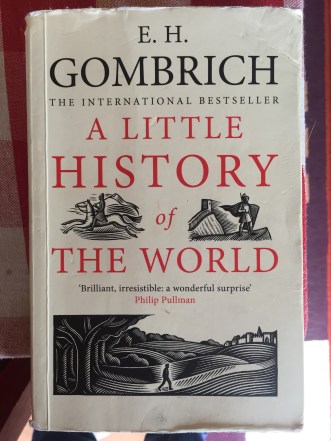
The book was written in the 1950s specifically for kids by an Austrian academic, and it’s an absolute gem. We dove in right away and were instantly charmed by the explanation in the first chapter for why history is important, then realized with growing delight that the book marches through, in chapter after chapter, the history of many of the places we had visited or would soon visit on our trip, beginning with the Egyptians, Minoans, and Babylonians, continuing with the Greeks, Macedonians, Romans, the birth of Buddhism in India and Nepal and the rise of Islam in the Middle East, etc. Best of all, it places it all in rich but accessible context. Bromwich has particular affection for the Greeks (and little love loss for the Romans), and manages to paint an entirely tractable history of conquests, religions, ideas and ideologies, and technological advances right up to Hiroshima and the atomic age, all of it built around, as a kind of a baseline, the Greek invention of democracy, their thirst for knowing and knowledge, and their lack of rigidity and thus open-ness to new ideas and cultural and intellectual renewal. The resulting narrative arc – of the move back and forth between darkness and light as Europe in particular ping-pongs between the Dark Ages, the Age of Chivalry, the Renaissance, the Age of Discovery (and beginning of some brutal colonialism), the Enlightenment, the French Revolution and Napoleonic Era, and then the Industrial Revolution and full-on Age of Colonialism leading up to two world wars – is beautifully done and perfect for kids. (It’s also great, it turns out, for law professors with fading memories of survey-style college coursework.) By the end of the book – which, at a chapter or two a day, would take until our first night in Indonesia – we were all engaged in a lively family discussion of the current Trump-ian and tech-dominated moment, but with a rich understanding of the history of empire, monarchy, democracy, the nation-state, capitalism and communism, and the various tensions through the ages among tradition, religion, ideology, technological innovation, rationalism, and obscurantism. How fun to watch our kids frame Donald Trump’s outrages around the Enlightenment, and AI-driven cars as a second industrial revolution!
In the final two paragraphs of the original version – there’s also a final chapter in the edition we had that covers World War II – Bromwich first takes the reader on an imaginary trip in an “aeroplane” above the world and threads together the entire book in brilliant fashion:
Imagine time as a river, and that we are flying high above it in an aeroplane. Far below you can just make out the mountain caves of the mammoth-hunters, and the steppes where the first cereals grew. Those distant dots are the pyramids and the Tower of Babel. In these lowlands the Jews once tended their flocks. This is the sea the Phoenicians sailed across. What looks like a white star shining over there, with the sea on the other side, is in fact the Acropolis, the symbol of Greek art. And there, on the other side of the world, are the great, dark forests where the Indian penitents withdrew to meditate and the Buddha experienced Enlightenment. Now we can see the Great Wall of China and, over there, the smouldering ruins of Carthage. In those gigantic stone funnels the Romans watched Christians being torn to pieces by wild beasts. The dark clouds on the horizon are the storm clouds of the Migrations, and it was in these forests, beside the river, that the first monks converted and educated the Germanic tribes. Leaving the deserts over there behind them, the Arabs set out to conquer the world, and this is where Charlemagne ruled. On this hill the fortress still stands where the struggle between the pope and emperor, over which of them was to dominate the world, was finally decided. We can see castles from the Age of Chivalry and, nearer still, cities with beautiful cathedrals – over there is Florence, and there the new St. Peters, the cause of Luther’s quarrel with the Church. They city of Mexico is on fire, the Invincible Armada is being wrecked off England’s coasts. That dense pall of smoke comes from burning villages and the bonfires on which people were burnt during the Thirty Years War. The magnificent chateau set in a great park is Louis XIV’s Palace of Versailles. Here are the Turks encamped outside Vienna, and nearer still the simple castles of Frederick the Great and Maria Theresa. In the distance the cries of ‘Liberty, Equality and Fraternity’ reach us from the streets of Paris, and we can already see Moscow burning over there, and the wintry land in which the soldiers of the Last Great Conqueror’s Grand Armée perished. Getting nearer, we can see smoke rising from the factory chimneys and hear the whistle of railway trains. The Peking Summer Palace lies in ruins, and warships are leaving Japanese ports under the flag of the rising sun. Here, the guns of the World War are still thundering. Poison gas is drifting across the land. And over there, through the open dome of an observatory, a giant telescope directs the gaze of an astronomer towards unimaginably distant galaxies. But below us and in front of us there is nothing but mist, mist that is dense and impenetrable. All we know is that the river flows onwards. On and on it goes, towards an unknown sea.
He then arms his young readers with a subtle and compelling combination of humility and agency:
But now let us quickly drop down in our plane towards the river. From close up, we can see it is a real river, with rippling waves like the sea. A strong wind is blowing and there are little crests of foam on the waves. Look carefully at the millions of shimmering white bubbles rising and then vanishing with each wave. Over and over again, new bubbles come to the surface and then vanish in time with the waves. For a brief instant they are lifted on the wave’s crest and then they sink down and are seen no more. We are like that. Each one of us no more than a tiny glimmering thing, a sparkling droplet on the waves of time which flow past beneath us into an unknown, misty future. We leap up, look around us and, before we know it, we vanish again. We can hardly be seen in the great river of time. New drops keep rising to the surface. And what we call our fate is no more than our struggle in that great multitude of droplets in the rise and fall of one wave. But we must make use of that moment. It is worth the effort.
The words of these two paragraphs sang for us as I read aloud at dinner at a restaurant on our first night in Bali. It provided the intellectual glue of our entire trip. And I confess that I felt a surge of parental pride at having worked as hard as Nora and I have – in these moments, I remember the chronic low-grade headache that came from pre-tenure nights that I returned to my office for the 9:00 p.m. to 3:00 a.m. shift to wrestle with data sets and then woke up at 6:30 with Elliot – in order to be able to give this trip to our kids and to be able to visit, live and in-person, so many of the places mentioned.
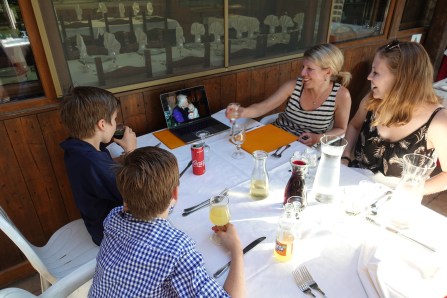
The third and final highlight came on Mary’s last day with us, when we stopped off at a small town in between Orvieto and Rome (on our way to dropping Mary at an airport hotel to ease the pain of her early-morning flight back to the US) and, at a little family-owned restaurant, held an elementary school graduation ceremony for Connor as a substitute for the one that was going on the same day back at Nixon Elementary at Stanford.
Mary had worked up a faux diploma.

I had put together a photo slideshow on my laptop (set, of course, to Elgar) of Connor’s first 11 years to substitute for the baby-next-to-present-day-picture juxtapositions that his elementary school puts up on a screen in the school auditorium as each student walks across the stage. (That’s baby Connor with Grandma Fayette on my laptop.)
Then we all had tears in our eyes as Nora read a letter she had written to Connor. Here are its closing paragraphs, which show just how sweet and kind and talented son and mom both are:
Last but not least, always, always, be kind. Our golden boy, you have come into this world with crazy good looks, natural charm, innate intelligence, hand-eye coordination to beat the band, a great mom and dad (if we say so ourselves), an extended family that loves you and is invested in your growth, and, if that weren’t enough, a 94305-zip code, social capital, and (as we see from our travels) no small measure of economic advantage. But as you well know: To whom much is given, much is expected. Take your many gifts and develop them, while ensuring that you are generous and kind to all who have to paddle much harder to get to the same spot.
Connor Freeman Engstrom, dad and I love you with our whole hearts. You have, quite frankly, kicked ass in elementary school. We are so proud of you. It’s time to close the book on that glorious and important chapter. You’re more than ready for those challenges that await. Go forward with your head held high—and, as you do, know that we always, always have your back.

It was a great but bittersweet moment, for it perfectly captured for me the end of an era (at least for son #1) and a shift in parenting from providing for him and keeping him safe to advising and helping him as he makes his way in the world.
 Fanatical Sabbatical
Love reading about all your adventures, but Nora’s letter to Connor that you shared is truly beautiful.
LikeLike